P1 3.3, P1 1.11, P1 1.12 - Trigonometric graphs
Understand the shapes, symmetries and periods of sine, cosine and tangent in radians. Transform their key features and read intersections to solve equations graphically on a stated interval.
Sine cosine and tangent graphs
How could you solve when isolating by ordinary algebra does not work? Plot both sides as heights: a shared height will reveal a solution. First, we need to know what the trigonometric graphs look like.
Imagine a point moving anticlockwise around a circle of radius , starting at . After a turn of radians, its horizontal coordinate is and its vertical coordinate is . These extend the familiar right-triangle ratios to angles beyond a right angle and to negative turns. A clockwise turn gives a negative input.
Sine cosine and tangent
The sine graph records the vertical coordinate on the unit circle; the cosine graph records the horizontal coordinate. Both have values between and .
The tangent graph records the slope of the radius line at angle . It is undefined when that line is vertical and can take any real value between successive vertical asymptotes.
One complete turn gives these landmarks:
| undefined | undefined |
At , the unit-circle coordinates are and the slope is , so . A tangent branch increases from arbitrarily large negative values to arbitrarily large positive values between its asymptotes. Draw separate branches; never connect across an undefined input.
[DIAGRAM: asset_name: The three trigonometric graphs; asset_slug: trig-base-graphs; caption: Sine and cosine are bounded waves; tangent has separate unbounded branches.; description: The upper panel shows sine in blue and cosine in green from negative two pi to two pi, with pi-over-two landmarks. The lower panel shows tangent in rose with dashed vertical asymptotes at odd multiples of pi over two and zeros at integer multiples of pi.]
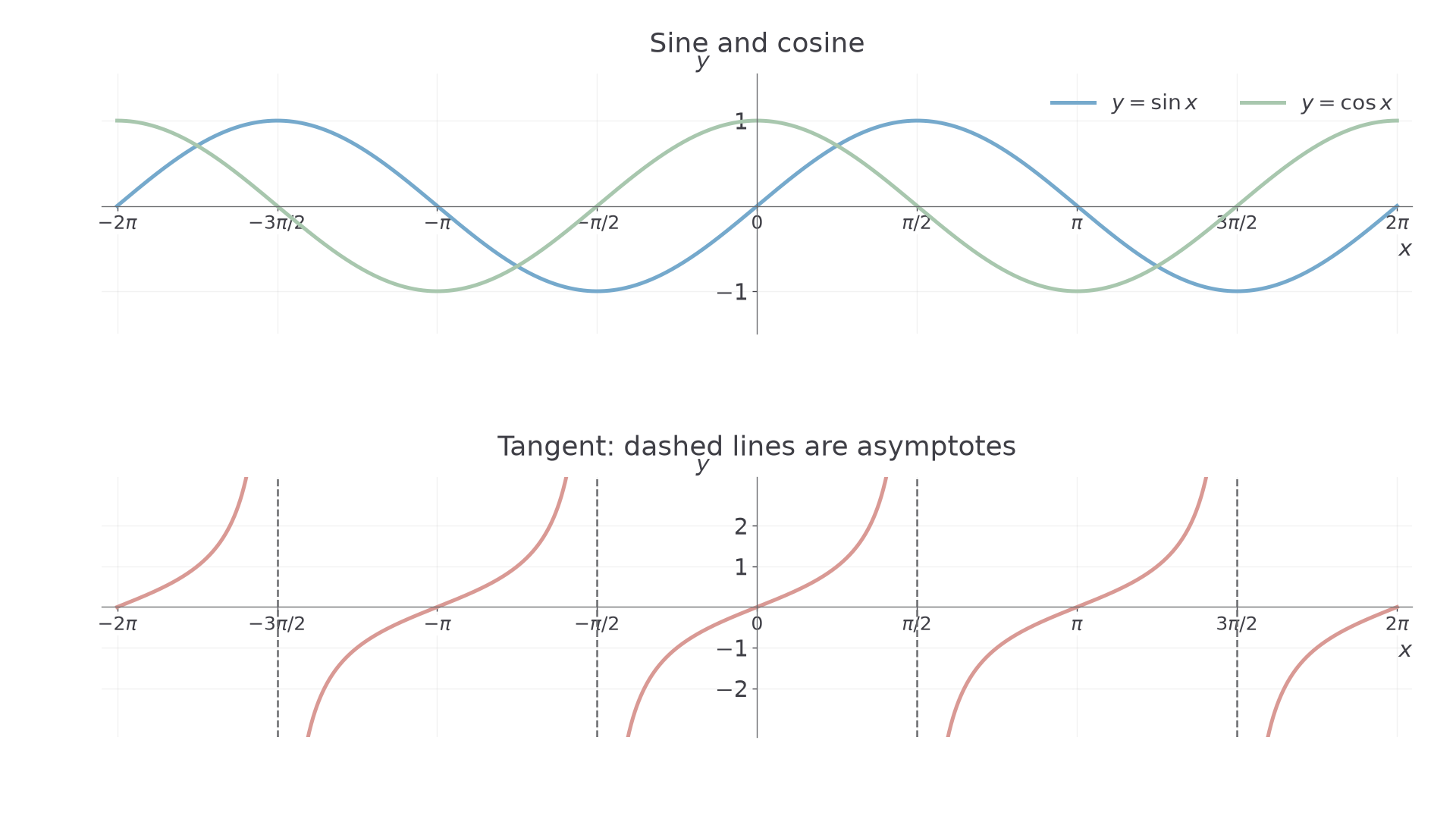
All horizontal coordinates in these graphs are radians. For example, ; typing into a calculator in degree mode would evaluate a different angle.
Symmetry and period
A whole repeating graph can be understood from one cycle and its symmetry.
After one full turn, the unit-circle point returns to its starting position, so both sine and cosine repeat after . The radius line already has the same slope after half a turn, so tangent repeats after . A repeat need not be the shortest repeat: is also a period of tangent, but its least positive period is .
Period and symmetry
A period is a positive horizontal displacement after which all defined outputs repeat. The least positive period is the shortest such displacement.
A graph with even symmetry is reflected onto itself in the -axis. A graph with odd symmetry is unchanged by a half-turn about the origin.
Cosine has even symmetry: turning clockwise or anticlockwise by the same angle gives the same horizontal coordinate, so . Sine and tangent have odd symmetry: their heights or slopes change sign, so and , wherever tangent is defined.
| Function | Least positive period | Symmetry | Example |
|---|---|---|---|
| Sine | About the origin | ||
| Cosine | In the -axis | ||
| Tangent | About the origin |
These properties let you read values outside the first turn. For instance, , so . Similarly, , so . By reflection, but .
Watch out
does not generally equal : the point has moved to the opposite side of the circle. At , the two values are and . Sine needs a full turn to repeat every height.
The next choices separate a reflection from a repeat.
Single transformations in radians
The same point mappings used for algebraic graphs apply to trigonometric graphs; the horizontal coordinates are now radian angles.
A multiplier outside the function changes its heights. A multiplier inside changes where each old height occurs: to find the image of input on , solve . Consequently, the period of and is , while the period of is , for .
For a single translation, moves the sine curve left by . Thus its zero at moves to , and its maximum at moves to . In contrast, moves heights up by : its values run from to , while the period remains .
Worked example 1: multiply the heights
Question. Sketch for , showing its zeros and extreme values.
Plan. Multiply the five standard sine heights by , keeping their inputs fixed.
Draw a smooth wave through these points.
Answer. One cycle with period , maximum at , minimum at , and zeros .
Check. At , the original height is ; the new height is , confirming the vertical scale without changing the input.
Change only the position of the multiplier , from outside sine to inside its input. The range now stays fixed and the period changes.
Worked example 2: multiply the input
Question. Sketch for , showing one cycle's key points and how the pattern repeats.
Plan. Divide the standard sine inputs by , retaining their heights.
Repeat this cycle every up to .
Answer. Three complete cycles, period , with maximum and minimum .
Check. At the first maximum, , so the height is . At , the argument is , so one whole cycle is complete.
[DIAGRAM: asset_name: Height change input change and translation; asset_slug: trig-single-transformations; caption: Moving the multiplier changes height scaling into horizontal scaling; an added input shifts the landmarks left.; description: Three labelled panels show y equals three sine x, y equals sine three x, and y equals sine of x plus pi over six. Periods, extreme heights and the translated maximum at pi over three are shown.]
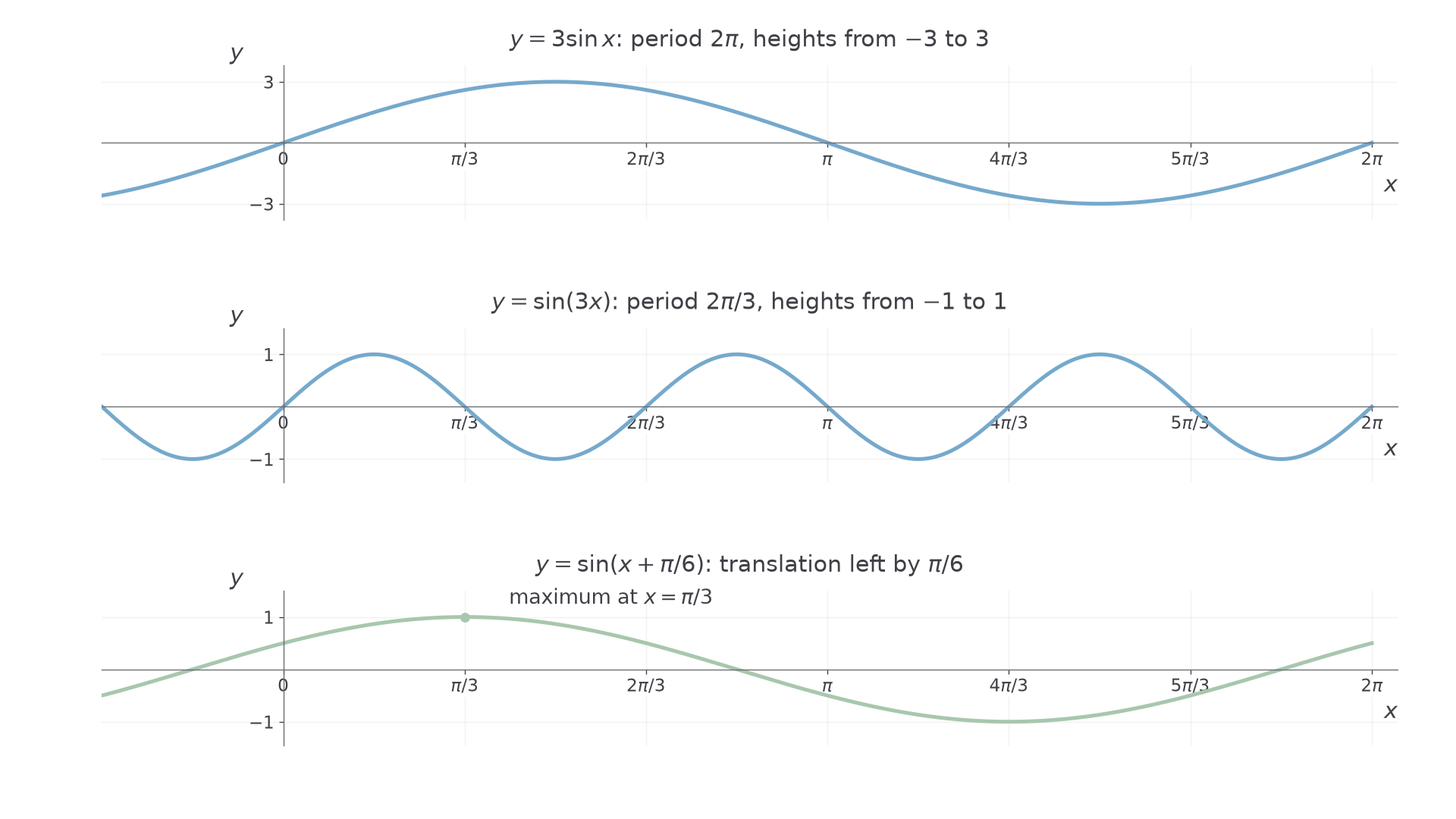
Reflections also follow the old rules: reflects cosine in the -axis, with becoming . For , divide both zeros and asymptote positions by : the period is , and the closest vertical asymptotes to the origin are and .
Reading intersections from trigonometric graphs
An equation is satisfied where the two sides give the same height at the same input, so its solutions are the horizontal coordinates of intersections.
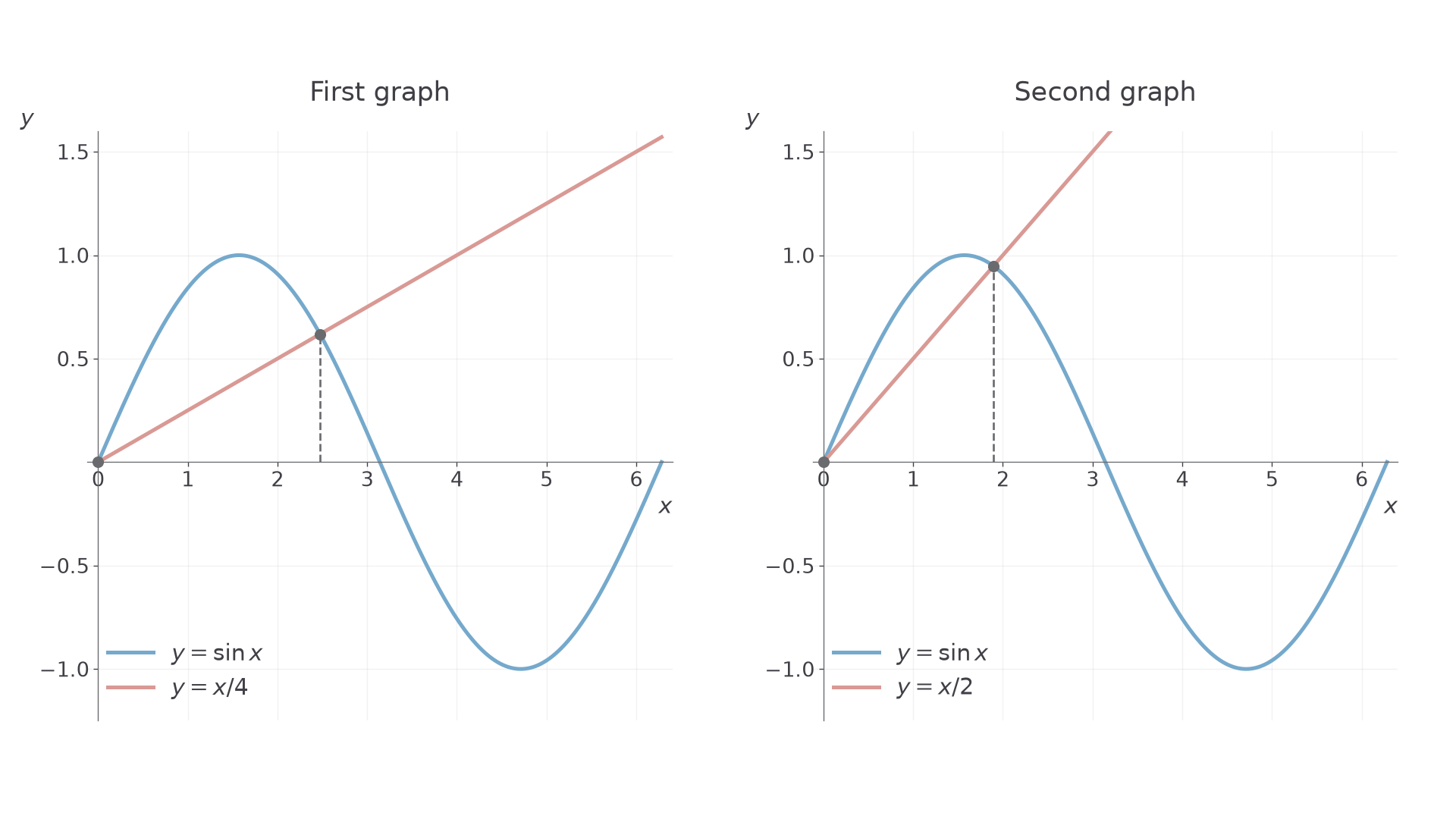
For , draw and on the same axes. Read the -coordinates where they meet, including interval endpoints. These are approximate graphical solutions: the graph's scale determines how many decimal places can be justified. Merely crossing the -axis is relevant only when the other side of the equation is zero.
[DIAGRAM: asset_name: Sine meeting two straight lines; asset_slug: trig-line-intersections; caption: A steeper line changes the nonzero solution while the origin remains an intersection.; description: Two panels show sine from zero to two pi against the lines y equals x over four and y equals x over two respectively. Intersections are marked, with dashed vertical guides to the horizontal axis. The vertical display is clipped above 1.6; each straight line continues beyond it.]
Worked example 3: read a line-curve intersection
Question. Use the first graph to solve for , giving nonzero solutions to decimal place.
Plan. Find every intersection of the sine curve with the line, then read its horizontal coordinate.
The nonzero intersection lies just below . Beyond , the line is above , so the sine curve cannot reach it; on , sine is nonpositive while the line is positive.
Answer. or approximately radians.
Check. Substitute a value near the crossing: at , and , close agreement. The origin satisfies the equation exactly.
Change only the gradient of the line from to . The shared origin stays fixed, but the other intersection moves left.
Worked example 4: read the steeper line
Question. Use the second graph to solve for , giving nonzero solutions to decimal place.
Plan. Read the horizontal coordinates of the intersections with .
For , the line exceeds the largest sine value, so there are no further intersections there.
Answer. or approximately radians. This answers our opening equation.
Check. Substituting , close to the graphical crossing, gives heights and . Also lies in the graphically possible interval .
The height at an intersection is useful for checking; the equation asks for the input . Always state the angle measure and the interval considered.
Quick Recap
- Sine and cosine repeat after ; tangent repeats after and has vertical asymptotes.
- Cosine has even symmetry; sine and tangent have odd symmetry.
- Outside multipliers change heights; inside multipliers change periods by the reciprocal factor.
- Read equation solutions as intersection inputs. For on , they are and approximately radians.