P1 1.1 - Rational indices
Make sense of zero, negative and fractional powers, then use index laws to simplify expressions exactly. These ideas let you rewrite roots and fractions into forms you can later differentiate and integrate.
Integer index laws
Can you find without a calculator? The small fraction is an instruction, and the minus sign is another. We will build their meaning from the powers you already know.
Start with . The base is ; the index, or exponent, is . Multiplying by gives five factors of , so
Dividing cancels factors instead. Raising a power to a power repeats a whole group of factors: .
Key formula
For a positive base ,
We have explained these using positive integers. They also hold for the rational indices developed below.
The decision comes before the arithmetic: multiplication of equal bases adds indices; a power of a power multiplies them.
Worked example 1
Simplify , where .
Plan. Keep the common base and add the indices.
Answer. .
Check. At , the original expression is , which equals .
Change just the operation between the same two powers. The index calculation must change too.
Worked example 2
Simplify , where .
Plan. Division cancels three of the four factors in the numerator.
Answer. .
Check. At , .
A numerical check can catch a mistake; the index law is what establishes the identity for every allowed value.
Watch out
Adding powers is different from multiplying them. For example,
There is no rule that adds the indices when the powers are joined by a plus sign.
Use the operation in the next expression to choose the law.
Zero and negative indices
A negative index does not make a number negative: it tells you to take a reciprocal.
Follow the powers of down one step at a time. Each step divides the value by : , , so the next value is , followed by .
[DIAGRAM: asset_name: Powers through zero; asset_slug: powers-through-zero; caption: Each decrease of one in the index divides the value by two.; description: A row of equally spaced index positions from 3 to negative 3, with exact powers of two 8, 4, 2, 1, one half, one quarter and one eighth. Arrows between positions are labelled divide by two.]
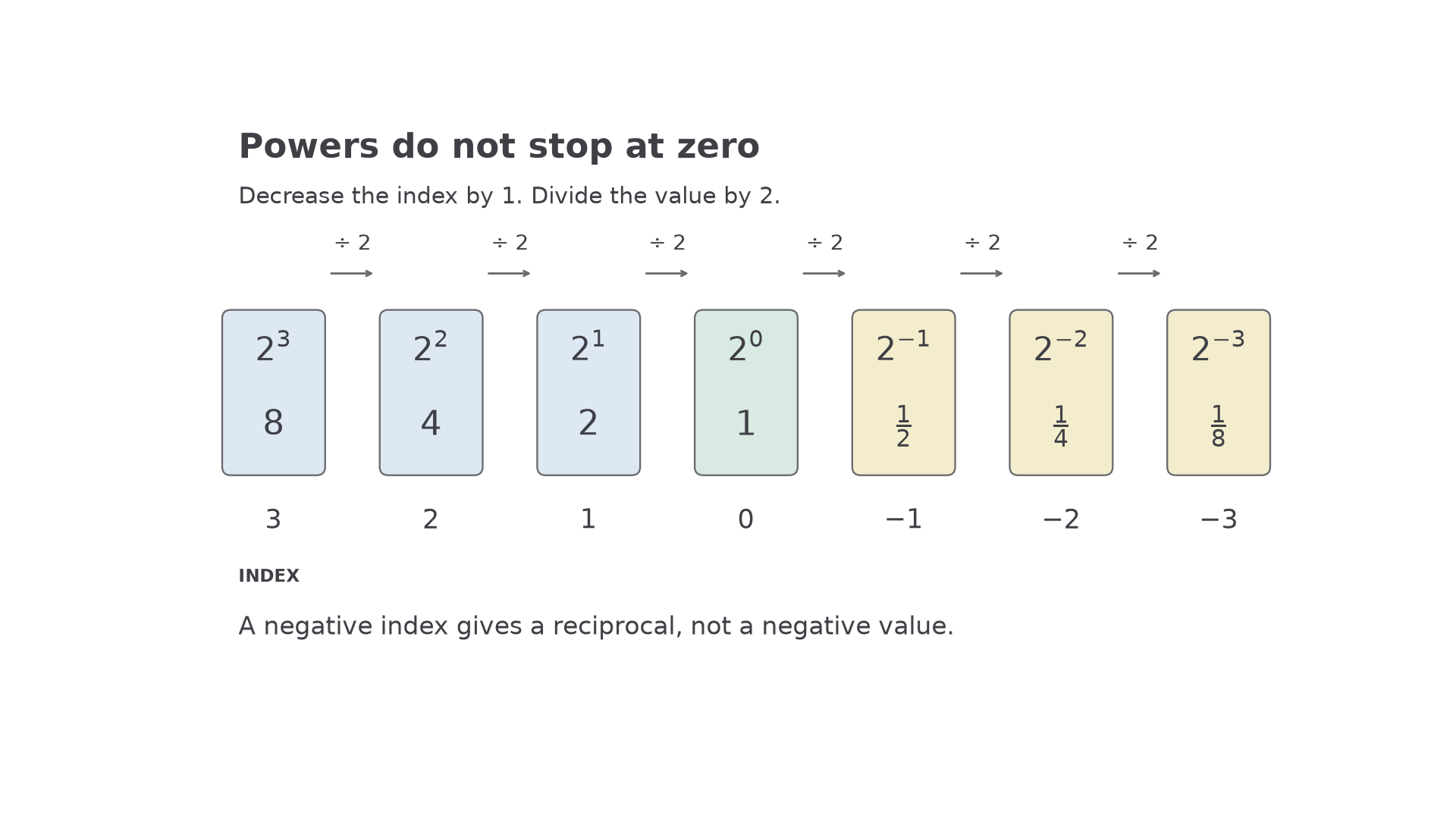
The quotient law gives the same result. For , ; subtracting indices gives .
Key formula
For and a positive integer ,
In particular, a negative power of a nonzero fraction turns the fraction over:
Zero needs care: would mean division by zero, so it is undefined. The rule for above does not assign a value to .
Worked example 3
Find the exact value of .
Plan. Replace the negative power by a reciprocal, then square.
Answer. .
Check. Multiplying this by gives , as a reciprocal should.
Now change the base from an integer to a fraction. The negative index still means reciprocal.
Worked example 4
Find the exact value of .
Plan. Turn the entire base over before applying the positive power.
Answer. .
Check. .
The sign belongs to the index, not to the value.
Watch out
, whereas . Brackets distinguish both of these from .
Try the same reciprocal method with a new base.
Fractional indices
A fractional index extends the same laws to roots: a third power is undone by a one-third power.
Suppose . Cubing it gives
so . The denominator of the index tells you which root to take; its numerator tells you the power to apply.
Key definition
For , an integer and a positive integer ,
For example, means the square of the cube root. Taking the root first often keeps the numbers smaller.
The laws above use positive bases. For a negative base, an odd root such as exists, but an even root such as is not real. Also, : the root symbol means the nonnegative square root, even though the equation has two solutions.
[DIAGRAM: asset_name: Cube roots divide an index step into thirds; asset_slug: third-power-steps; caption: Increasing the index by one third multiplies the value by four.; description: Exact values of 64 to the power r at r equal to negative two thirds, negative one third, zero, one third and two thirds, shown as one sixteenth, one quarter, one, four and sixteen. Equal index steps each multiply the value by four.]
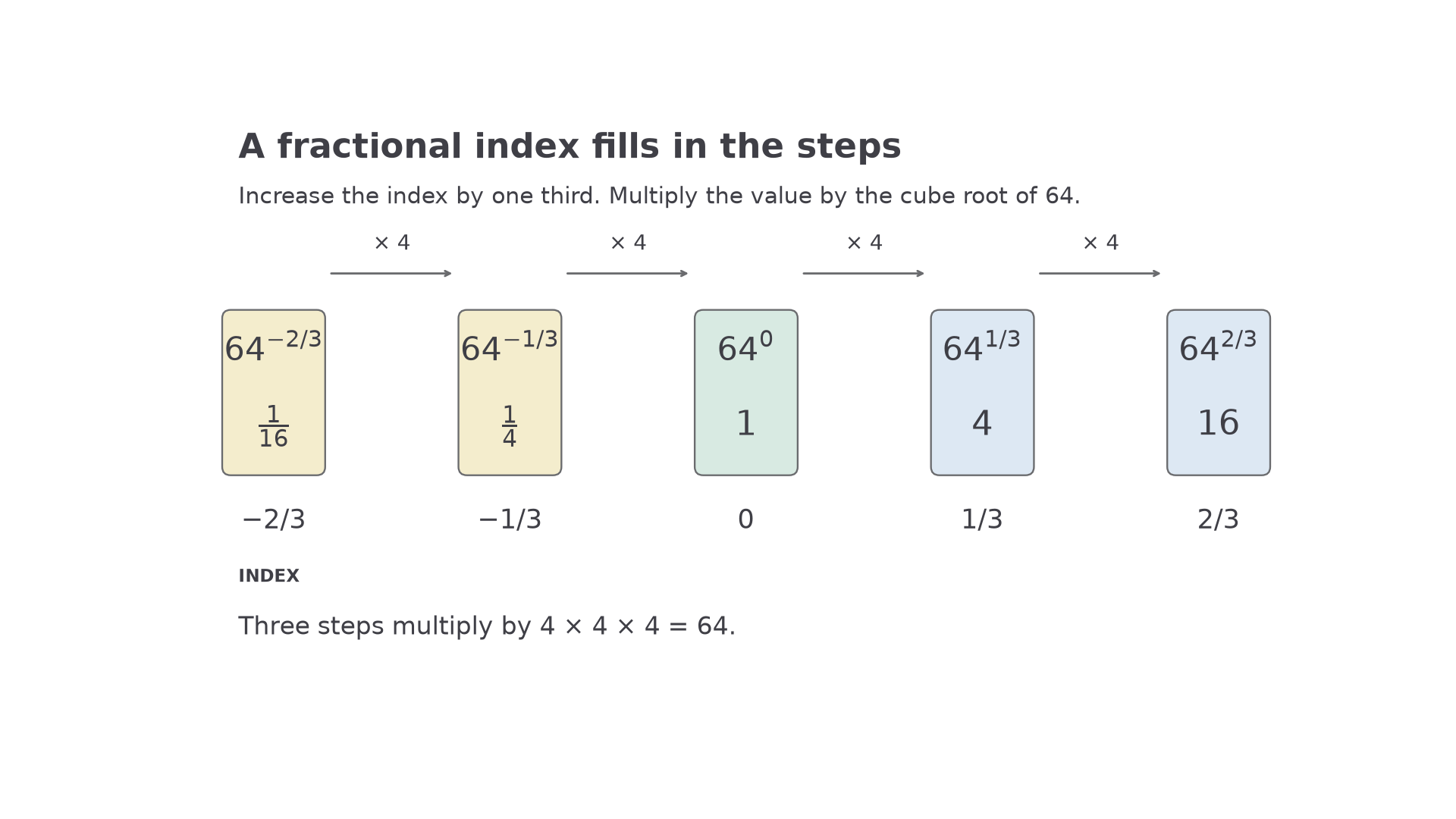
Three equal one-third steps multiply by three times: . This is why a root fits the index pattern.
Worked example 5
Find the exact value of .
Plan. Take the cube root first, then square.
Answer. .
Check. Cubing the answer gives .
Change only the sign of the exponent to answer our opening question.
Worked example 6
Find the exact value of .
Plan. Use the same root and square, then take the reciprocal.
Answer. .
Check. It is positive and less than ; multiplying by gives .
Read the numerator and denominator separately before calculating.
Watch out
means cube root, then square. It does not mean , and it does not mean square root, then cube.
Use a cube root to keep this calculation exact.
Combining index laws
An expression with several powers becomes manageable when you keep track of each base separately.
In , the outer power applies to both factors:
More generally, for positive and rational , and . Along with the three laws in Part 1, these let you simplify products, quotients and powers with rational indices.
Fractional indices use ordinary fraction arithmetic. For , subtract with a common denominator:
The result is also ; choose whichever form the question requests.
Key idea
First apply any power outside brackets to the entire base. Then combine powers of the same base. Work on the numerical coefficient and the variable power separately.
You may be asked for the form . That specifies the final form: a coefficient multiplied by a single power of , which may have a negative or fractional index.
Worked example 7
Write in the form , where .
Plan. Square the first bracket, then combine the coefficients and the powers of .
Answer. , so and .
Check. At , the original is , and .
Change just the outer exponent on the first bracket from to . The numerical coefficient must now be reciprocated too.
Worked example 8
Write in the form , where .
Plan. Apply the negative power to both factors of the first bracket, then multiply.
Answer. , so and .
Check. At , the original is . The answer gives .
A bracket changes which factors an exponent acts on.
Watch out
squares only ; squares both and . Likewise, is , not .
Keep the answer in the requested single-power form.
Quick Recap
- Multiply equal bases: add the indices. Divide equal bases: subtract them.
- A power of a power multiplies indices; a power outside brackets acts on every factor.
- For a nonzero base, a zero power is , and a negative integer power gives a reciprocal.
- For a positive base, the denominator of a fractional index gives the root and the numerator gives the power.
Our opening expression is : cube root, square, reciprocal.