P1 1.6 - Simultaneous equations
Solve two equations by replacing one unknown with an equivalent expression. You will find exact intersection coordinates, then use a quadratic's discriminant to explain why a line and a curve can meet twice, once or not at all.
Linear substitution
How can one pair of numbers obey two different rules at the same time? If and , choosing an fixes , but only one choice makes their sum .
Simultaneous solution
A simultaneous solution is a set of values satisfying every given equation at the same time. For equations in and , write each solution as a paired coordinate .
Substitution replaces an expression by another equal to it. Because , the equation can be written . It now contains only . After finding , use either original equation to recover its matching .
Worked example 1: an isolated unknown
Question. Solve and .
Plan. Replace in the second equation, solve for , then substitute back.
Answer. .
Check. and , so both original equations hold.
Change only the coefficient of in the second equation, from to . The whole replacement expression must now be multiplied by ; fractional answers are perfectly valid.
Worked example 2: substitution into a multiple
Question. Solve and .
Plan. Put brackets around the expression replacing , then expand.
Answer. .
Check. , and .
If neither equation has an isolated unknown, rearrange one first. For example, becomes ; this is often simpler than introducing a fraction by isolating .
Watch out
Substituting into gives , not . The coefficient multiplies the entire expression.
Use both equations when checking your pair.
Line and quadratic intersections
When one equation is quadratic, substitution can leave a quadratic equation, so there may be two pairs of values.
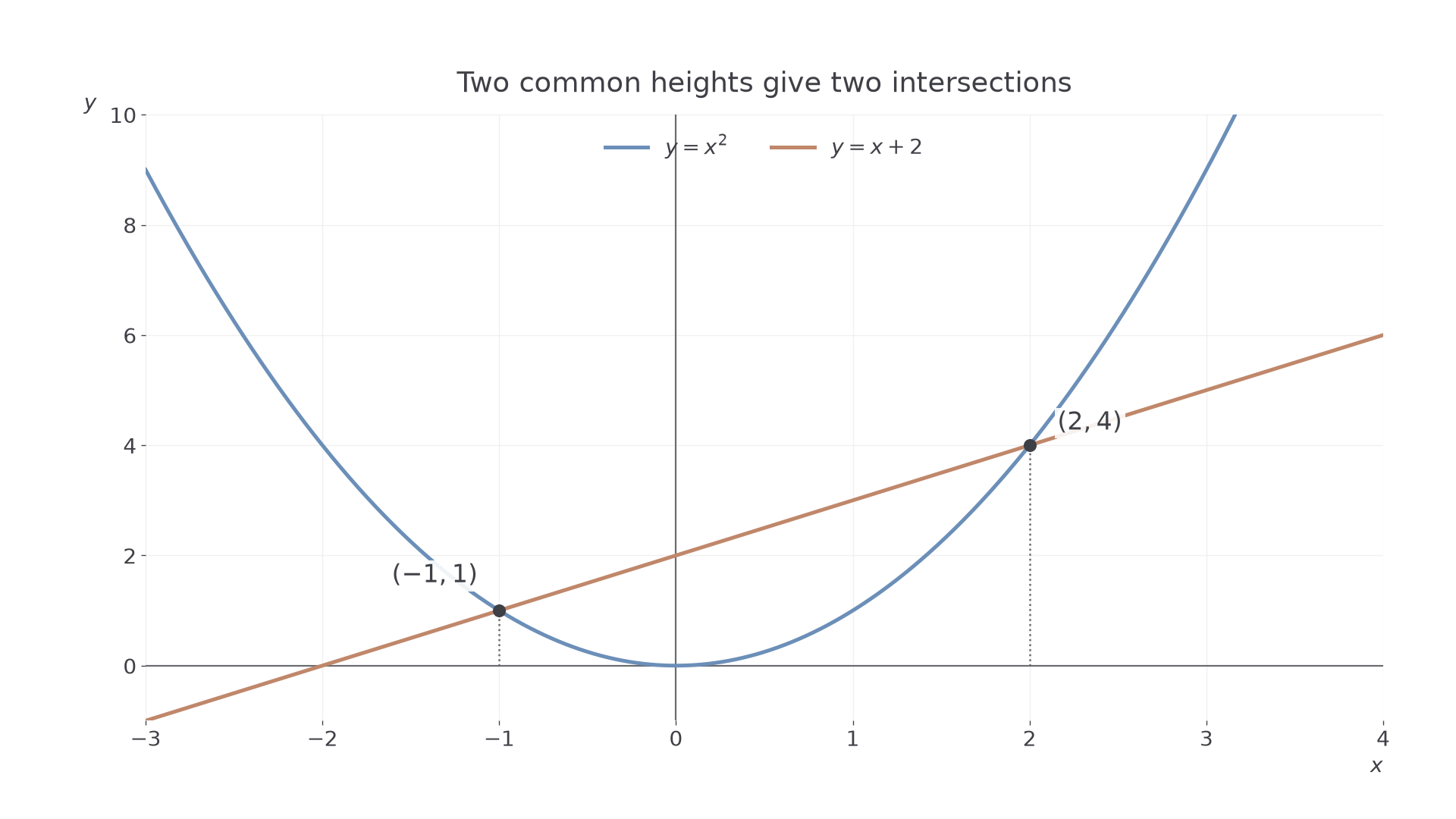
A point on and must have the same height on both graphs. Therefore . Solving this equation gives the horizontal coordinates of the intersections; each still needs its own vertical coordinate.
You already know
A quadratic equation can be solved by factorisation, completing the square or the quadratic formula. Keep exact values during substitution; rounding a root early changes its matching coordinate.
The graph makes the pairing visible.
[DIAGRAM: asset_name: Two intersections of a line and a parabola; asset_slug: line-parabola-intersections; caption: Equal heights occur at two different x-values.; description: The parabola y equals x squared and line y equals x plus two intersect at minus one comma one and two comma four, both labelled, with vertical guide lines to the x-axis.]
Worked example 3: two integer intersections
Question. Solve and .
Plan. Equate the two expressions for , factorise, then calculate separately for each root.
At , . At , .
Answer. and .
Check. Their heights on the parabola are and , matching the line.
Change only the line's coefficient of , from to . The substitution is unchanged, but the resulting quadratic no longer has integer roots.
Worked example 4: exact irrational intersections
Question. Solve and .
Plan. Equate heights, complete the square, then use the linear equation for .
Answer. and .
Check. , so both points also lie on the parabola.
Substitution also works when the quadratic is not already . For example, a line in gives ; the squared bracket must be expanded in full.
Watch out
Do not list and without pairing them. The point satisfies neither pair of graph conditions. One root and its own back-substitution form one solution.
Keep the two coordinates together in your answer.
Interpreting no or repeated solutions
Two intersections are possible, but they are not guaranteed: the quadratic produced by substitution decides the number of real solutions.
For and , substitution gives . Its discriminant is . A positive value gives two distinct horizontal coordinates; zero gives one repeated coordinate; a negative value gives no real coordinate. A repeated root counts twice algebraically but locates only one point.
Tangent at an intersection
A line is a tangent to a smooth curve at a point when it has the curve's direction there. For a line and parabola, a repeated intersection root identifies a tangency: the line touches the parabola there without crossing it.
We can recognise this using algebra, without finding a gradient of the curve.
Worked example 5: a repeated solution
Question. Solve and , and interpret the result.
Plan. Reduce to a quadratic and inspect its factorisation.
Answer. The only intersection is ; the line is tangent to the parabola.
Check. The vertical difference is . Equality occurs only at , so the curve stays on one side of the line.
Lower only the line's constant term, from to . The gap now cannot become zero.
Worked example 6: no real solution
Question. Solve and over the real numbers.
Plan. Complete the square in the equation for an intersection.
A real square is nonnegative, so the left side is at least .
Answer. There are no real solutions; the line and parabola do not intersect.
Check. The discriminant is , confirming the conclusion independently.
Our opening question had one pair because substituting between two nonparallel linear equations left a linear equation. With a line and a parabola, the same method can reveal two pairs, one pair or none.
Watch out
A discriminant of zero does not mean . It means the quadratic has a repeated root; that root still has to be found.
Use the repeated factor to find the point, not just its existence.
Quick Recap
- Substitute an equal expression to reduce two unknowns to one.
- Recover and pair the second coordinate for every root.
- Two distinct, repeated or non-real roots mean two, one or no real intersections.
The pair obeys both opening rules: and .