P4 4.1 - Binomial series with rational powers
A square root or reciprocal can be approximated by a polynomial, even though its full expansion never ends. Learn to build binomial series, state where they are valid and combine them with partial fractions to approximate rational functions.
General binomial coefficients
Can a polynomial give a useful estimate of ? An integer power such as expands to a finite polynomial. For a fractional or negative power, the same coefficient pattern continues indefinitely.
The first coefficient is . Multiply it by for the coefficient of , then by for the coefficient of , then by for the coefficient of . For a nonnegative integer , a factor eventually becomes zero and the expansion terminates. That does not happen for a negative integer or a non-integer rational power.
General binomial series
For rational and ,
The infinite series equals the function in this interval. A truncated series is an approximation when .
In the formula booklet.
Put negative or fractional values of in brackets while calculating coefficients. The factorial denominators remain , .
Worked example 1: a square root
Question. Expand up to and including .
Plan. Substitute in the coefficient formula.
Answer. , valid for .
Check. Squaring the polynomial and collecting terms up to gives : its coefficient is , and its coefficient is .
Change only the sign of the exponent. A reciprocal square root has a different sign pattern; it is not the negative of the first expansion.
Worked example 2: a reciprocal square root
Question. Expand up to and including .
Plan. Retain the coefficient method with .
Answer. , for .
Check. At , the cubic gives ; direct evaluation gives approximately . Their closeness checks the coefficients without claiming exact equality for the truncation.
A finite list of terms must retain an indication that more terms follow.
Watch out
The coefficient for has three negative factors, so it is negative. Work out the sign before simplifying the fraction.
Keep the fractional factors visible while finding the next coefficients.
Taking out a constant factor
The binomial formula starts with , so a different constant inside the bracket must be factored out before expanding.
For example, . Raising the whole product to gives , so the outside factor is , not .
Putting a bracket into binomial form
For ,
Use in the general series and multiply every term by . The series condition is .
Not in the formula booklet in this rearranged form: learn the step.
This also explains why a change of sign inside the bracket changes odd powers but leaves even powers unchanged.
Worked example 3: factor before expanding
Question. Expand up to and including .
Plan. Factor out , then substitute into the reciprocal-square-root series.
Answer. , for .
Check. At , both sides give . For small positive , the function decreases, matching the negative linear term.
Change only to . Use the existing series rather than recalculating all its coefficients.
Worked example 4: changing the sign
Question. Expand up to and including .
Plan. Replace every in Worked example 3 by .
Answer. , for .
Check. At , the polynomial gives , compared with .
The outside factor applies to the whole series.
Watch out
. Apply the exponent to the extracted constant as well as to the remaining bracket.
Here the extracted constant has a different square root, but the same expansion method applies.
The interval of validity
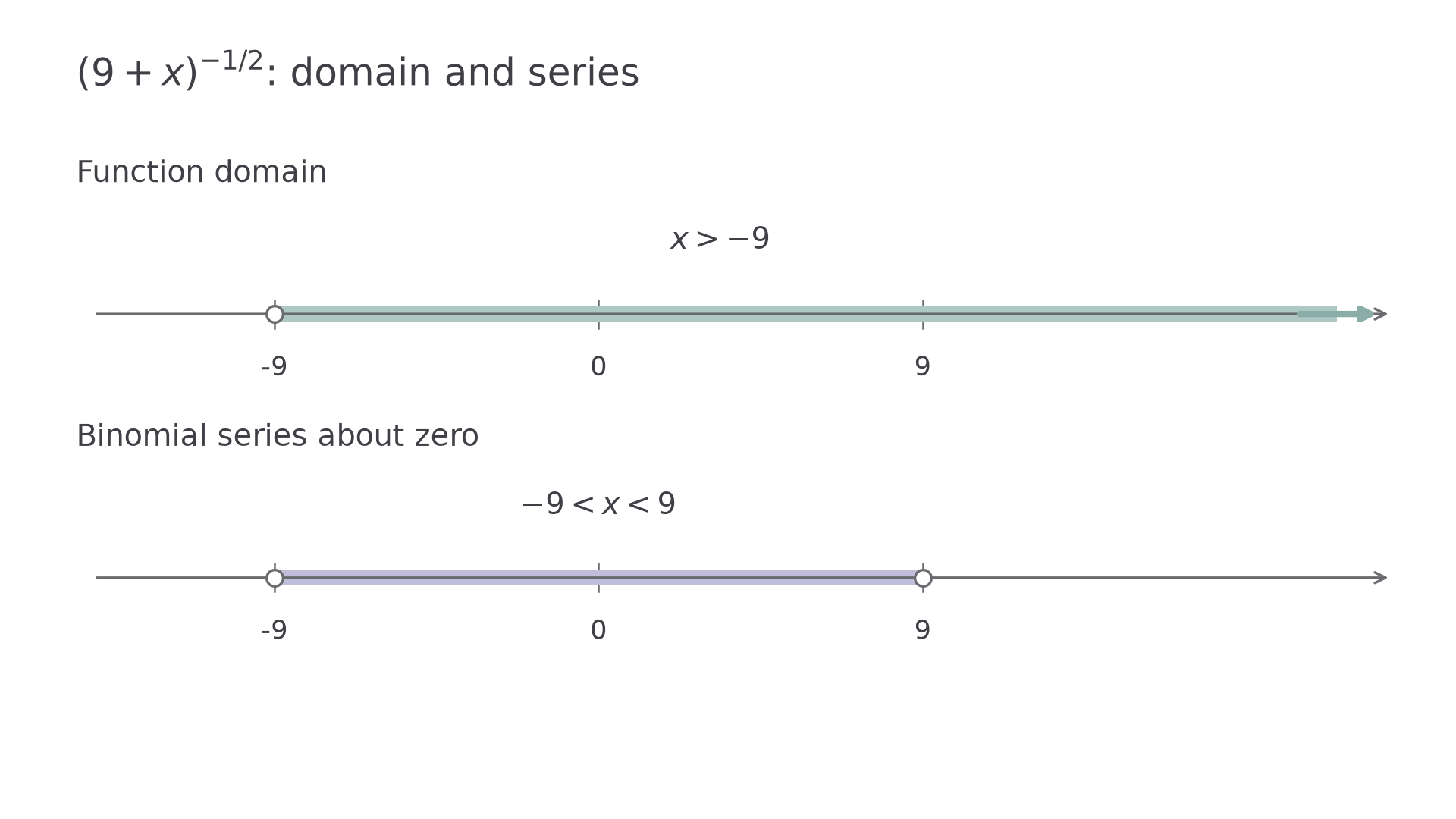
A real function can exist at a value where its binomial series about zero is not valid. Always apply the condition to the expression taking the place of , rather than automatically writing .
For with and , the standard condition becomes . This is the open interval centred at zero. We use that strict condition here; it makes no claim about individual endpoint convergence.
[DIAGRAM: asset_name: Function domain and series validity; asset_slug: series-validity; caption: The function can exist beyond the interval in which its series about zero is valid.; description: Two aligned number lines for (9+x) to the power negative one half. The function domain is x greater than negative nine, while binomial series validity is negative nine less than x less than nine. Open circles mark excluded endpoints.]
Continue this lesson.
You’re previewing NovaLearn without an account. Create a free account to read the rest.
Create free account