M1 4.1, M1 5.1 - Newton's laws and force components
Connect force diagrams to acceleration using Newton's laws in M1 4.1. Resolve forces into perpendicular components using M1 5.1, then build scalar and vector equations for the chosen object.
Force and the three laws
A person pushes a trolley, and the trolley pushes back equally. Why can the trolley accelerate? The two forces act on different objects, so they do not cancel in the trolley's force equation.
A force is an interaction that can change motion. It has magnitude and direction; its SI unit is the newton, . A force diagram includes only forces acting on one chosen object. The resultant force is their vector sum.
Newton's laws of motion
First law: a particle remains at rest or moves with constant velocity when the resultant force on it is zero.
Second law: for constant mass, the resultant force equals mass multiplied by acceleration, .
Third law: when one body exerts a force on another, the second exerts an equal-magnitude, opposite-direction force of the same type on the first. These forces act on different bodies.
One newton gives a mass of acceleration . Weight is the gravitational force on an object, with magnitude ; mass itself is not a force. In this lesson, where required, use .
Worked example 1: balanced forces on one body
Question. A trolley is pushed right by and resisted left by . Its vertical forces also balance. Explain what follows about its acceleration and whether it must be stationary.
Plan. Add forces on the trolley and apply the first and second laws.
Answer. Acceleration is zero. It may be at rest or may move with constant velocity; the forces alone do not choose between these possibilities.
Check. Either behaviour has zero velocity change, consistent with zero acceleration.
Change only the body on which the second force acts. A third-law pair cannot be combined as two forces on the trolley.
Worked example 2: a third-law pair
Question. A hand pushes a trolley right with . The trolley pushes the hand left with . Do these two forces establish zero resultant force on the trolley?
Plan. Assign each force to its receiving body before adding anything.
The rightward force acts on the trolley; the leftward force acts on the hand. Only the first belongs on the trolley's diagram.
Answer. No. These are a third-law pair on different bodies. The trolley's acceleration depends on all the forces acting on the trolley.
Check. Adding the hand's force to the trolley's diagram would incorrectly mix two different systems.
The weight and normal reaction on a resting book are also not a third-law pair: both act on the book. The partner to the Earth's gravitational pull on the book is the book's gravitational pull on the Earth.
Resolving forces
A sloping force can be replaced by two perpendicular components whose vector sum is the original force.
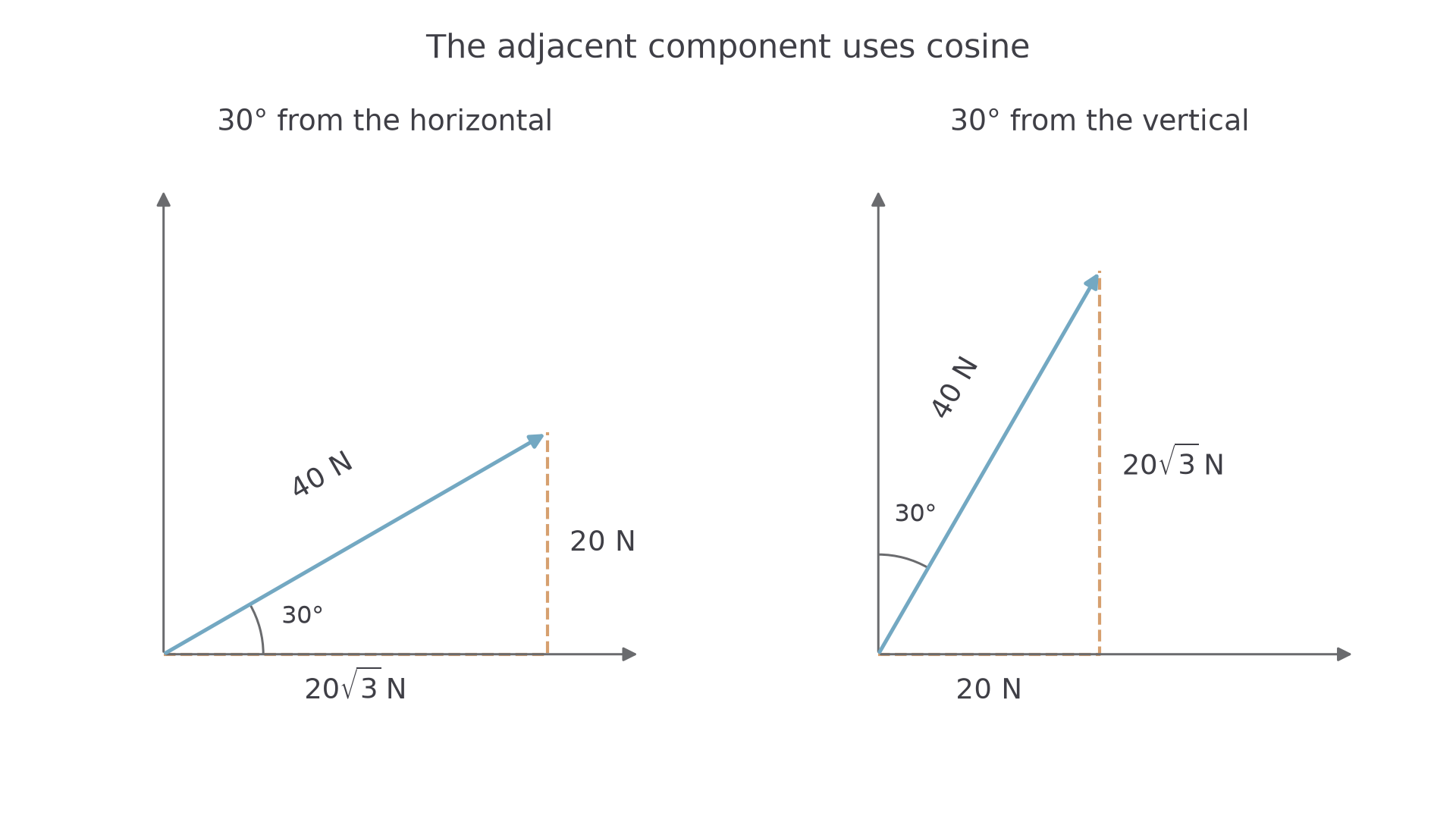
Draw the right triangle beside the force. A component adjacent to the stated angle uses cosine; the opposite component uses sine. The choice follows the angle's location, so it is unsafe to memorise “horizontal always uses cosine”.
Resolving a force
For force magnitude making angle above the positive horizontal,
If the angle is measured from the positive vertical instead,
Attach component signs from the diagram. These resolution formulae are not in the formula booklet: learn them.
[DIAGRAM: asset_name: The reference axis changes the components; asset_slug: m1-force-resolution; caption: Cosine belongs to the component adjacent to the given angle.; description: Two force triangles show a forty-newton force thirty degrees above horizontal, with horizontal component twenty root three and vertical component twenty, and a forty-newton force thirty degrees from vertical, with horizontal component twenty and vertical component twenty root three.]
Worked example 3: angle from the horizontal
Question. A force of magnitude acts above the positive horizontal. Find its horizontal and vertical components.
Plan. Use cosine for the adjacent horizontal component and sine for the opposite vertical component.
Answer. right and up.
Check. , recovering the original magnitude.
Change only the reference axis for the angle. The component values swap.
Worked example 4: angle from the vertical
Question. A force of magnitude acts upwards and right, making with the positive vertical. Find its horizontal and vertical components.
Plan. The vertical component is now adjacent to the angle.
Answer. right and up.
Check. , as the angle from the vertical requires.
Components replace the original force in an equation; they are not extra forces to add on top of it.
Watch out
A force does not become horizontally and vertically. Recombining its perpendicular components must recover magnitude .
Read the reference axis before choosing sine or cosine.
Continue this lesson.
You’re previewing NovaLearn without an account. Create a free account to read the rest.
Create free account