P1 4.1 - Gradients and rates of change
A straight line has one gradient, but a curve can be steep in one place and almost flat in another. Learn how a tangent gives a curve's gradient at one point, how derivative notation records that gradient, and how to interpret it as an instantaneous rate of change.
Secants approaching a tangent
How can a curve have a gradient when its steepness keeps changing? Begin with two points, where the familiar straight-line gradient still works, then bring those points closer together.
On , take and another point . The segment joining them is a chord; the whole straight line through them is a secant. Its gradient describes the average change in per unit change in between the points.
Gradient between two points
For distinct points with ,
Use the same order of subtraction in numerator and denominator.
Not in the formula booklet: learn it.
First keep fixed and choose a second point a short distance to its right.
Worked example 1: a chord gradient
Question. Find the gradient of the chord from to the point on where .
Plan. Find the second point's height, then divide its vertical change from by its horizontal change.
Answer. The chord gradient is .
Check. Moving units horizontally along this line changes its height by , as required.
Change only how close is to : reduce the horizontal separation from to .
Worked example 2: a closer second point
Question. Find the gradient of the chord from to the point on where .
Plan. Use the same gradient calculation with the closer point.
Answer. The chord gradient is .
Check. The line through with this gradient gives at , so it also passes through .
The chord becomes a better description of the curve close to . The picture shows the line approaching a fixed position.
[DIAGRAM: asset_name: Chords approaching a tangent; asset_slug: chords-to-tangent; caption: As the second point approaches P on the parabola, the chord line approaches the tangent of gradient two.; description: Three equal-scale coordinate panels show y equals x squared near P at one comma one. Second points have x coordinates two, one point five and one point one, giving chord gradients three, two point five and two point one. The tangent y equals two x minus one is dashed in each panel.]
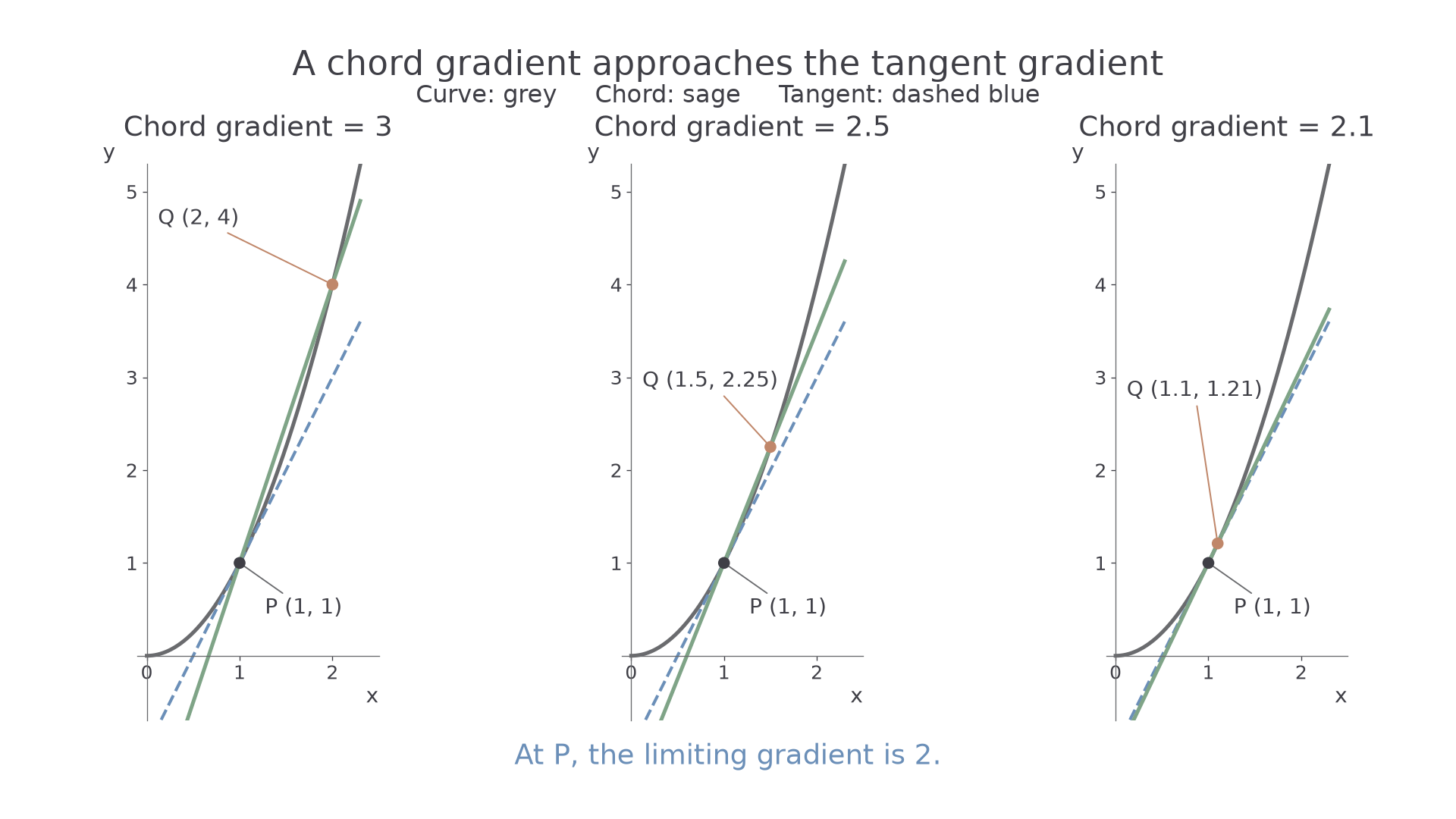
To see the exact limiting value, write the two points as and , where :
As approaches zero from either side, this gradient approaches . At , the values approach from above; using gives , approaching from below.
Derivative at a point
The derivative at a point is the gradient of the tangent there. When the chord gradients approach one finite value as the second point approaches from either side, that value is the tangent gradient.
A tangent describes the curve's direction locally. It need not meet the curve only once, and it can cross the curve elsewhere.
Watch out
Do not put into the original quotient: that gives , which is undefined. Simplify for , then consider the value approached as tends to zero.
Try a chord approaching from the other side.
Derivative notation
A derivative function records the tangent gradient at each allowed value of the input, rather than at just one point.
The calculation above worked for every real , so for , the gradient function is . At , the curve's height is , while its tangent gradient is . Those are different pieces of information.
Derivative notation
For , write the derivative as
Read as “f prime of x”, and as “the derivative of y with respect to x”. The operation of finding it is differentiation.
Here is the distinction for the square function:
| Notation | Meaning | Value |
|---|---|---|
| Height of the curve at a general input | ||
| Height when | ||
| Tangent gradient at a general input | ||
| Tangent gradient when |
A prime changes the function being evaluated. You substitute into to find a height and into to find a gradient. The notation says the same as .
A positive derivative means the curve rises as increases locally; a negative derivative means it falls. A zero derivative gives a horizontal tangent. It does not by itself tell you everything about the curve's shape.
Key idea
locates the point's height; describes the curve's direction at that point. Neither value can generally replace the other.
Use the prime to choose which information is relevant.
Instantaneous rates and units
When the axes represent quantities, a tangent gradient measures how fast one quantity is changing with respect to the other at that instant.
If a distance changes from to between and , its average rate is . This uses a whole interval. The derivative gives the rate at one instant by taking the limiting gradient.
Instantaneous rate of change
If depends on , then is the instantaneous rate of change of with respect to . Its units are the units of divided by the units of .
The same graph calculation can therefore describe a journey or a filling tank. Keep the variable and its units attached to the rate.
Worked example 3: average and instantaneous rates
Question. A moving object's distance metres after seconds is , for . Its derivative is . Find its instantaneous rate at and its average rate from to .
Plan. Evaluate the derivative for the instantaneous rate, and use a difference quotient for the average rate.
Answer. The instantaneous rate is ; the average rate is .
Check. The object covers in the one-second interval. Its rate increases from to , so an average of fits.
Change only the interval's end from to . The instantaneous rate at stays fixed while the average rate moves closer to it.
Worked example 4: a shorter time interval
Question. For the same model , with , find the instantaneous rate at and the average rate from to .
Plan. Keep the tangent rate, then calculate the gradient over the shorter interval.
Answer. The instantaneous rate is ; the average rate is .
Check. An average of over predicts , matching the change in .
A rate can be negative. For example, if , a tank's volume is decreasing at litres per minute. The negative sign describes direction of change, not a negative volume.
Watch out
An average rate needs two input values. A derivative evaluated at one input gives an instantaneous rate. Always divide the dependent quantity's units by the input quantity's units.
Our opening problem now has a precise answer: a curve has a gradient at a point because nearby chord gradients can approach one tangent gradient.
Quick Recap
- A chord gradient is an average change; its limiting value gives the tangent gradient.
- and both denote the derivative when .
- Evaluate the derivative at the required input to obtain an instantaneous rate.
- A rate's units are output units divided by input units; its sign tells you the direction of change.