M2 3.1 - Work and mechanical energy
Calculate work, kinetic energy and gravitational potential energy, then balance them to find speeds and distances. Decide when mechanical energy is conserved and when resistance removes it. Use unless another value is stated.
Work by a constant force
Two smooth tracks start at the same height and finish at the same lower height: must a particle released from rest reach the same speed on both? We will answer this by tracking energy rather than time.
First consider pulling a box horizontally with a force at above the horizontal. Only the component acts along the displacement. The vertical component does no work because there is no vertical displacement.
Work
The work done by a constant force is its component along a displacement multiplied by the displacement. Work is a scalar, measured in joules: .
[DIAGRAM: asset_name: Resolving a force for work; asset_slug: m2-work-force-component; caption: Only the force component along the displacement contributes to work.; description: A box moves six metres horizontally right. A forty newton force points sixty degrees above the horizontal, with its twenty newton horizontal component shown by a dashed projection.]
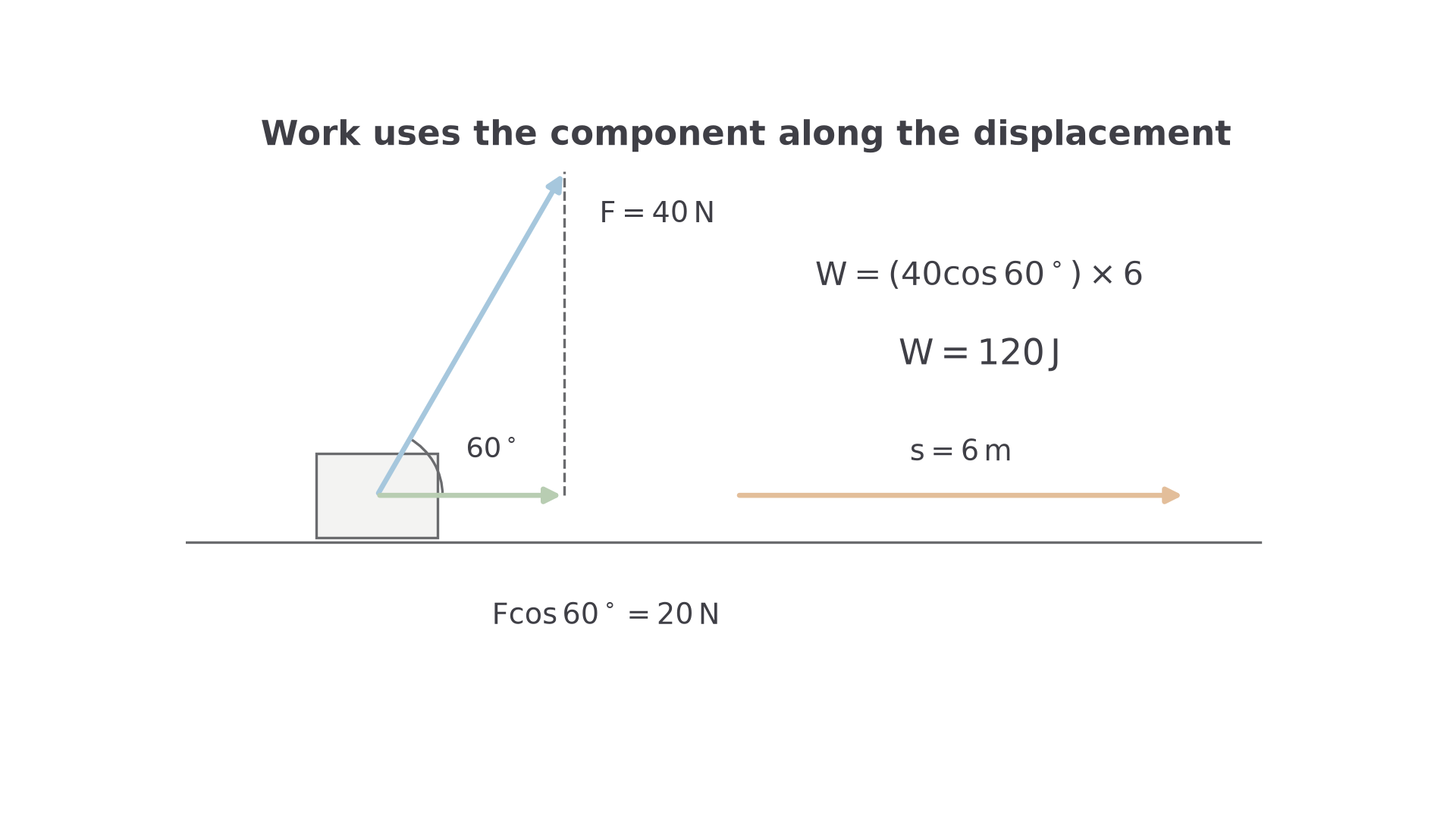
Work by a constant force
Here is the angle between the force and displacement. Positive work transfers energy to the particle; negative work transfers energy away. A perpendicular force does zero work.
Not in the formula booklet: learn it.
Worked example 1: pulling forwards
Question. A constant force makes with a horizontal displacement of . Find its work.
Plan. Multiply the displacement by the force component along it.
Answer. .
Check. The component is half the whole force, so the work is half of .
Change only the force angle. A component opposing motion must produce negative work.
Worked example 2: a resisting component
Question. The same force acts at to the same displacement. Find its work.
Plan. Keep the angle with the displacement, including its obtuse sign.
Answer. .
Check. Its component along the displacement is , so .
Watch out
The work done by a resistance of magnitude over distance is . The work done against it is the positive amount . State which you mean.
Kinetic and gravitational potential energy
A moving particle stores energy because of its speed, and a raised particle stores energy because of its height in a gravitational field.
Mechanical energy
Kinetic energy is energy associated with motion. Gravitational potential energy is energy associated with height. Their sum is the mechanical energy considered here.
For a constant resultant force along the motion, . Using gives . This identifies kinetic energy as . Raising a mass vertically through against weight requires work .
Kinetic and gravitational potential energy
Take height above any fixed chosen level. Only changes in height matter. Mass is in kilograms, speed in metres per second and height in metres, giving energy in joules.
Not in the formula booklet: learn them.
Worked example 3: gaining speed and height
Question. A particle speeds up from to while rising . Find its increase in mechanical energy.
Plan. Calculate the kinetic and potential changes separately, then add.
Answer. An increase of , to three significant figures.
Check. Choosing initial height zero gives energies initially and finally; their difference is .
Change only the sign of the height change: the particle now descends.
Worked example 4: gaining speed while descending
Question. The same particle has the same speed change while descending . Find its increase in mechanical energy.
Plan. Keep the kinetic change and use a negative potential change.
Answer. An increase of .
Check. Set final height zero. Initial energy is ; final energy is . The difference is again .
Watch out
Doubling speed multiplies kinetic energy by four. Kinetic energy uses speed squared, so it is never negative; a negative velocity still gives positive kinetic energy.
Work-energy balance with resistance
Work done by all forces changes kinetic energy, so resistance and gravity must both appear in the balance.
Work-energy principle
An equivalent arrangement, with gravity accounted for as potential energy, is
Use one arrangement consistently: include either work by gravity or the potential energy change, never both.
Not in the formula booklet: learn it.
Continue this lesson.
You’re previewing NovaLearn without an account. Create a free account to read the rest.
Create free account