M1 5.2, M1 5.3 - Particle equilibrium
Balance coplanar forces on a particle, including weight, contact forces, tension and thrust. You will distinguish the friction actually needed for equilibrium from its maximum possible value, then find limiting forces. Take and round non-exact final numerical answers to three significant figures.
Weight reaction tension and thrust
Why does a box stay at rest when you give it a small push, yet slide under a larger one? A zero acceleration requires a zero resultant force, but the individual forces need not vanish.
Equilibrium of a particle
A particle is in equilibrium when its resultant force is zero. Its acceleration is zero. A particle initially at rest stays at rest; one already moving with zero resultant continues at constant velocity.
Draw each force in the direction it acts on the chosen particle. Weight is vertically downwards. A normal reaction is perpendicular to a contact surface. Tension pulls along a string away from the particle. A rod under compression exerts thrust, pushing along the rod; a rod under tension pulls. A light string cannot exert thrust.
Worked example 1: support by a string
A particle hangs at rest from a vertical light string. Find the tension.
Plan. Balance the upward string force against weight.
Answer. Tension , acting upwards on the particle.
Check. The two forces are equal and opposite, so the resultant is zero.
Change only the support: replace the string above by a vertical light rod fixed below the particle.
Worked example 2: support by a rod
The same particle rests on the top of the rod. Find the force the rod exerts on it and identify tension or thrust.
Plan. The required supporting force still acts upwards, now away from the rod below.
Answer. Upward thrust ; the rod is in compression.
Check. A string in the rod's position would pull downwards, so it could not provide this support.
The force diagram belongs to one object. The particle's downward force on the rod is the reaction partner of the rod's upward force on the particle; do not put both into the same particle equation.
Resolving coplanar equilibrium
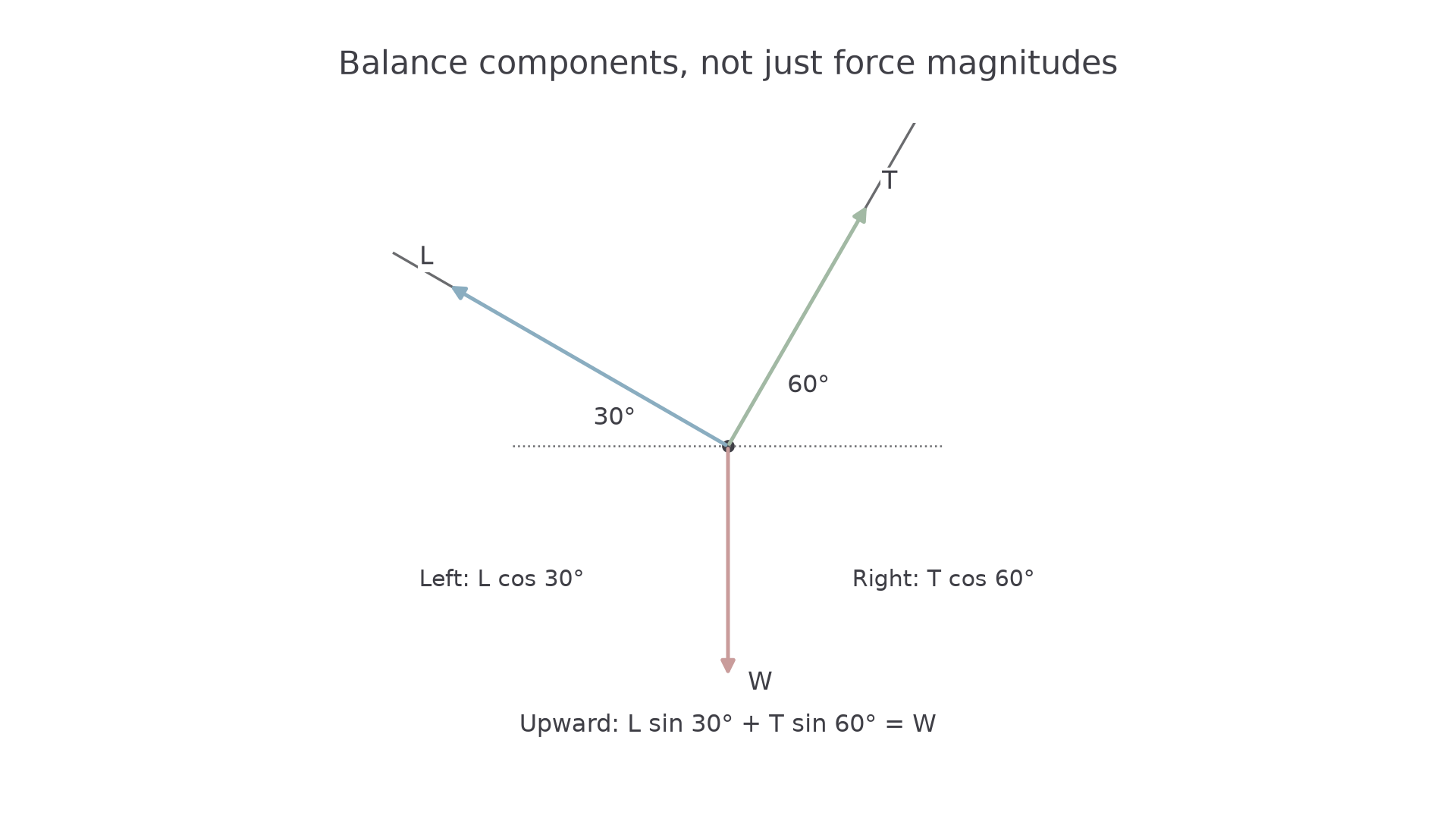
For forces in one plane, choose two perpendicular directions and set each component resultant to zero. This supplies two simultaneous equations. Use the angles to the chosen axes carefully: a component adjacent to the angle uses cosine.
[DIAGRAM: asset_name: Two strings support one weight; asset_slug: m1-coplanar-string-equilibrium; caption: Horizontal components cancel while the vertical components support the weight.; description: A particle with a left string at thirty degrees above horizontal and right string at sixty degrees, tensions away from the particle and weight vertically down.]
Worked example 3: unequal string angles
A particle of weight is held by two light strings in a vertical plane. The left string is above horizontal and the right string above horizontal. Find their tensions and .
Plan. Balance horizontal components first to relate the unknowns, then resolve vertically.
Answer. , to three significant figures.
Check. Horizontal components are both ; vertical components and sum to .
Change only the weight, doubling it while preserving the string directions.
Worked example 4: a larger supported weight
The weight is now , with the same string angles. Find the tensions.
Plan. The horizontal relation is unchanged, but the vertical resultant must support twice the weight.
Answer. , to three significant figures.
Check. Both tensions doubled, so all components doubled without changing their equilibrium directions.
A steeper string can supply more vertical support for a given tension. Equal vertical support is not implied when the two angles differ.
Continue this lesson.
You’re previewing NovaLearn without an account. Create a free account to read the rest.
Create free account