P1 3.2 - Radians and sectors
Measure angles using arc length rather than degrees. Convert between the two measures, calculate arc lengths and sector areas, and build composite areas and perimeters from the correct curved and straight boundaries.
Radian measure and degree conversion
A circle of radius has an arc of length . A larger circle has radius and an arc of length . Which arc subtends the larger angle at its centre? Neither: both occupy the same fraction of their circle.
An angle can be measured by comparing its arc with its radius. Scaling the circle changes both lengths in the same proportion, so the ratio measures the angle independently of the circle's size.
Radian
An angle of one radian subtends an arc whose length equals the radius. In general, the radian measure of a central angle is
The two lengths must use the same units. Their ratio has no length unit; use when the angle measure needs to be explicit.
[DIAGRAM: asset_name: One radian compares arc and radius; asset_slug: one-radian; caption: An arc equal in length to the radius subtends one radian.; description: A circle sector has two equal radii labelled r and a highlighted circular arc also labelled r. The central angle is labelled one radian. A second note states a full turn has arc two pi r and angle two pi radians.]
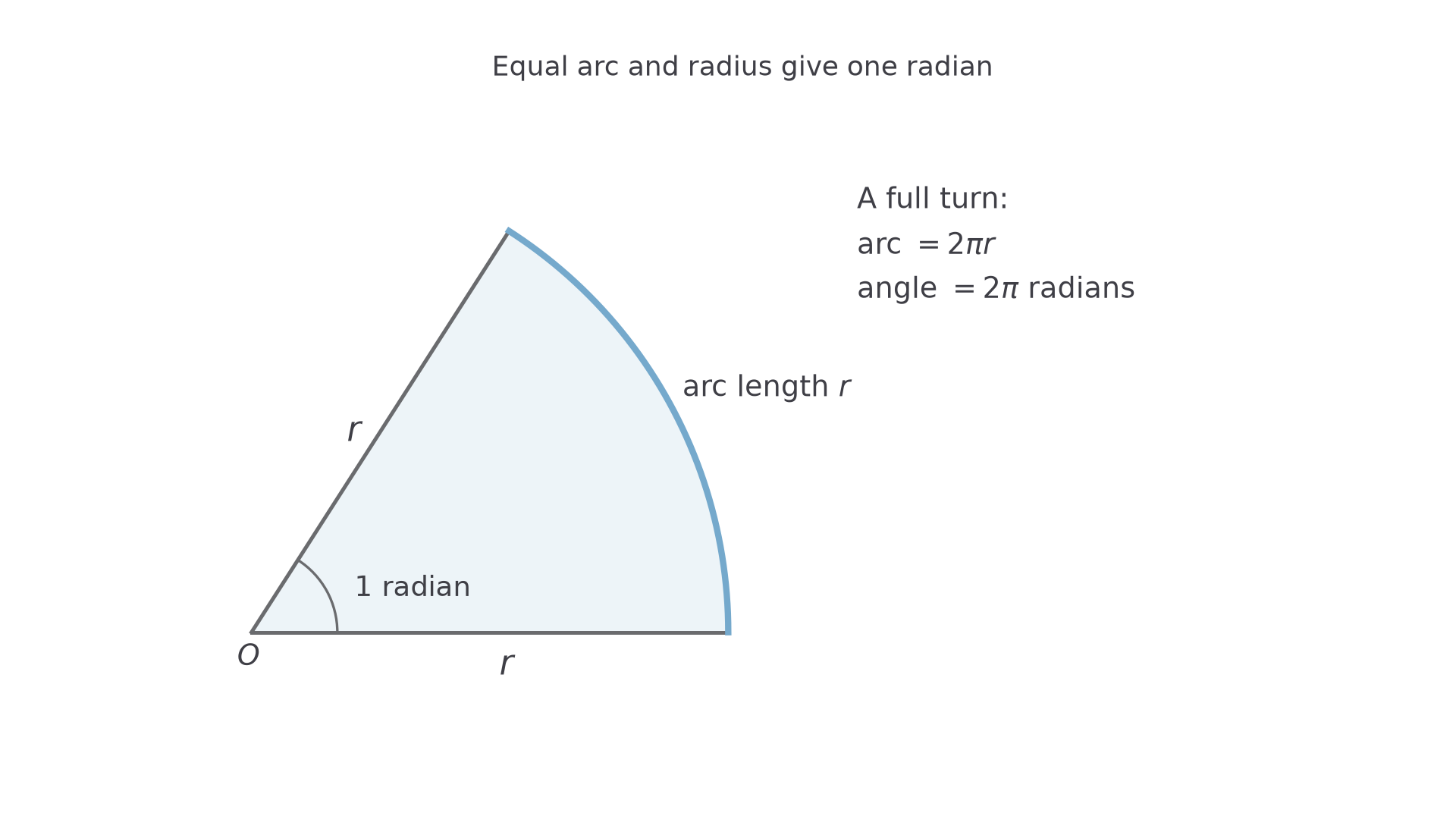
A full circumference is , so a full turn is radians. Hence
A right angle is , and a reflex angle such as is . Keep multiples of exact when possible.
Worked example 1: degrees to radians
Question. Express in radians, in exact form.
Plan. Multiply by , since corresponds to radians.
Answer. .
Check. is three eighths of a full turn; .
Change only the direction of conversion. Use the reciprocal conversion factor to recover degrees from the same angle measured in radians.
Worked example 2: radians to degrees
Question. Express in degrees.
Plan. Multiply the radian measure by .
Answer. .
Check. The answer lies between and , just as lies between and .
A bare angle such as in an arc-length formula means radians. A degree symbol explicitly means degrees; is a much smaller angle.
Arc length
The definition of a radian immediately gives an arc length once the radius and angle are known.
For example, an angle of radians subtends an arc times as long as the radius. This is the curved distance along the circle; it is longer than the straight chord joining the same endpoints.
Arc length
where is the arc length, is the radius and is the central angle in radians. The arc and radius use the same length unit.
Not in the formula booklet: learn it.
Two radii and an arc enclose a sector. Its perimeter includes both radii: . Between two points on a circle, the minor and major arcs together make a full circumference; their central angles add to .
Worked example 3: the minor arc
Question. A circle has radius . Two radii enclose an angle of radians. Find the minor arc length and the perimeter of the minor sector.
Plan. Multiply the radius by the given angle, then include both straight radii for the perimeter.
Answer. Arc length ; sector perimeter .
Check. The fraction of the circumference is . Multiplying this by gives , independently using proportionality.
Keep the same circle and endpoints; change only the selected arc from minor to major. Its angle must now be the rest of the full turn.
Worked example 4: the major arc
Question. For the same radius and minor angle radians, find the major arc length and the perimeter of the major sector.
Plan. Use the major angle , retaining until the end.
Answer. Major arc ; major sector perimeter , to significant figures.
Check. Minor and major arcs sum to , the full circumference.
If an angle is supplied in degrees, convert it before using . For example, , not radians.
Sector area
A sector occupies the same fraction of a circle's area as its angle occupies of a full turn.
The fraction is . Multiplying by the whole area gives . Notice the square on the radius: doubling a radius makes the area four times as large at the same angle.
Sector area
where is in radians. This is the area enclosed by two radii and their chosen arc.
Not in the formula booklet: learn it.
A major sector uses its reflex angle. A sector is different from the segment enclosed by a chord and an arc; the segment's straight edge does not pass through the centre.
Worked example 5: find the area
Question. Find the area of a sector with radius and angle radians.
Plan. Square the radius, multiply by the angle, then halve.
Answer. .
Check. The arc is . Since , it gives .
Change only which quantity is unknown: give the area and angle, and recover the radius. Rearranging now requires a square root.
Worked example 6: find the radius
Question. A sector has area and angle radians. Find its radius.
Plan. Isolate first, then take its positive square root.
Answer. . A negative radius has no geometric meaning.
Check. A circle with this radius has area . The sector fraction gives .
The radius formula is . Stopping at would report an area-sized number as a length.
Composite arc and sector problems
For a composite region, identify its area pieces and trace its actual boundary before calculating a perimeter.
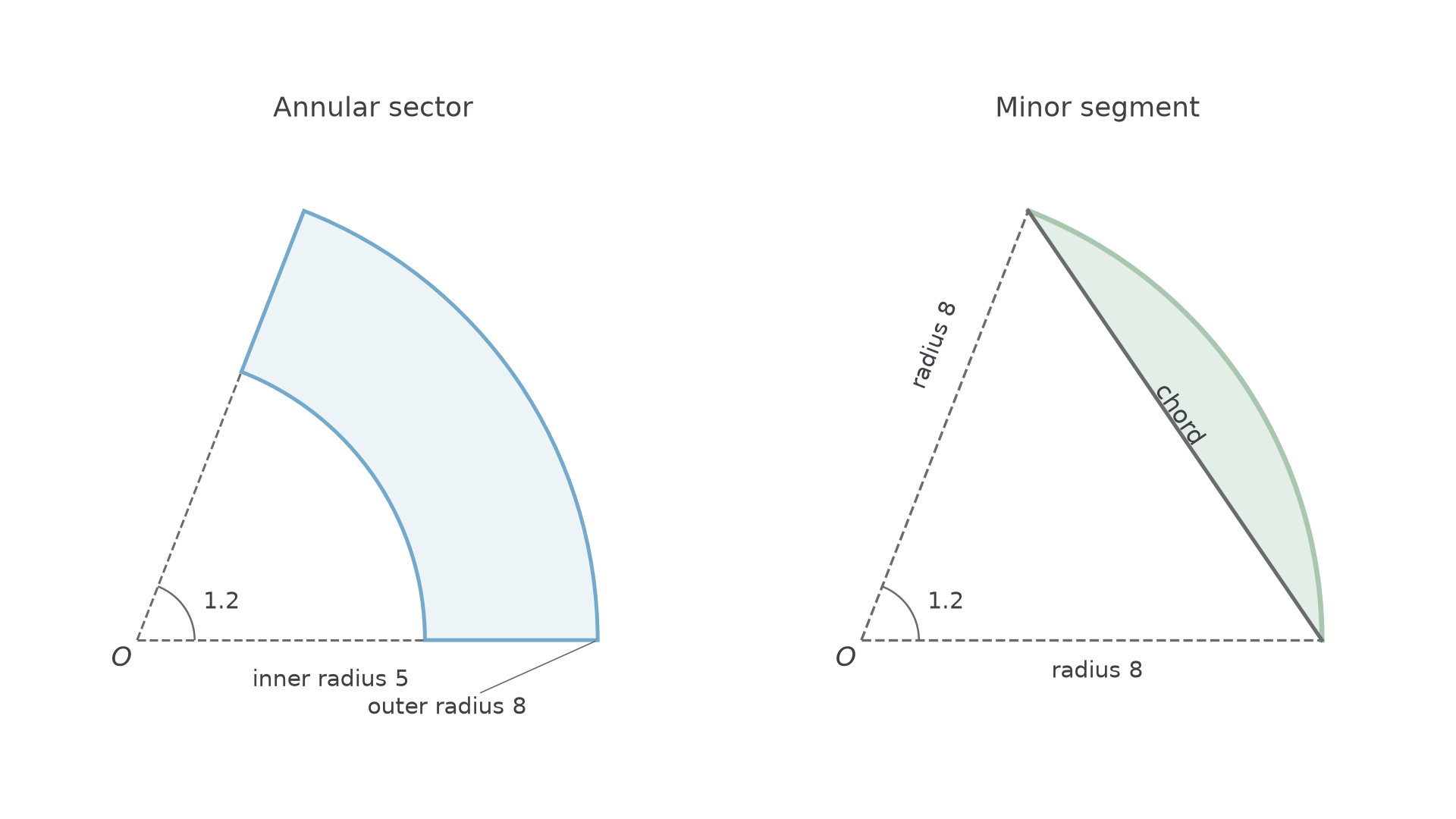
An annular sector lies between two concentric arcs and two radial edges. If its outer radius is , inner radius and angle , subtract the smaller sector area from the larger. Its two straight boundary pieces each have length , not .
A minor segment lies between a chord and the minor arc. For , subtract the triangle between the radii from the sector. Its triangle area is . Here is in radians in both the sector formula and the sine calculation, so select radian mode on the calculator.
[DIAGRAM: asset_name: Curved and straight inner boundaries; asset_slug: sector-composites; caption: An inner arc removes a sector; a chord removes a triangle.; description: Side-by-side diagrams show an annular sector with radii eight and five and angle 1.2 radians, and a minor segment in a circle of radius eight with central angle 1.2 radians. The annular region is pale blue; the segment is pale green. The chord and two radii enclose an unshaded triangle.]
Worked example 7: remove an inner sector
Question. An annular sector has outer radius , inner radius and angle radians. Find its area and perimeter.
Plan. Subtract sector areas; add both arc lengths and the two short radial edges.
Answer. Area ; perimeter .
Check. The outer and inner sector areas are and , whose difference is . The two radial edges total , rather than two full outer radii.
Keep the outer radius and angle; change the inner boundary from an arc to the chord joining the outer endpoints. The removed area is now a triangle.
Worked example 8: remove a triangle
Question. A minor segment has radius and central angle radians. Find its area and perimeter.
Plan. Subtract triangle area from sector area. For the chord, split the isosceles triangle into two right triangles, each with angle at the centre.
Answer. Area ; perimeter , to significant figures.
Check. The cosine rule independently gives chord , shorter than the arc .
Our opening arcs each subtend exactly one radian. Their equal arc-to-radius ratios explain why circle size does not alter that angle.
Quick Recap
- One full turn is radians; multiply degrees by .
- With radians, arc length is and sector area is .
- Choose the minor or major angle to match the region asked for.
- Subtract area pieces, but trace the perimeter separately; an arc, chord and radius are different boundary lengths.