6.5.1(a)-(d) - X-ray production and attenuation
X-rays are useful because they are high-energy photons that can pass through some materials but are strongly reduced by others. In this lesson you will build the physics from the tube that makes the photons, through the interactions that remove them from a beam, to the exponential law OCR uses for attenuation calculations. We will keep the medical imaging motivation in the background: this lesson is about production and attenuation, not contrast media or CAT scanning.
The X-ray tube as an energy converter
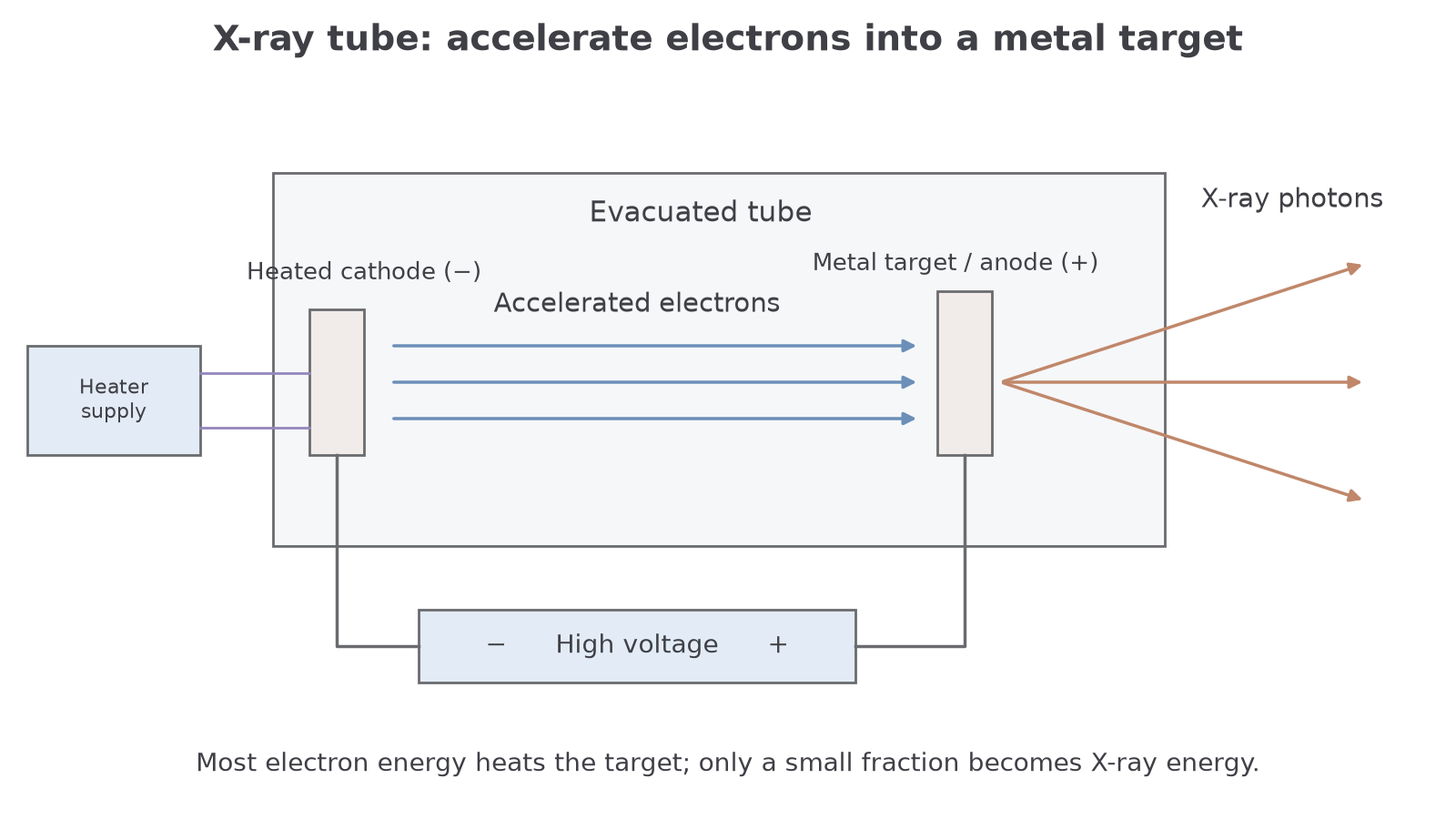
An X-ray tube is designed to give electrons a large amount of kinetic energy and then stop them suddenly in a metal target. The lost kinetic energy is transferred mainly to heat, with a small fraction emitted as X-ray photons.
The main components are:
- a heater at the cathode, often a hot filament, which releases electrons by thermionic emission
- an anode containing a target metal, where the electrons are stopped
- a high-voltage supply between cathode and anode, so electrons are accelerated across the tube
The tube is evacuated so that electrons are not slowed by collisions with gas molecules before reaching the target. The high potential difference gives the electrons sufficient kinetic energy to generate X-rays at the target.
The sequence is worth making precise:
- The heater raises the temperature of the cathode.
- Electrons leave the cathode surface.
- The high voltage accelerates the electrons towards the positive anode.
- The electrons strike the target metal.
- Some of their kinetic energy is emitted as X-ray photons.
[DIAGRAM: asset_name: 6.5.1(a)-(d) - X-ray production and attenuation - diagram 1; asset_slug: 6_05_1a_xray_production_and_attenuation__diagram_01; recommended_method: drawn_physics; description: Negative heated cathode, separate two-lead heater supply and positive anode across labelled high voltage; electrons go to target and photons leave it.; caption: A heated negative cathode emits electrons that accelerate towards the positive target, where X-rays are produced.]
How the target produces photons
An electron accelerated through a potential difference gains kinetic energy , where is the elementary charge. This is why tube voltage is often quoted in kilovolts and photon energies in kilo-electronvolts. For example, an electron accelerated through gains of kinetic energy.
When the fast electron enters the target metal, it may lose energy in many small interactions. Two routes can produce X-ray photons.
Bremsstrahlung
Bremsstrahlung is X-ray radiation emitted when a fast electron is decelerated or deflected by the electric field near a target nucleus. The photon energy equals the kinetic energy lost by the electron in that interaction.
Bremsstrahlung gives a continuous range of photon energies because different electrons lose different fractions of their kinetic energy. The maximum possible photon energy occurs if one electron loses all its kinetic energy in a single interaction. With an tube this maximum is .
Characteristic X-ray
A characteristic X-ray is emitted when a target atom has an inner-shell vacancy and an outer electron drops to a lower energy level. The photon energy is the difference between the two atomic energy levels, so it depends on the target metal.
An incident fast electron can eject an inner-shell electron from a target atom, creating the vacancy needed for characteristic emission. The replacement outer electron loses a definite energy, so the emitted photon has a characteristic energy. These discrete energies sit on the continuous bremsstrahlung background. Increasing the tube voltage increases the maximum possible photon energy, while the characteristic line energies remain fixed by the target atom.
Worked example:
An X-ray tube has a potential difference of between cathode and anode.
The maximum kinetic energy of each electron is:
So the maximum possible X-ray photon energy is . Most photons have less energy because most electrons lose their kinetic energy through several interactions and much of the energy becomes heat.
How matter attenuates X-rays
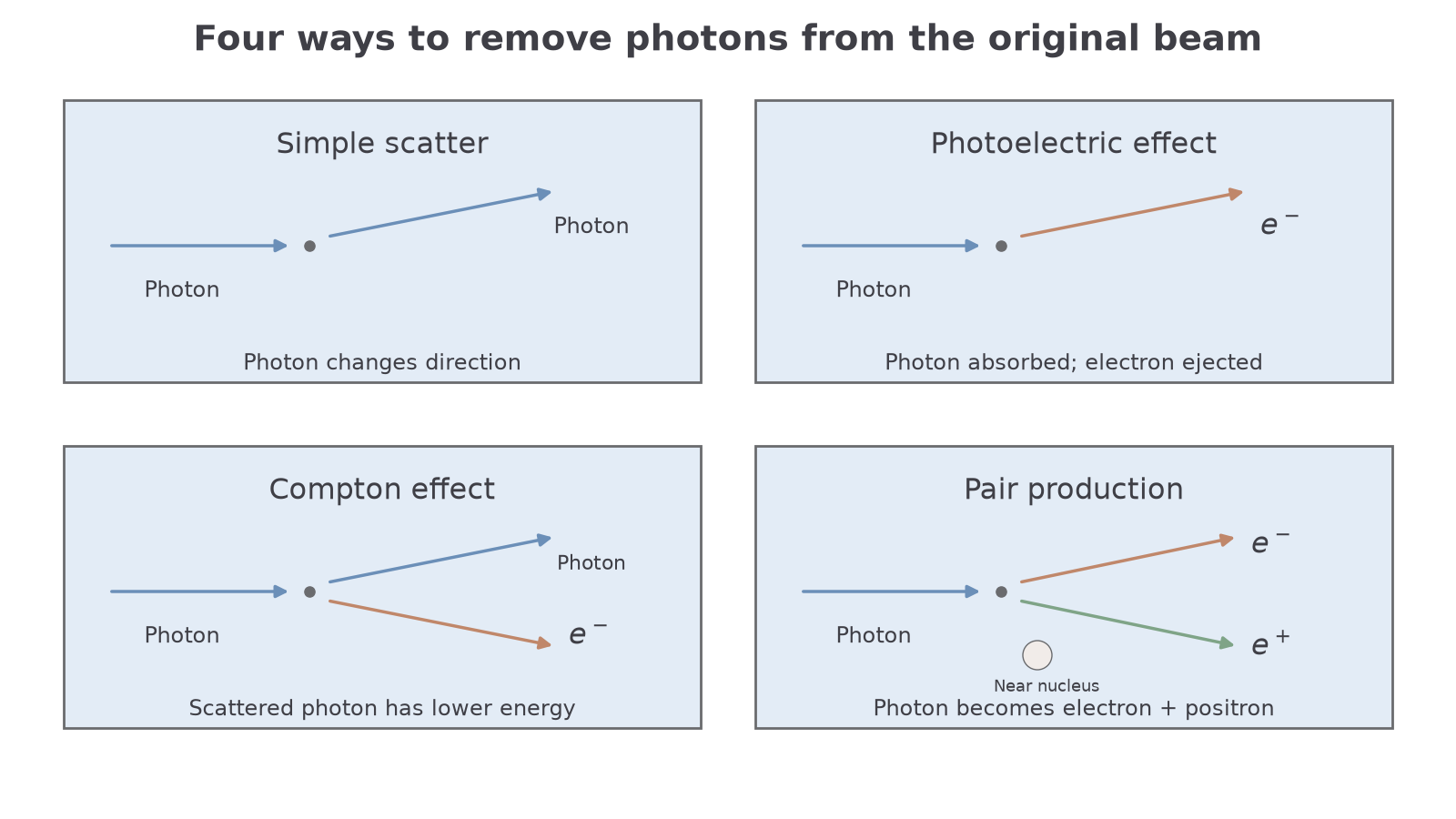
Attenuation is a reduction in intensity of the original X-ray beam as it passes through matter. Photons can be absorbed, scattered away from the original direction or converted into particle pairs. Four mechanisms are relevant.
[DIAGRAM: asset_name: 6.5.1(a)-(d) - X-ray production and attenuation - diagram 2; asset_slug: 6_05_1a_xray_production_and_attenuation__diagram_02; recommended_method: drawn_physics; description: Four complete panels distinguish scattered surviving photon, photoelectric disappearance, lower-energy Compton photon and near-nucleus pair creation.; caption: Simple scattering, the photoelectric effect, Compton scattering and pair production remove photons from the original beam.]
Simple scatter
Simple scatter changes a photon’s direction and removes it from the original beam; in this model there is no electron ejection or significant change of photon energy.
Photoelectric effect
In the photoelectric effect, an X-ray photon is absorbed by an atom and an electron is removed. The photon disappears, so all of its energy is transferred to the atom/electron system.
Photoelectric absorption is important for contrast between materials because it is more likely in high-proton-number materials and at lower X-ray photon energies. This is why dense materials such as bone or lead attenuate X-rays more strongly than soft tissue or air. That imaging consequence is useful motivation, but the mechanism is the part tested here.
Compton effect
In the Compton effect, an X-ray photon interacts with a loosely bound or free electron. The electron is ejected and the photon is scattered with lower energy, so its wavelength is longer.
Continue this lesson.
You’re previewing NovaLearn without an account. Create a free account to read the rest.
Create free account