6.4.3(a)-(c) - Nuclear radiation and decay equations
Radioactive sources are useful because they emit ionising radiation, but the emission is not like a machine releasing one particle every second. In this lesson you will learn how alpha, beta and gamma radiation differ, how their absorption can be investigated safely, and how to balance nuclear decay equations using nucleon number and proton number. The quantitative laws of activity, half-life and exponential decay come in the next split lesson.
Spontaneous and random decay
A radioactive nucleus is unstable. When it decays, the nucleus changes into a more stable nucleus or a lower-energy state and emits nuclear radiation.
Radioactive decay
Radioactive decay is the spontaneous change of an unstable nucleus with the emission of ionising radiation.
The word spontaneous means that the decay is not triggered by heating, cooling, squeezing, chemical bonding, shining light on the sample, or connecting it to a circuit. The instability is a nuclear property. Normal laboratory conditions can change the atoms around the nucleus, but they do not choose which nucleus decays next.
The word random means that you cannot predict the exact nucleus that will decay next, or the exact time at which a particular nucleus will decay. You can only talk about probability for a large number of identical unstable nuclei. This is why a detector near a source may record, for example, 19 counts, then 24 counts, then 17 counts in three equal time intervals even when the source and detector have not moved.
That fluctuation is not a mistake by itself. A steady experimental setup gives a mean count rate, with random variation about the mean. Repeating readings and averaging them is therefore part of good radioactivity work.
For one unstable nucleus, the next decay is unpredictable. For many unstable nuclei, a stable average pattern can be measured.
Alpha beta and gamma radiation
The three radiations here are alpha particles, beta particles and gamma rays. They are all ionising radiation, but they are not the same kind of object.
Alpha particle
An alpha particle is a helium nucleus, written or . It contains two protons and two neutrons and has charge .
Alpha particles are relatively massive and strongly charged. They ionise strongly, so they lose energy quickly. Their range in air is only a few centimetres, and they are stopped by paper, skin, or a thin card sheet.
Beta particle
A beta particle is a fast electron or positron emitted from a nucleus. Beta-minus radiation is written ; beta-plus radiation is written .
Beta particles are much less massive than alpha particles and have charge of magnitude . They ionise less strongly than alpha particles, so they travel further. Beta radiation usually passes through paper but is absorbed by a few millimetres of aluminium or plastic, depending on its energy.
Gamma ray
A gamma ray is a high-energy electromagnetic photon emitted from the nucleus. It has no mass and no charge.
Gamma rays ionise weakly compared with alpha and beta radiation, so they are highly penetrating. A school laboratory absorber does not usually "stop" gamma completely; thick lead or concrete reduces the intensity.
This gives a useful contrast: high ionising power usually means low penetrating power. Alpha particles interact strongly and stop quickly. Gamma photons interact less often, so many travel through the absorber.
[DIAGRAM: asset_name: 6.4.3(a)-(c) - Nuclear radiation and decay equations - diagram 1; asset_slug: 6_04_3a_nuclear_radiation_absorption_and_decay_equations__diagram_01; recommended_method: drawn_physics; description: Paper, aluminium and thick lead show proper attenuation order; residual gamma arrow makes progressive attenuation explicit.; caption: Paper, aluminium and thick lead attenuate alpha, beta and gamma radiation differently.]
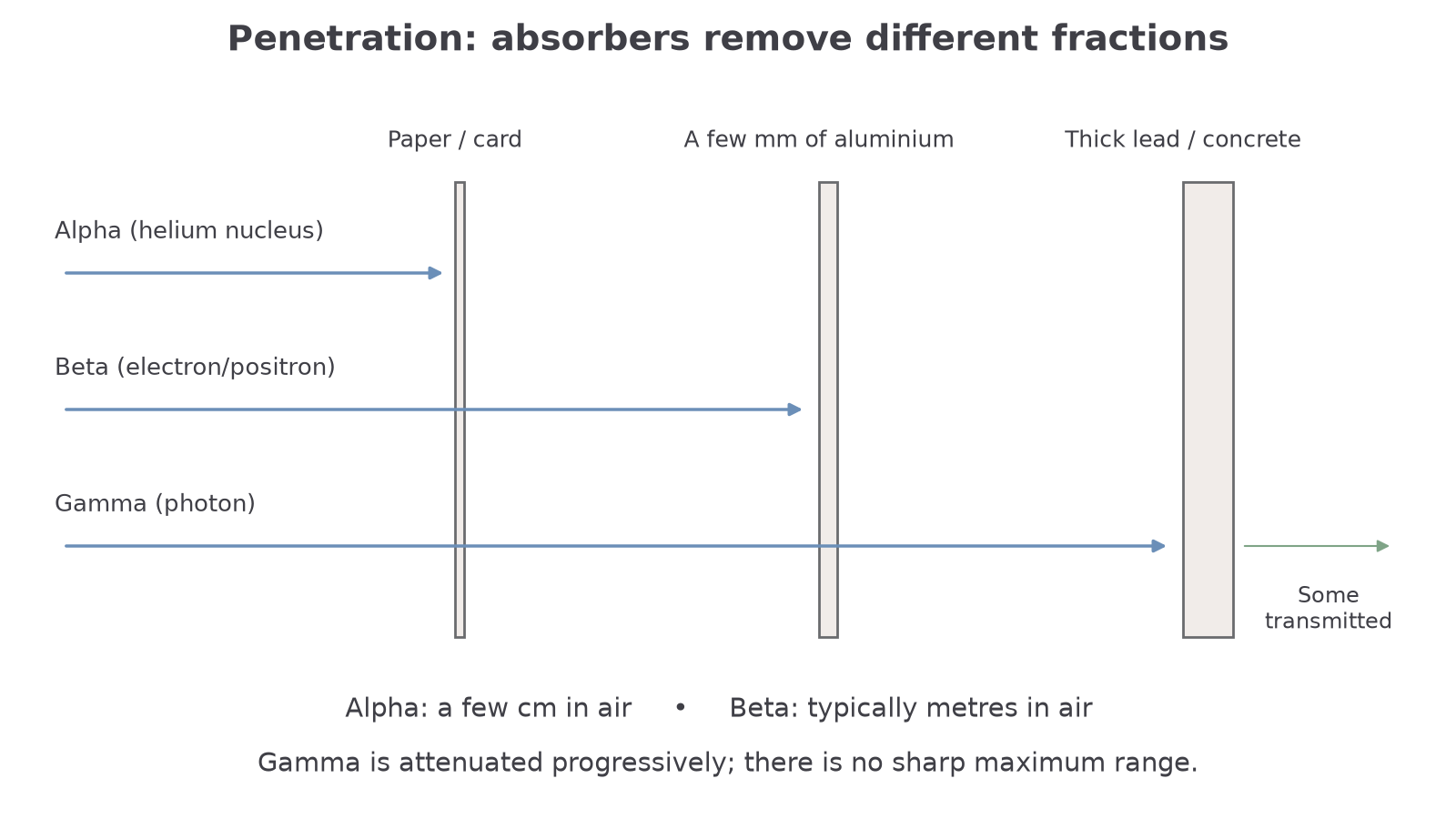
The word range is the distance radiation travels in a material before it is absorbed or loses enough energy to stop being detected. Range depends on the particle type, its energy and the absorbing material, so OCR questions usually expect a qualitative comparison rather than one fixed universal distance. Gamma photons are attenuated probabilistically: they have no sharp maximum stopping distance.
Investigating absorption
An absorption investigation compares the count rate reaching a detector when different materials, or different thicknesses of material, are placed between a source and the detector.
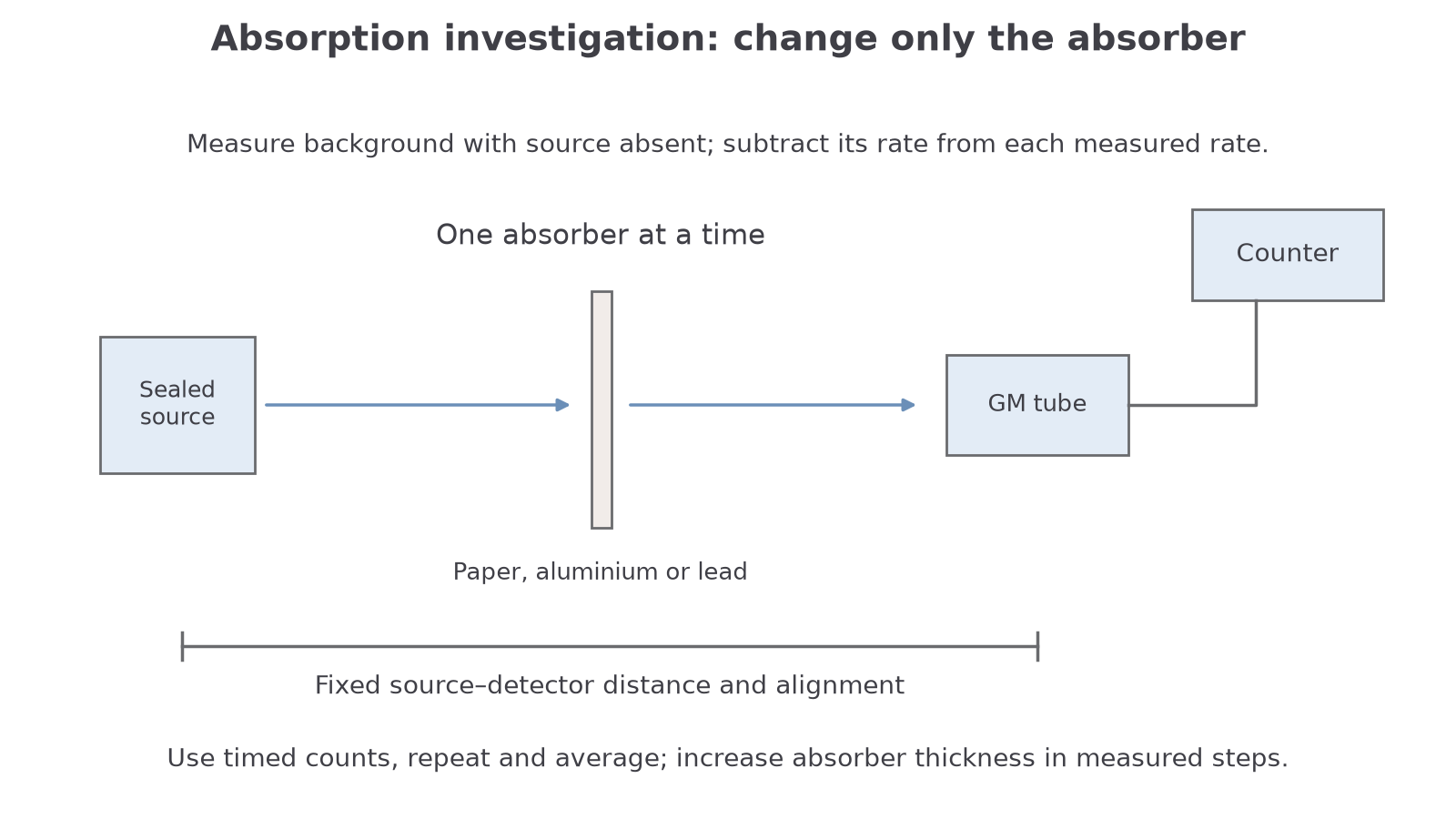
A typical school method uses a sealed source, a source holder, an absorber slot, a Geiger-Muller tube and a counter or rate meter. The geometry matters: if the source-detector distance changes, the count rate changes even without extra absorption. Keep the source, absorber and detector fixed in line.
[DIAGRAM: asset_name: 6.4.3(a)-(c) - Nuclear radiation and decay equations - diagram 2; asset_slug: 6_04_3a_nuclear_radiation_absorption_and_decay_equations__diagram_02; recommended_method: drawn_physics; description: One removable absorber, fixed source–GM geometry, counter connection and background/timed-repeat method clearly shown.; caption: Change one absorber at a time while keeping the source and detector fixed, then subtract the measured background rate.]
A careful method is:
- Measure the background count with no source present, using the same time interval or a longer interval.
- Put the sealed source in a holder and place the detector at a fixed distance. For alpha radiation use a suitable thin-window detector close enough to lie within its few-centimetre range in air; do not dismantle the source.
- Record the count for a fixed time with no absorber between source and detector.
- Place one absorber in the slot, such as paper for alpha, aluminium for beta or lead for gamma, and record the count for the same time.
- Repeat readings and calculate a mean count rate.
- Subtract the background count rate from each measured count rate before comparing absorption.
Continue this lesson.
You’re previewing NovaLearn without an account. Create a free account to read the rest.
Create free account