6.4.2(h)-(l) - Quarks, beta decay and particle decay
Beta decay is not just a nucleus changing its proton number; in the quark model, it is one quark inside a particle changing type. In this lesson you will use the , and quark charges to write beta-minus and beta-plus decay equations, check charge conservation, and handle simple particle-decay bookkeeping in OCR style.
Weak interactions and spectator quarks
From the previous lesson, retrieve only the pieces we need:
- an up quark has charge
- a down quark has charge
- a strange quark also has charge
- an antiquark has the opposite charge to its matching quark
- a proton has quark composition
- a neutron has quark composition
The weak interaction changes one quark type in beta decay. The other quarks in the hadron remain unchanged spectators.
Spectator quark
A spectator quark is a quark in the particle that does not change during the decay. It stays in the particle and is carried into the product hadron.
The emitted beta particle is a charged lepton:
- beta-minus, , is an electron, often written
- beta-plus, , is a positron, often written
The other emitted particle is neutral: an electron antineutrino in beta-minus decay, and an electron neutrino in beta-plus decay. OCR often writes these simply as and ; the subscript in this lesson reminds you that they are the electron-flavour neutrino and antineutrino.
For OCR quark-decay questions, first identify the quark that changes, then check that charge is conserved.
Beta-minus decay
In beta-minus decay, a down quark changes into an up quark. The charge of the quark has increased from to , an increase of . To keep total charge conserved, an electron with charge is emitted, along with an electron antineutrino with charge zero.
Beta-minus quark transformation
For a neutron, the full quark picture is:
That is the quark-model version of a neutron becoming a proton. Only one of the two down quarks changes into an up quark; the original up quark and the other down quark are spectators.
[DIAGRAM: asset_name: 6.4.2(h)-(l) - Quarks, beta decay and particle decay - diagram 1; asset_slug: 6_04_2b_quarks_beta_decay_and_particle_decay__diagram_01; recommended_method: drawn_physics; description: Only one d changes in udd to uud; electron and antineutrino, spectator pair and charge equation all correct.; caption: In beta-minus decay, a down quark becomes an up quark and emits an electron and an electron antineutrino.]
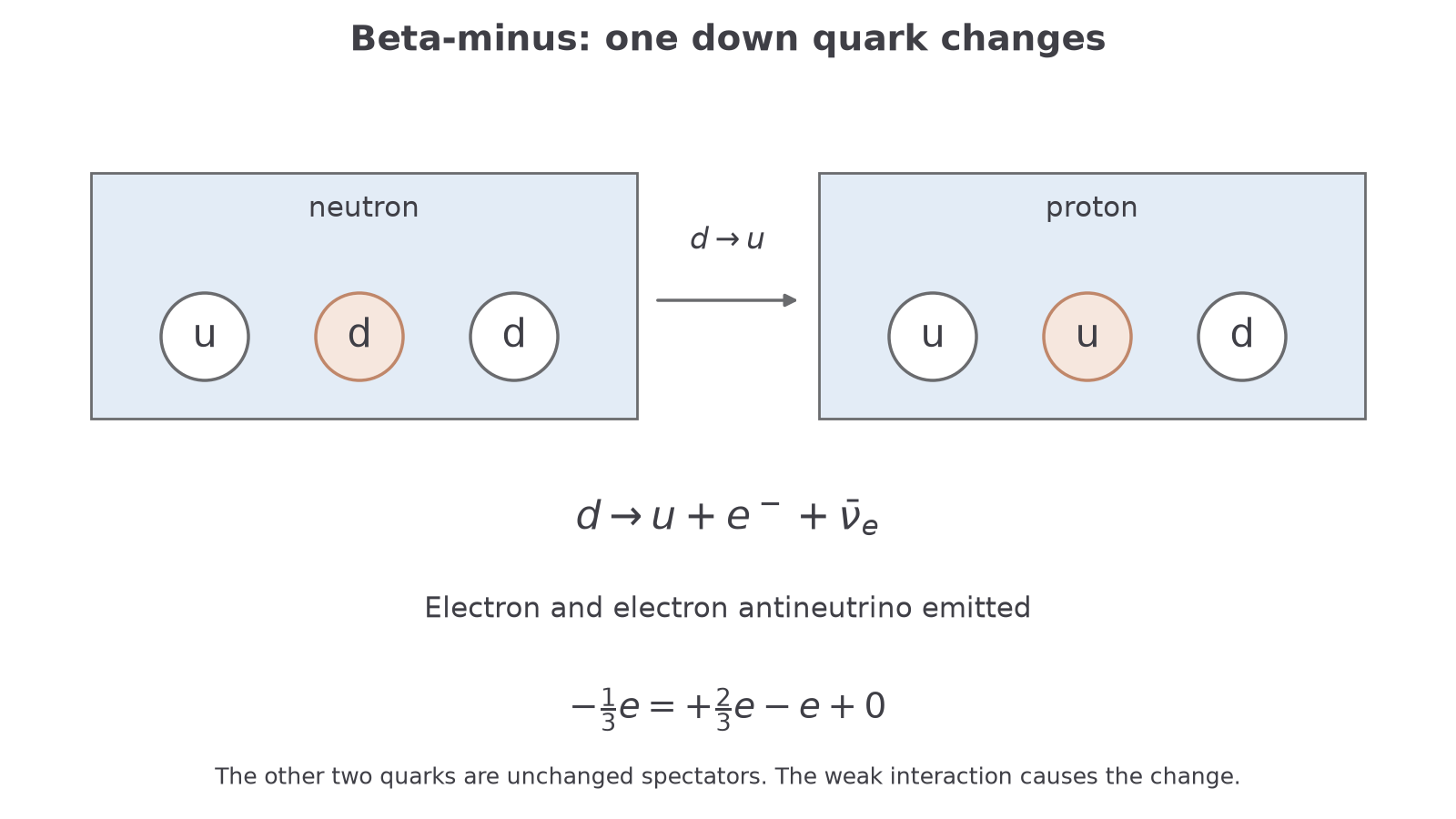
Worked charge check:
Left-hand side:
Right-hand side:
So the quark equation is balanced in terms of charge.
Beta-plus decay
Beta-plus decay is the opposite quark change. An up quark changes into a down quark. The quark charge decreases from to , a decrease of . A positron with charge is emitted, with an electron neutrino of charge zero.
Beta-plus quark transformation
Inside a proton-rich nucleus, the quark model for a proton changing into a neutron is:
One up quark becomes a down quark. The other up quark and the original down quark are spectators.
Continue this lesson.
You’re previewing NovaLearn without an account. Create a free account to read the rest.
Create free account