6.4.2(a)-(g) - Particles, antiparticles, hadrons and leptons
Particle physics uses classification to keep a very small world tidy. In this lesson you will learn the principal particle–antiparticle pairs, separate hadrons from leptons by the forces they experience, and use the simple quark model to explain the proton and neutron. The main skill is charge accounting: quark charges are fractions of the elementary charge , but the hadrons you meet here have whole-number charges.
Particle and antiparticle pairs
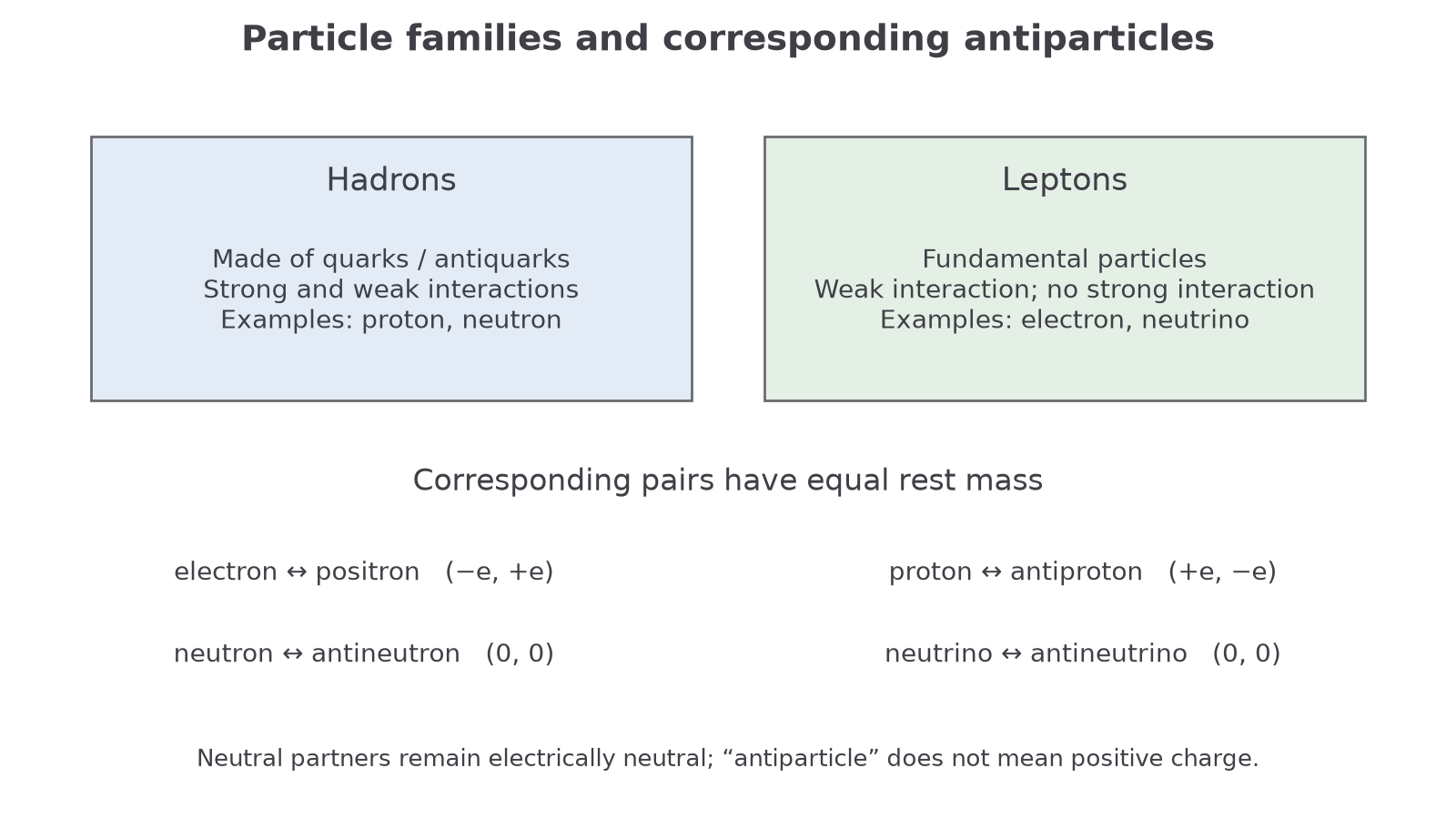
An antiparticle is the corresponding partner of a particle. Four important pairs are:
- electron and positron
- proton and antiproton
- neutron and antineutron
- neutrino and antineutrino
Antiparticle
An antiparticle is the corresponding partner of a particle. Four important pairs are:
The word "corresponding" matters. A positron is not just "a positive particle"; it is the electron's antiparticle. A proton and an antiproton are a corresponding pair, and so are a neutron and an antineutron.
The specification is precise here: a particle and its corresponding antiparticle have the same mass. An electron and positron have opposite charge. A proton and antiproton have opposite charge. The neutron-antineutron pair and the neutrino-antineutrino pair should still be named as particle-antiparticle pairs, but do not invent an opposite net electric charge for the neutral examples.
The charged examples can be summarised like this:
Opposite electric charges alone do not make an antiparticle pair. A proton and an electron have very different masses and belong to different particle families.
Hadrons and leptons
The next classification is not based on size or usefulness. It is based on the type of particle and the nuclear forces it experiences.
Hadron
A hadron is a composite particle made from quarks or antiquarks and is subject to the strong nuclear force. OCR examples in this lesson are the proton and the neutron.
All hadrons are subject to both the strong and weak nuclear interactions. The strong interaction binds quarks into hadrons and also acts between neighbouring nucleons.
- hadrons: strong nuclear force and weak nuclear force
- leptons: weak nuclear force, but not strong nuclear force
Lepton
A lepton is a fundamental particle, such as an electron or neutrino, that is not subject to the strong nuclear force. OCR examples in this lesson are the electron and the neutrino.
Electrons and neutrinos are leptons. They are subject to the weak nuclear force, but not the strong nuclear force. That is the key force difference from hadrons in this lesson. Quarks themselves also experience the strong interaction; they are constituents of hadrons, rather than hadrons in their own right. These force statements alone are not definitions of every possible particle family.
[DIAGRAM: asset_name: 6.4.2(a)-(g) - Particles, antiparticles, hadrons and leptons - diagram 1; asset_slug: 6_04_2a_particles_antiparticles_hadrons_and_leptons__diagram_01; recommended_method: drawn_physics; description: Hadron/lepton boxes, forces, examples and four equal-mass antiparticle pairs are readable; neutrality explicitly preserved.; caption: Particle families differ in their interactions. Corresponding antiparticles have equal mass and opposite charge when charged.]
Do not decide the family from charge alone. A proton is positive and a positron is positive, but a proton is a hadron while a positron is the antiparticle of the electron and is a lepton. A neutron is neutral, but it is still a hadron.
Continue this lesson.
You’re previewing NovaLearn without an account. Create a free account to read the rest.
Create free account