5.2.1 + 5.2.2(b) - Circular kinematics
Circular motion is easier when you describe position by an angle instead of by separate horizontal and vertical coordinates. In this lesson you will meet the radian, connect period and frequency to one complete revolution, and use angular velocity to link rotational motion with ordinary tangential speed. The next lesson explains the acceleration and force needed for circular motion; here the job is purely kinematic.
Radians and arc length
When an object moves around a circle, its position can be described by the angle swept out at the centre. OCR expects you to use the radian as the natural angle measure for circular motion.
Radian
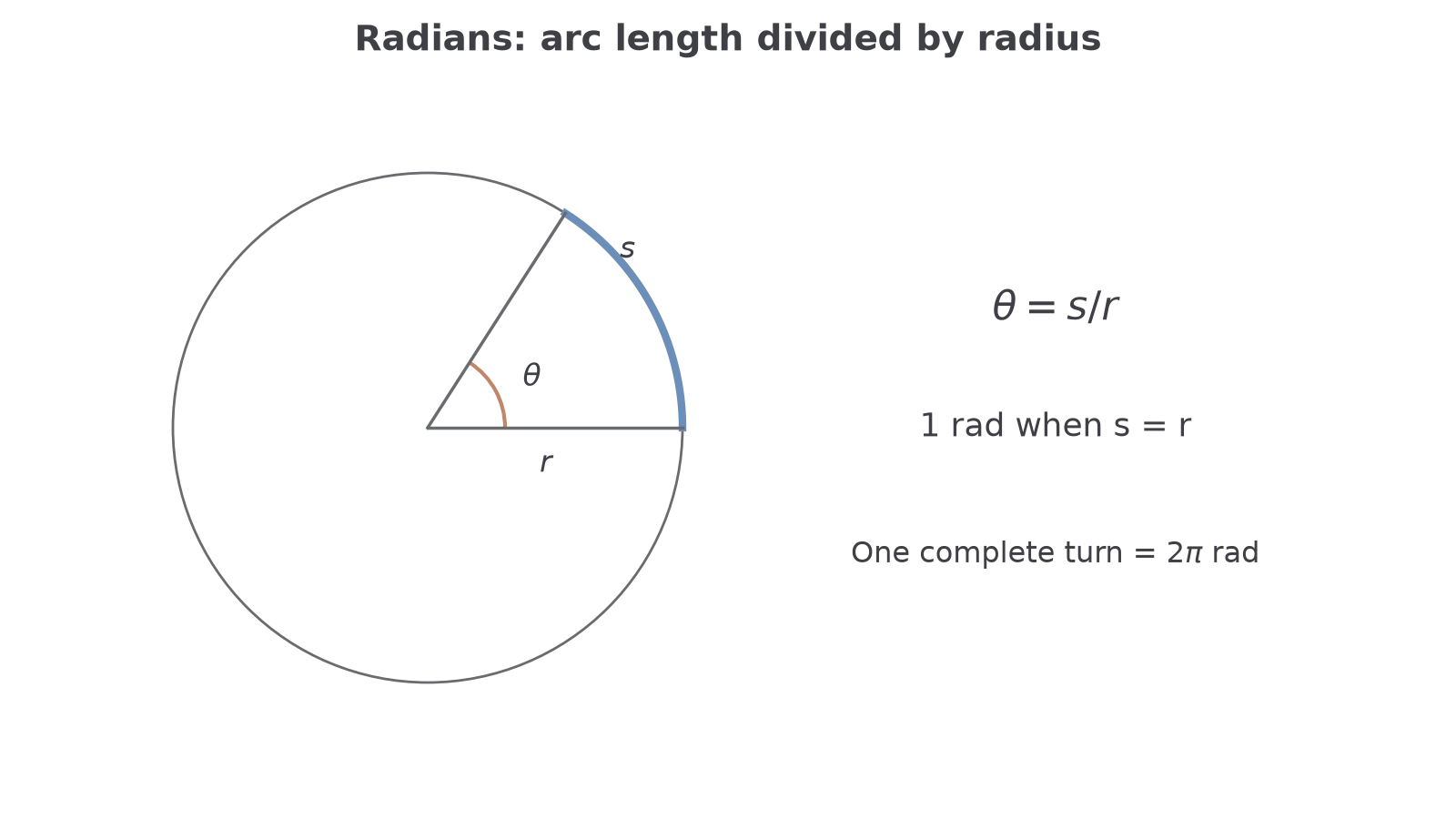
One radian is the angle at the centre of a circle when the arc length is equal to the radius of the circle.
For an angle in radians, radius , and arc length ,
Arc length in radians
This equation is also the definition rearranged: . The ratio has no dimensions because both and are lengths, but OCR answers commonly quote angular displacement in rad.
There are radians in one full revolution because the full circumference is , so
That is why circular-motion formulae use so often. If a question gives an angle in degrees, convert it before using : , so .
Worked example: A point on a rotating platform is from the centre. It moves through an angle of . The distance travelled along its circular path is
The angle must be in radians for the multiplication to work directly.
[DIAGRAM: asset_slug: 5_02_1_angular_measure_and_circular_kinematics__diagram_01; description: An arc equal in length to the radius subtends one radian.; caption: An arc equal in length to the radius subtends one radian.]
Period and frequency
For repeated circular motion, two timing quantities are especially useful.
Period
The period is the time taken for one complete revolution. Its unit is seconds, .
Frequency
The frequency is the number of complete revolutions per second. Its unit is hertz, , which is equivalent to .
Period and frequency are reciprocals:
Frequency and period
If a turntable completes one revolution in , its frequency is
If a wheel rotates at , it completes five revolutions each second, so the time for one revolution is
A longer period means fewer revolutions each second: doubling halves . For a point at a fixed radius, each revolution covers the same distance, so halving the number of revolutions per second also halves its speed. The next parts express these timing links using angular velocity.
Be careful with revolutions per minute. Convert to revolutions per second before using hertz. For example, .
Continue this lesson.
You’re previewing NovaLearn without an account. Create a free account to read the rest.
Create free account