3.4.1 - Springs and Hooke's law
Springs are useful because their deformation can be measured and modelled. In this lesson you will distinguish extension from total length, use Hooke's law in the form , interpret force-extension graphs, and describe a practical method for investigating springs, wires, rubber bands and polythene strips. The central habit is simple but powerful: measure the change in length, convert it to metres, and link the graph gradient to stiffness.
Deformation, extension and compression
Deformation means a change in shape or size caused by forces. In this topic, the important change is along the length of an object such as a spring, wire, rubber band or strip.
Tensile deformation
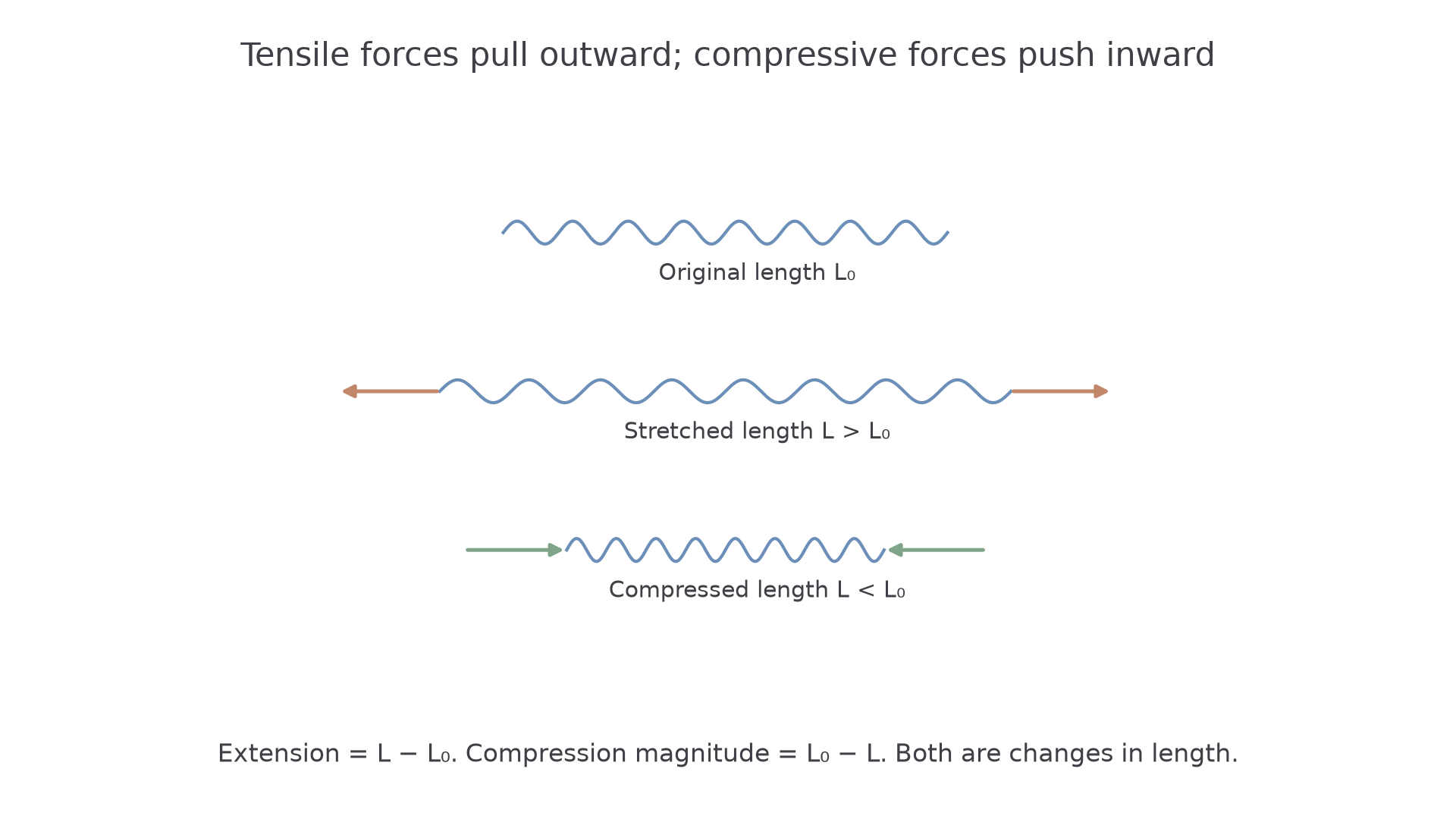
Tensile deformation is deformation caused by forces that stretch an object. The object gets longer in the direction of the tensile forces.
Compressive deformation
Compressive deformation is deformation caused by forces that squash an object. The object gets shorter in the direction of the compressive forces.
Extension and compression are both changes in length. They are not the final length of the object.
If the original length is and the stretched length is , then:
where is the extension. For compression, is the amount by which the length has decreased.
Worked example: finding an extension
A spring has original length . When a load is attached, its length is .
Extension:
Convert to metres before using it in :
A common error is to substitute as . That is the loaded length, not the extension.
[DIAGRAM: asset_name: 3.4.1 - Springs and Hooke's law — figure 1; asset_slug: 3_04_1_springs_hookes_law_and_force_extension_graphs__diagram_01; recommended_method: drawn_physics; caption: Tension lengthens a specimen while compression shortens it.; description: Outward arrows show tension and inward arrows show compression; initial and loaded spring lengths distinguish length from extension.]
Hooke's law and force constant
Hooke's law is a proportionality law. It applies only over the range where force and extension, or force and compression, are directly proportional.
Hooke's law
Hooke's law states that the force applied to a spring or wire is directly proportional to its extension or compression, provided the limit of proportionality has not been exceeded.
In this lesson, use the magnitude form:
Hooke's law
Here is the applied force or load in newtons, is the extension or compression in metres, and is the force constant in newtons per metre, .
Force constant
The force constant is the force needed per unit extension or compression of a particular spring, wire or arrangement. A larger means a stiffer object.
The force constant is not a pure material property. A short thick wire and a long thin wire made from the same material can have different force constants because their dimensions are different.
Worked example: calculating a force constant
A spring extends by when a load of is attached.
First convert the extension:
Rearrange Hooke's law:
Substitute:
So this spring needs for each metre of extension, or for each centimetre of extension while it remains Hookean.
Worked example: using to find extension
A wire has force constant . A force of is applied within the Hookean range.
That is . Notice that the calculation used metres first; the conversion to millimetres came at the end.
Force-extension graphs
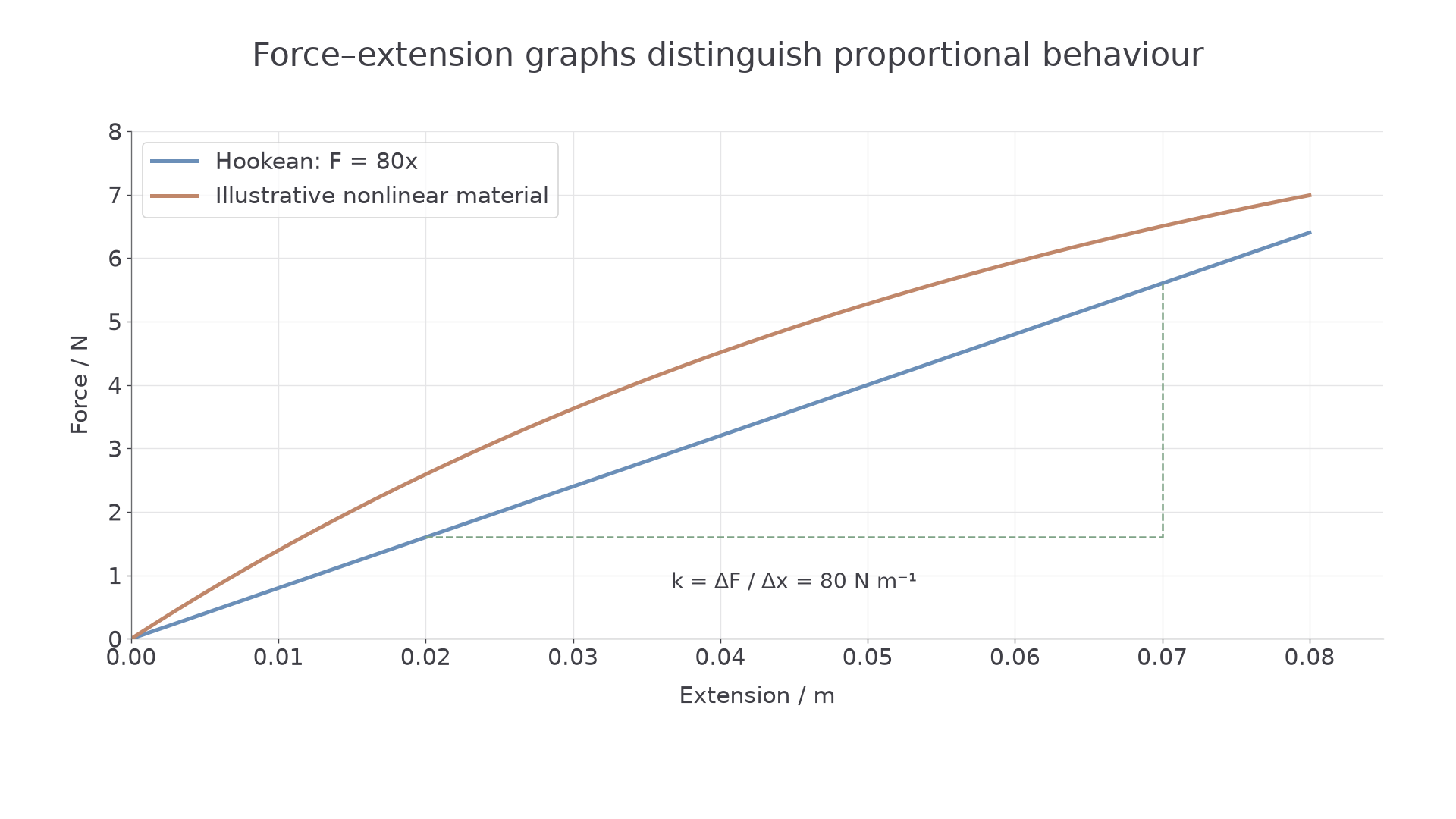
A force-extension graph shows how the applied force changes with extension. For this topic, plot force on the vertical axis and extension on the horizontal axis. Then the gradient of the straight-line section is the force constant:
[DIAGRAM: asset_name: 3.4.1 - Springs and Hooke's law - diagram 1; asset_slug: 3_04_1_springs_hookes_law_and_force_extension_graphs__diagram_02; recommended_method: drawn_physics; caption: A straight force-extension line has constant stiffness while the curved response does not.; description: A straight force-extension line of gradient 80 N per metre is compared with a nonlinear response; a gradient triangle shows force change over extension change.]
For a spring or wire obeying Hooke's law:
- the graph is a straight line
- the straight line passes through the origin
- doubling the extension doubles the force
- the gradient is constant, so is constant
For a rubber band or polythene strip, the graph often curves. A curved graph means the gradient changes, so there is no single constant for the whole range.
Be careful with axes. If a question gives a graph of extension against force, the gradient is , so the force constant is the reciprocal of that gradient. The cleanest route for this lesson is usually against .
Worked example: finding from a graph
A force-extension graph for a spring has a straight-line region. Two points on the best-fit line are:
- ,
- ,
Find the gradient:
Use points far apart on the line, not two cramped plotted points. A large gradient triangle reduces the effect of reading uncertainty.
This lesson uses force-extension graphs for shape, proportionality and gradient. The area under a force-extension graph is a later energy idea, so do not use area when the question is only asking whether Hooke's law applies or what is.
Continue this lesson.
You’re previewing NovaLearn without an account. Create a free account to read the rest.
Create free account