5.3.3 - Damping, forced oscillations and resonance
Real oscillators do not keep moving forever unless energy is supplied to them. In this lesson you will learn how damping removes energy from oscillating systems, how a periodic driving force can maintain an oscillation, and why resonance can make an apparently small driver produce a very large response. The key OCR skill is to connect the words, the graph shape and the practical situation: driver, natural frequency, damping and amplitude.
Free And Forced Oscillations
An oscillator has a natural frequency. This is the frequency at which it oscillates when it is displaced and then left to move freely. The value depends on the physical properties of the system, such as the mass and spring stiffness of a spring-mass oscillator or the length of a simple pendulum.
Natural frequency
The natural frequency of an oscillator is the frequency at which it oscillates when it is allowed to oscillate freely after being displaced.
A free oscillation is not being driven by a continuous external periodic force. In the ideal SHM model from earlier lessons it would keep the same amplitude, but real free oscillations usually die away because energy is lost to the surroundings. The word free is about the absence of a driver, not the absence of damping.
Free oscillation
A free oscillation is an oscillation where the system oscillates at its natural frequency without a continuous external periodic driving force.
A forced oscillation is different. A periodic external force, called the driving force, acts on the system. After any initial transient motion has died away, the driven system oscillates at the driving frequency. For example, a motor can shake one end of a spring at , or a person can push a swing once every period.
Forced oscillation
A forced oscillation is an oscillation caused by a periodic external driving force. In steady motion, the oscillator is forced to oscillate at the driving frequency.
The common trap is to say "forced oscillations occur at the natural frequency". They do not have to. They occur at the driving frequency. The natural frequency matters because the response becomes especially large when the driving frequency is close to it.
Damping And Energy Loss
Damping is the process that reduces the amplitude of an oscillation. It happens because energy is transferred from the oscillating system to the surroundings. In a pendulum this may be due to air resistance and friction at the pivot; in a spring-mass system it may be due to air resistance, internal friction in the spring, or a vane moving through a liquid.
Damping
Damping is the reduction in amplitude of an oscillation due to energy being transferred from the oscillating system to the surroundings.
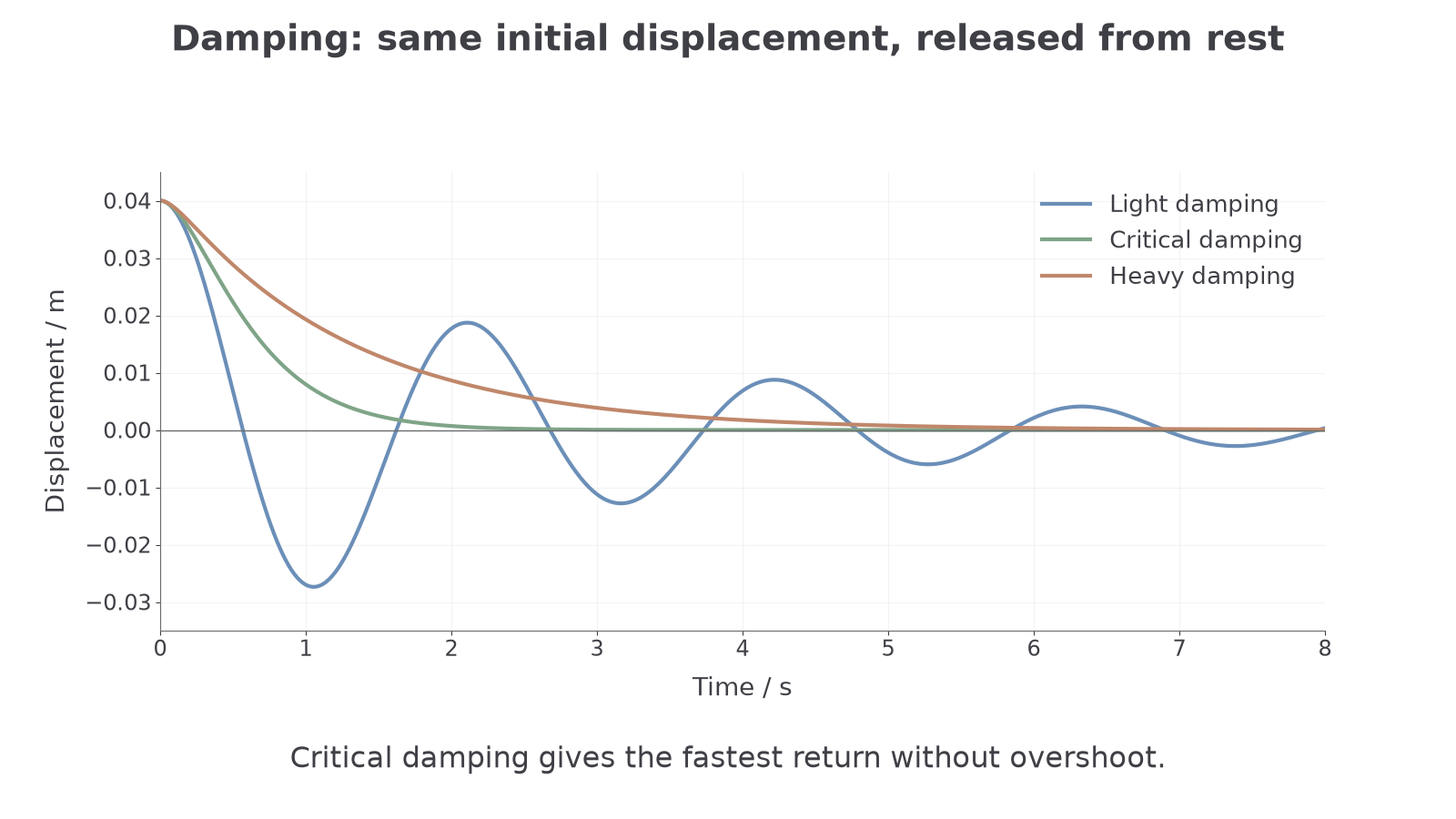
Light damping means the oscillator still completes many cycles, but the amplitude gradually decreases. Critical damping is the fastest return to equilibrium without oscillating about the equilibrium position. Heavy damping, also called overdamping, prevents oscillation but returns to equilibrium more slowly than critical damping.
That last comparison matters. "More damping" does not always mean "back to equilibrium sooner". A heavily damped door closer can be so resistant that the door creeps shut. A critically damped door closer shuts quickly and does not swing back and forth.
The energy picture is simple: when the amplitude is smaller, the maximum energy stored in the oscillation is smaller. Damping removes mechanical energy from the oscillator, usually transferring it as thermal energy to the surroundings.
[DIAGRAM: asset_slug: 5_03_3_damping_forced_oscillations_and_resonance__diagram_01; description: Light, critical and heavy damping for the same initial displacement and zero initial velocity.; caption: Light, critical and heavy damping for the same initial displacement and zero initial velocity.]
Observing Forced And Damped Systems
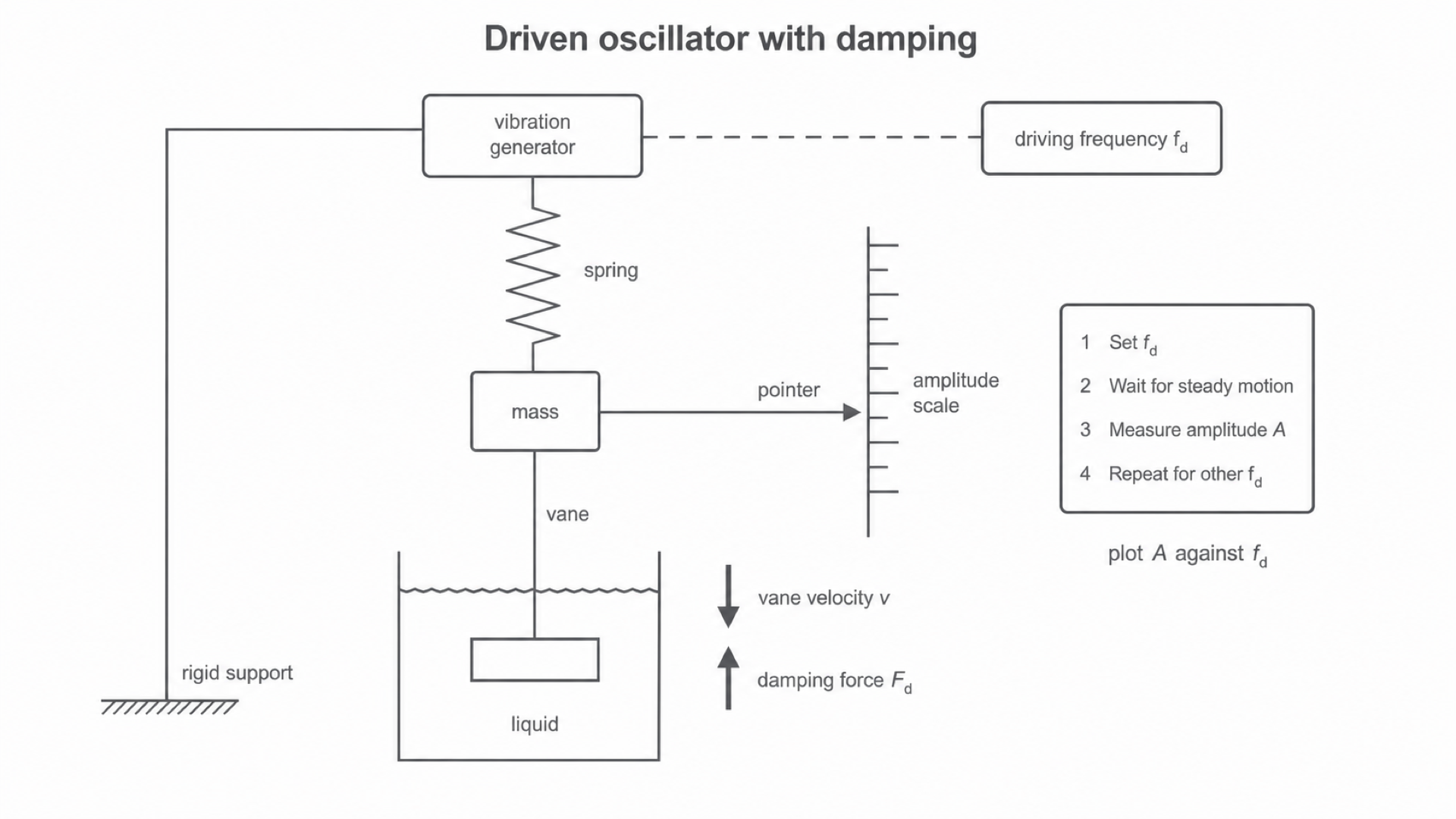
OCR expects you to have met forced and damped oscillations as observable laboratory systems, not just as definitions. A useful setup is a vertical spring-mass oscillator driven by a vibration generator or motor. A pointer and scale, motion sensor, video analysis or data logger can be used to measure amplitude.
For forced oscillations, the independent variable is usually the driving frequency . The dependent variable is the amplitude of the driven oscillator once the motion is steady. Important control variables include the mass, spring, driver amplitude, damping arrangement and measurement method.
A sound method is:
- set one driving frequency and keep the driver amplitude fixed
- allow the oscillator to settle into steady forced oscillations
- measure the amplitude, for example from the maximum displacement on either side of equilibrium
- repeat the amplitude reading and average it
- change the driving frequency in small steps, using closer spacing near the largest amplitudes
- plot amplitude against driving frequency
The same apparatus can show damping. Let the mass oscillate freely, then compare the displacement-time graph with and without a damping vane, or with the vane in air, water and a more viscous liquid. More damping gives faster energy loss from the oscillating system, but critical and heavy damping must still be distinguished by whether the system overshoots and how quickly it returns.
Another classic demonstration is Barton pendulums. Several pendulums of different lengths hang from a common support. When one pendulum is driven, the pendulum with the same length has the same natural frequency and reaches the largest amplitude.
When the pointer moves between two scale readings, amplitude is half the peak-to-peak range. For example, a steady range from to has amplitude , with equilibrium at . Repeat the sweep in both frequency directions; this helps reveal a transient reading or a changing setup.
[DIAGRAM: asset_slug: 5_03_3_damping_forced_oscillations_and_resonance__diagram_02; description: A driven mass–spring system with a damping vane and a fixed scale for amplitude measurements.; caption: A driven mass–spring system with a damping vane and a fixed scale for amplitude measurements.]
Continue this lesson.
You’re previewing NovaLearn without an account. Create a free account to read the rest.
Create free account