3.3.2 - Kinetic and gravitational potential energy
Energy calculations are most useful when they let you replace a messy force-and-motion story with a cleaner account of what has been transferred. In this lesson you will learn the two energy equations you must recall, derive them from work and motion ideas, and use them to follow the exchange between gravitational potential energy and kinetic energy.
Kinetic Energy
Kinetic energy is the energy an object has because it is moving. It depends on the object's mass and on the square of its speed, so speed matters more strongly than many students first expect.
Kinetic Energy
Kinetic energy is the energy of an object due to its motion.
For a single object moving with speed , the kinetic energy is:
Kinetic Energy
Here is kinetic energy in joules, is mass in kilograms, and is speed in metres per second. This equation is expected recall. Because is squared, doubling the speed makes the kinetic energy four times larger if the mass is unchanged.
Worked example: a ball moves at . Its kinetic energy is
The answer is non-negative because and , so .
The most common trap is to treat speed as if it were directly proportional to kinetic energy. It is not: kinetic energy is proportional to .
Deriving Kinetic Energy
The kinetic energy equation can be derived from first principles by connecting work done to a change in speed. Consider an object of mass starting from rest. A constant resultant force acts in the direction of motion over a distance .
From work done:
From Newton's second law:
so
From constant-acceleration motion:
Starting from rest means , so
and therefore
Substitute this into :
The work done by the resultant force has become the object's kinetic energy. More generally, if the object changes speed from to , the net work done is:
Worked example: a trolley starts from rest. A constant resultant force does of work on it. Its final kinetic energy is , so
Gravitational Potential Energy
Gravitational potential energy is energy associated with position in a gravitational field. In this lesson the field is uniform, which means the gravitational field strength is taken as constant and the object's weight is .
Gravitational Potential Energy
Gravitational potential energy is the energy of an object due to its position in a gravitational field.
For an object of mass raised through a vertical height in a uniform gravitational field:
Gravitational Potential Energy
Here is gravitational potential energy in joules, is mass in kilograms, is gravitational field strength in or , and is the vertical change in height in metres. This equation is also expected recall.
[DIAGRAM: asset_name: 3.3.2 - Kinetic and gravitational potential energy - diagram 1; asset_slug: 3_03_2_kinetic_and_gravitational_potential_energy__diagram_01; recommended_method: drawn_physics; caption: Balanced forces lift an object at constant speed through a vertical height.; description: An object lifted at constant speed has balanced upward and downward forces, with a marked change in vertical height.]
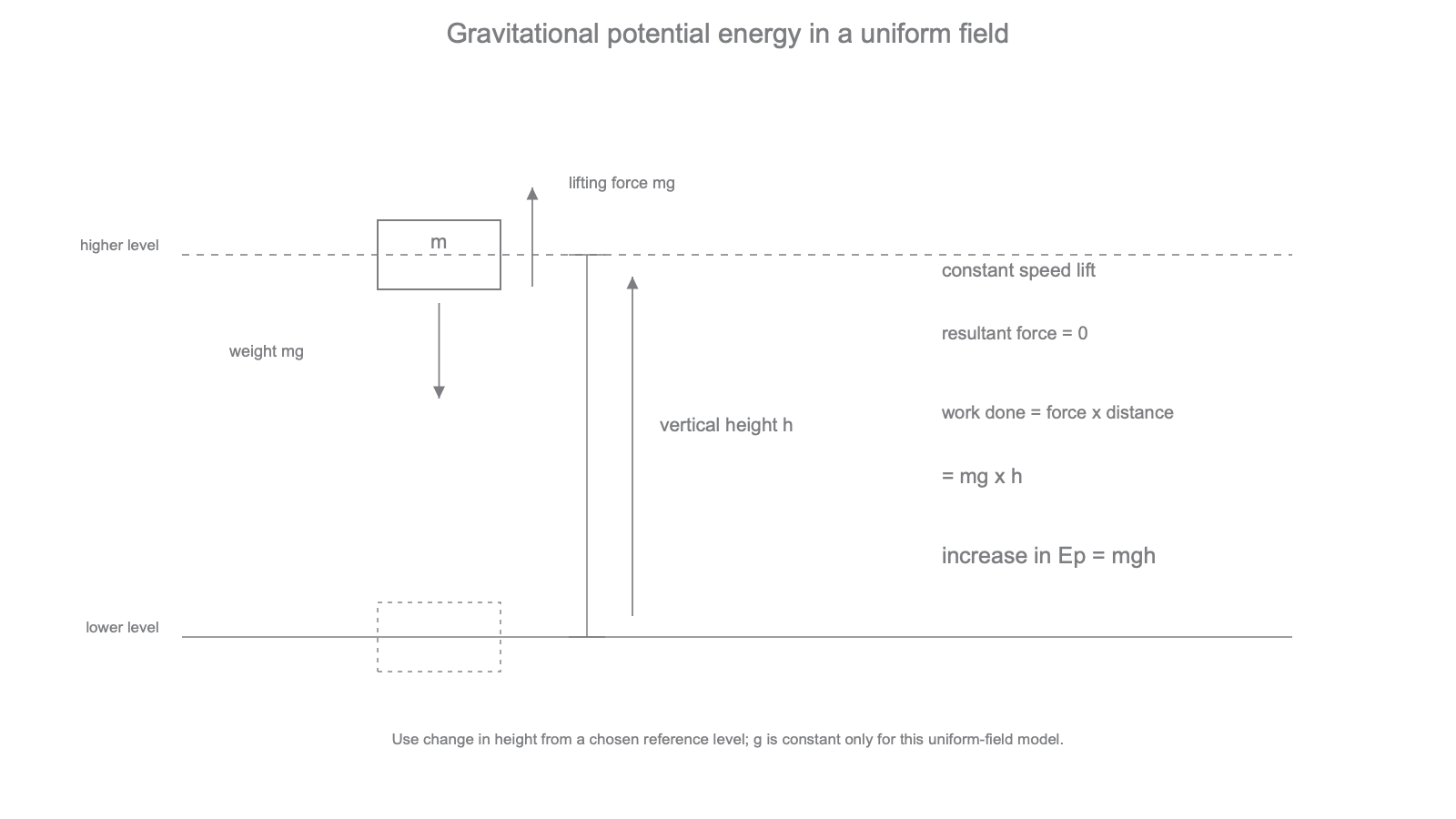
To derive , imagine lifting the object at constant speed. The upward lifting force has the same magnitude as the weight, , because the resultant force is zero. The work done against gravity is:
That work increases the gravitational potential energy of the object-Earth system. The zero level for gravitational potential energy is chosen for convenience, so questions normally use a change in height. A box raised from a table to a shelf and a box raised from the floor by the same vertical height gain the same amount of gravitational potential energy, if and are the same.
Worked example: a crate is raised through a vertical height of . Using ,
to two significant figures.
Do not use this model for large changes in distance from a planet, where the gravitational field is not uniform. That belongs to a later gravitational-fields model.
Continue this lesson.
You’re previewing NovaLearn without an account. Create a free account to read the rest.
Create free account