3.3.3 - Power and efficiency
Power tells you how quickly work is done or energy is transferred. Efficiency tells you what fraction of the input energy becomes useful output energy. In this lesson you will connect those ideas to moving systems, derive from first principles, and judge mechanical systems using clear percentage reasoning.
Power as a rate of doing work
Two machines can do the same amount of work but not be equally powerful. The one that does the work in the shorter time has the greater power.
Power
Power is the rate of doing work or the rate of energy transfer.
Average power over an interval is:
Power From Work Done
Here is power in watts, is work done or energy transferred in joules, and is time in seconds.
The unit of power is the watt, symbol .
Be careful with notation. In an equation, can mean work done. After a numerical value, is the unit watt. Context tells you which one is being used.
Worked example: a small motor transfers of energy in . Calculate its average power.
Convert the energy first:
Then use the definition of power:
So the motor's average power is:
, or .
The result is sensible because transferring thousands of joules every few seconds should give a kilowatt-scale power, not a few watts.
Power is not the same as total energy. A powerful machine transfers energy quickly; it does not automatically transfer more total energy unless it operates for long enough.
Power answers the question: how many joules are transferred each second?
Deriving power from force and velocity
The relationship connects power to force and speed. OCR expects you to derive it from first principles, so do not treat it as a detached formula.
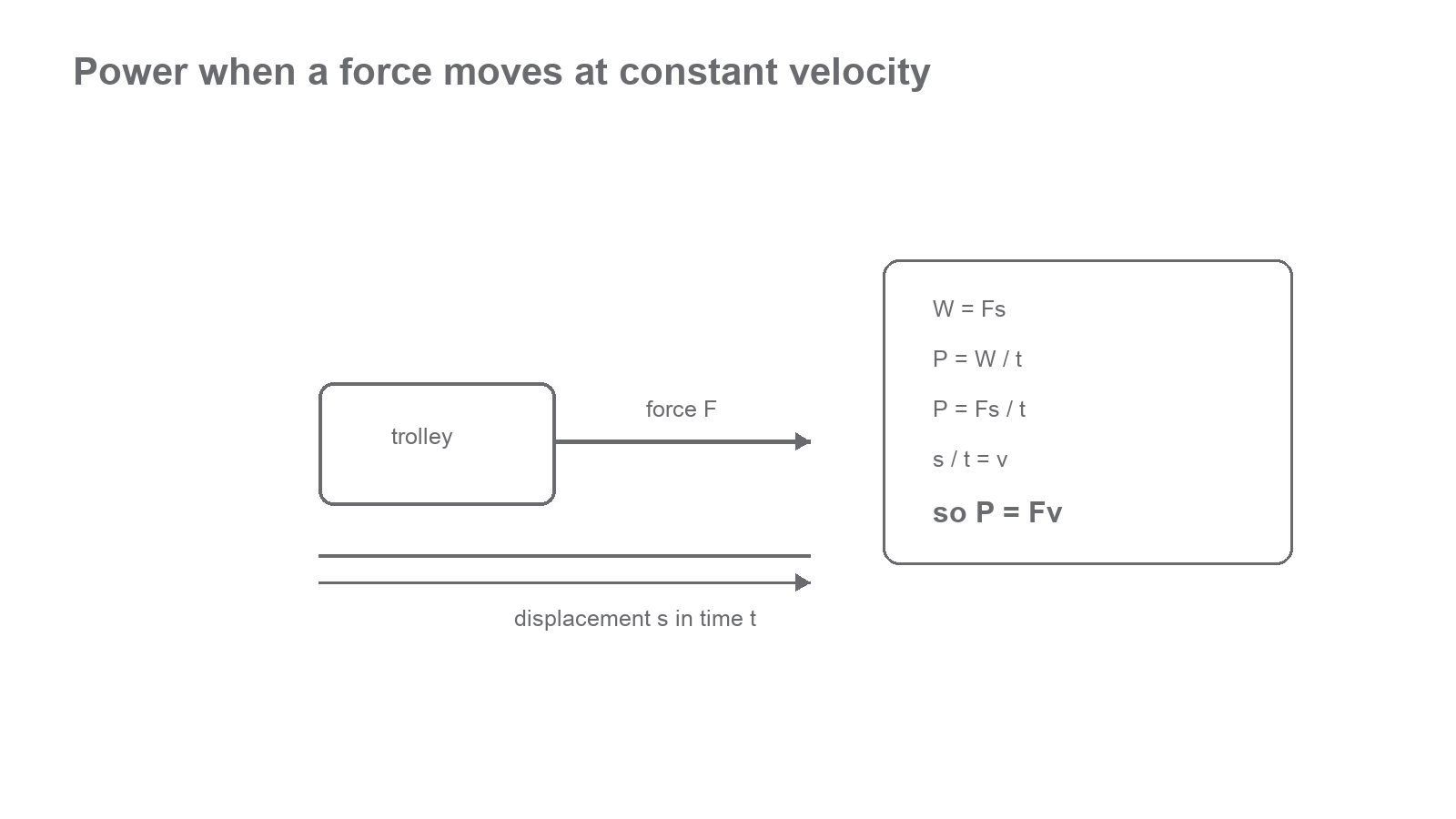
Start with work done by a constant force acting in the direction of motion:
where is force and is displacement in the direction of the force.
Substitute this into the power definition:
For straight motion in one direction, the average speed over this interval is:
For instantaneous power, use a small displacement and take the limit as : .
Power From Force And Speed
This form applies when is the force, or component of force, in the direction of motion. If a vehicle moves at constant speed, the driving force at the wheels can still be doing work against resistive forces even though the resultant force is zero.
[DIAGRAM: asset_name: 3.3.3 - Power and efficiency - diagram 1; asset_slug: 3_03_3_power_and_efficiency__diagram_01; recommended_method: drawn_physics; caption: Force acting along the motion links work, speed and power.; description: A trolley moves in the direction of an applied force, linking work, displacement, time and power.]
Worked example: a cyclist moves at a steady speed of . The useful forward driving force at the wheel is . Calculate the useful mechanical power output.
Use:
Substitute:
The useful output power is .
Notice what the equation is saying physically. At a higher speed, the same force moves through a larger distance each second, so it does more work each second.
The common trap is to say "constant speed means no power is needed". Constant speed means zero resultant force. It does not mean zero driving force or zero energy transfer when resistive forces are present.
Power At Speed
For many moving systems, the useful mechanical power is found from the force needed to maintain the motion and the speed of the object:
At constant speed on a level road or track, the driving force is equal in magnitude to the total resistive force. This is because the resultant force is zero, not because the resistive forces have disappeared.
Worked example: a vehicle moves at constant speed. At this speed the total resistive force is , and the vehicle travels at . Calculate the useful power needed to maintain this speed.
At constant speed:
Use:
So the useful power is about:
, or .
A frequent OCR-style extension is to give a model for the resistive force. For example, if the resistive force is described by:
then using gives:
That means the power needed rises very quickly with speed.
Worked example: the resistive force on a small racing car is modelled by , where is in newtons and is in . The maximum useful mechanical power is . Estimate the maximum speed.
At maximum steady speed:
Convert the power:
Now solve:
To two significant figures, the maximum speed is .
Continue this lesson.
You’re previewing NovaLearn without an account. Create a free account to read the rest.
Create free account