6.2.2 - Coulomb's law and point-charge fields
Charges do not need to touch to exert forces on each other. In this lesson you will learn how Coulomb's law gives the force between two point charges, how that leads to the electric field strength around a point charge, and why the pattern is an inverse-square field. You will also compare point-charge electric fields with point-mass gravitational fields, because OCR often assesses the similarities and the differences side by side.
Coulomb's Law For Point Charges
A point charge is a charged object treated as if all its charge is concentrated at one point. This is a model. It is useful for tiny charged spheres, charged particles, or larger charged spheres viewed from far enough away that their size is small compared with the separation involved.
Coulomb's law
Coulomb's law gives the magnitude of the electrostatic force between two point charges. The force is proportional to the product of the charges and inversely proportional to the square of their separation.
Coulomb's law
In OCR questions, and are the charges in C, is the separation between the charges in m, and is the permittivity of free space. The data booklet gives:
For most A-level calculations, use the magnitudes of and to calculate the size of the force, then decide the direction separately:
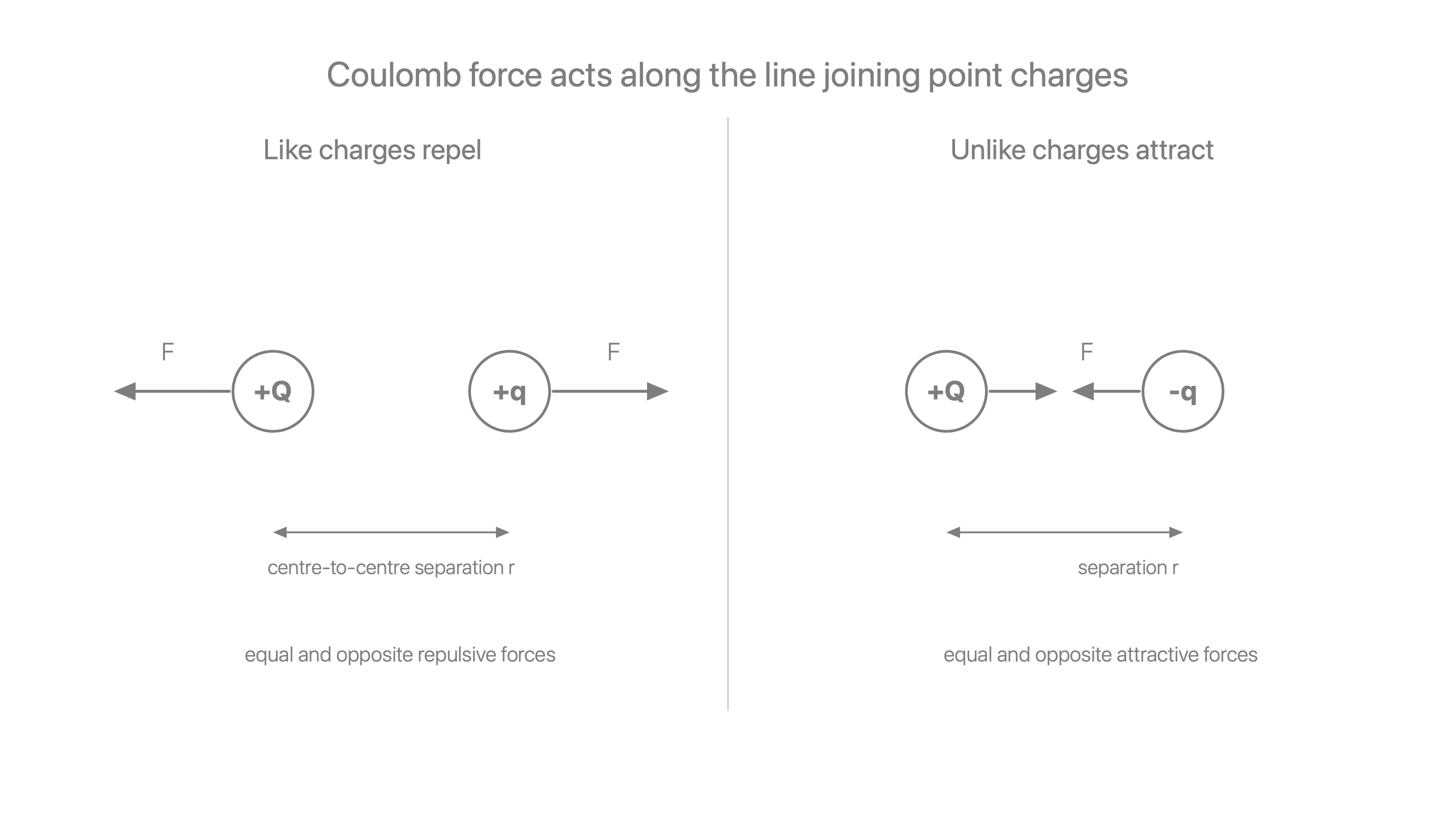
- like charges repel
- unlike charges attract
Air is normally treated as close enough to a vacuum for this equation unless a question gives a different permittivity.
[DIAGRAM: asset_name: 6.2.2 - Coulomb's law and point-charge fields - diagram 1; asset_slug: 6_02_2_coulombs_law_and_point_charge_fields__diagram_01; recommended_method: drawn_physics; caption: Like charges repel and unlike charges attract with equal and opposite forces.; description: Clean 16:9 force diagram comparing two point-charge pairs. Left panel: +Q and +q separated by distance r with equal and opposite repulsive force arrows pointing away from each charge and small gaps before the charge circles. Right panel: +Q and -q separated by distance r with equal and opposite attractive force arrows pointing toward the other charge, again stopping before the charge circles. Label "like charges repel", "unlike charges attract", and "centre-to-centre separation r". Use white background and #6A6B6E only.]
Worked example: force between two point charges
A charge is from a charge . Calculate the magnitude of the force between them and state whether the force is attractive or repulsive.
First convert the charges:
Then substitute into Coulomb's law:
The charges have opposite signs, so the force is attractive. Each charge experiences a force of the same magnitude, along the line joining the charges, towards the other charge.
For two conducting spheres that are close together, their charges can redistribute and cease to be spherically symmetric. Treat them as point charges when their radii are small compared with their centre-to-centre separation; the force is then along the joining line. Newton's third law makes the two interaction forces equal and opposite even if .
Inverse-square Behaviour
Coulomb's law contains in the denominator. That means the force does not just halve when the separation doubles; it becomes four times smaller.
For the same two charges:
So:
- if is doubled, becomes as large
- if is tripled, becomes as large
- if is halved, becomes times as large
This is why the phrase inverse-square field matters. A fixed bundle of radial field lines spreads over a spherical area proportional to , consistent with the decreasing field strength; the force on a fixed test charge follows the same dependence.
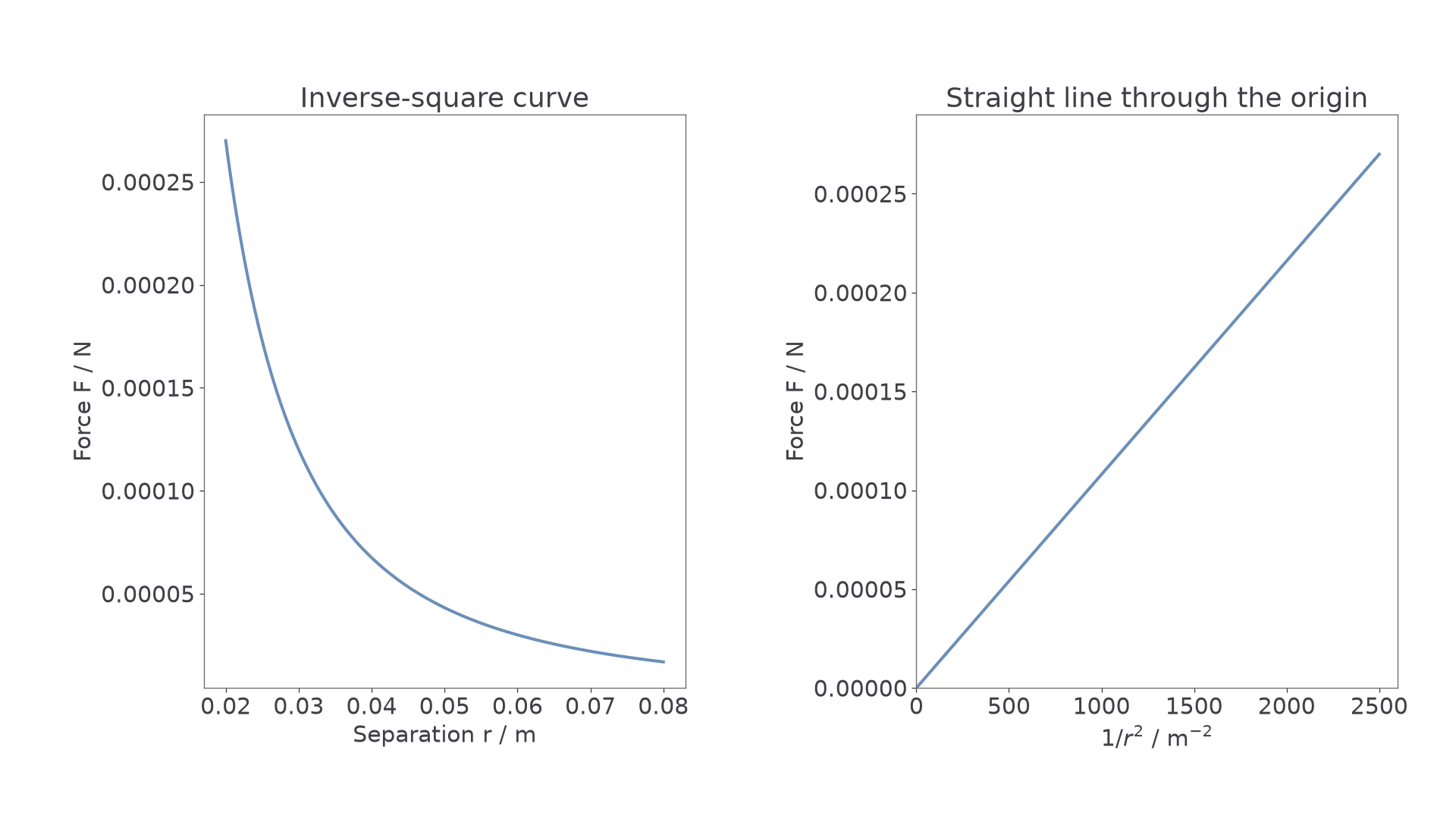
OCR can assess this as calculation, proportional reasoning, or data handling. A graph of against is a curve. A graph of against should be a straight line through the origin if the point-charge model is valid. For two fixed charges, the gradient would be:
You do not need a new equation for that graph. It is just Coulomb's law rearranged as a straight-line relationship.
Worked example: using proportionality
Two fixed point charges exert a force of on each other at a separation of . The separation is increased to .
The separation has been multiplied by:
Because , the force is divided by :
[DIAGRAM: asset_name: 6.2.2 - Coulomb's law and point-charge fields - diagram 2; asset_slug: 6_02_2_coulombs_law_and_point_charge_fields__diagram_02; recommended_method: drawn_physics; caption: Inverse-square force gives a curve against separation and a straight line against reciprocal squared separation.; description: Calculated inverse-square force data: curved F against r and straight F against reciprocal squared separation with SI axes.]
Continue this lesson.
You’re previewing NovaLearn without an account. Create a free account to read the rest.
Create free account