6.2.1 - Electric fields and field strength
Electric fields let us talk about how a charge can exert a force without touching another charge. In this lesson you will learn what an electric field is, how field lines map its direction and relative strength, why a uniformly charged sphere can be modelled as a point charge at its centre, and how to use electric field strength, , in calculations. The core habit is to keep the source charge, the field at a position, the test charge and the force on that test charge separate.
Charges Create Fields
Charge is the source quantity for an electric field. The field model assigns an electric field strength and direction to positions around the source charge. Another charge placed nearby can experience an electrostatic force, even though the two charges are not touching.
Electric Field
An electric field is a region in which a charge would experience an electrostatic force.
The charge or charged object used as the source is the source charge. Physicists often use the shorthand that it "creates" or "produces" the field; this does not mean that the source emits field material. A test charge is a charge we imagine placing at a point to find the force it would experience there. When mapping the source field, we choose a sufficiently small test charge so that it does not noticeably disturb that field.
This distinction matters. The source charge determines the field model, which assigns field strength and direction at each position. The test charge experiences the force. If you double the test charge, the force on it doubles, but the field at that point has not doubled just because you used a larger test charge.
For direction, physicists use a positive test charge as the reference. If a positive test charge would be pushed to the right at a point, the electric field at that point is to the right. A negative charge placed at the same point would feel a force in the opposite direction.
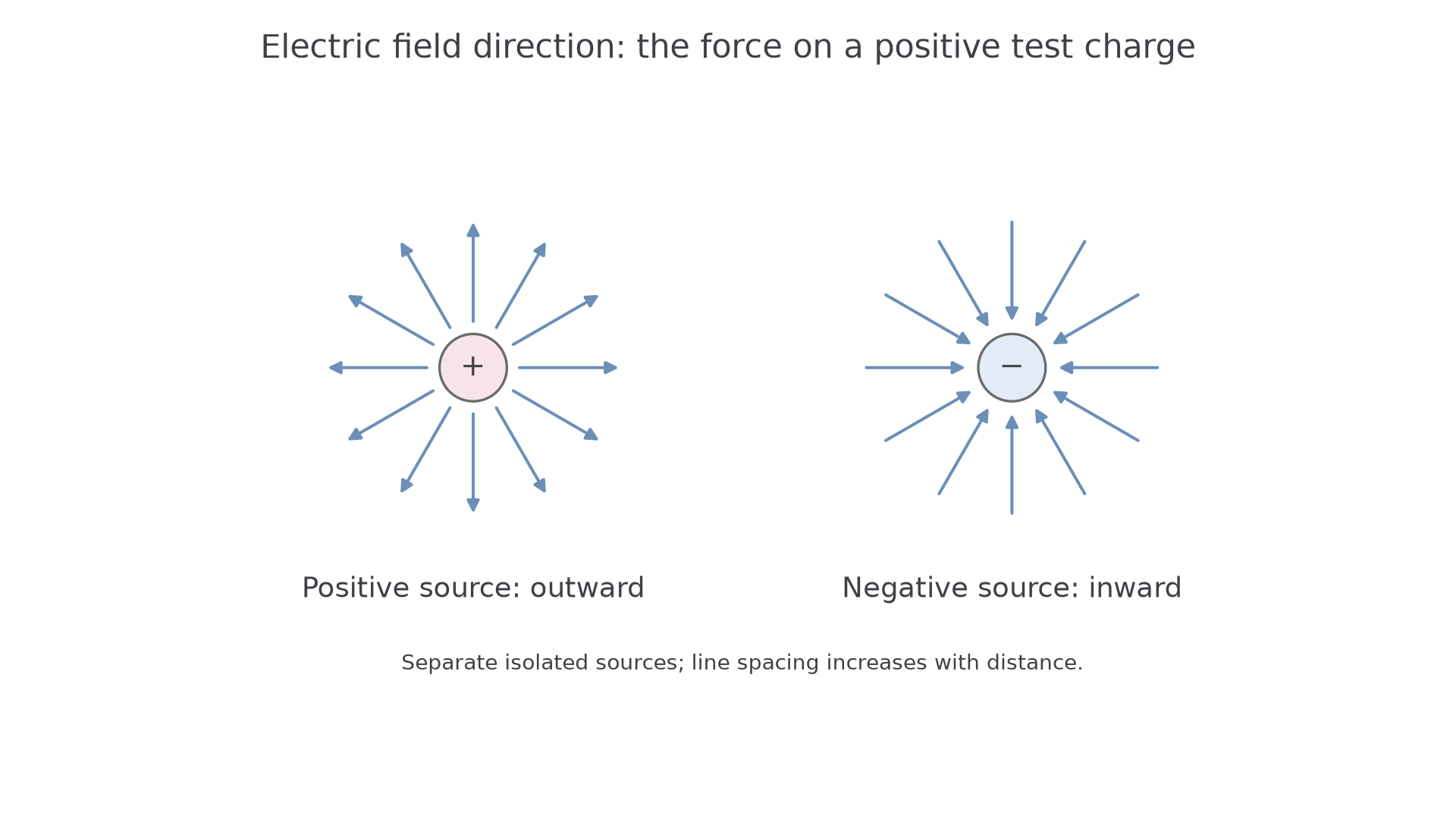
[DIAGRAM: asset_name: 6.2.1 - Electric fields and field strength - diagram 1; asset_slug: 6_02_1_electric_fields_and_field_strength__diagram_01; recommended_method: drawn_physics; caption: Electric field lines point away from a positive charge and towards a negative charge.; description: Separate isolated positive and negative sources: electric field arrows point outward and inward respectively.]
Field-Line Maps
Electric field lines are a way of mapping an electric field. They are not threads in space or material emitted by a charge. They are a diagram convention that helps you see direction and relative strength at a glance.
At any point on a field line, the tangent to the line gives the direction of the electric field at that point. The arrow on the line points in the direction a positive test charge would be forced. Around a positive point charge, field lines point radially outwards. Around a negative point charge, field lines point radially inwards.
The spacing of field lines shows relative field strength. Where field lines are closer together, the field is stronger. Where they are more spread out, the field is weaker. This is why a radial field map usually has lines that spread further apart as you move away from the charge.
There are a few useful rules to keep the map physically meaningful:
- field lines point away from positive charge and towards negative charge
- closer spacing means a stronger field
- field lines do not cross, because the field cannot have two different directions at one point
- where field lines meet the surface of a charged sphere, they are perpendicular to the surface in the simple spherical model used here
A common trap is to say "the field line is the path of the particle". That is too strong. A charge initially at rest may start moving along the field direction, but a charge with an initial velocity can curve through the field, and the path depends on the changing force as it moves.
Spherical Charge Model
Real charged objects often have size and shape, but a model can strip away detail that is not needed for a particular prediction. In this lesson, the important model is a uniformly charged sphere.
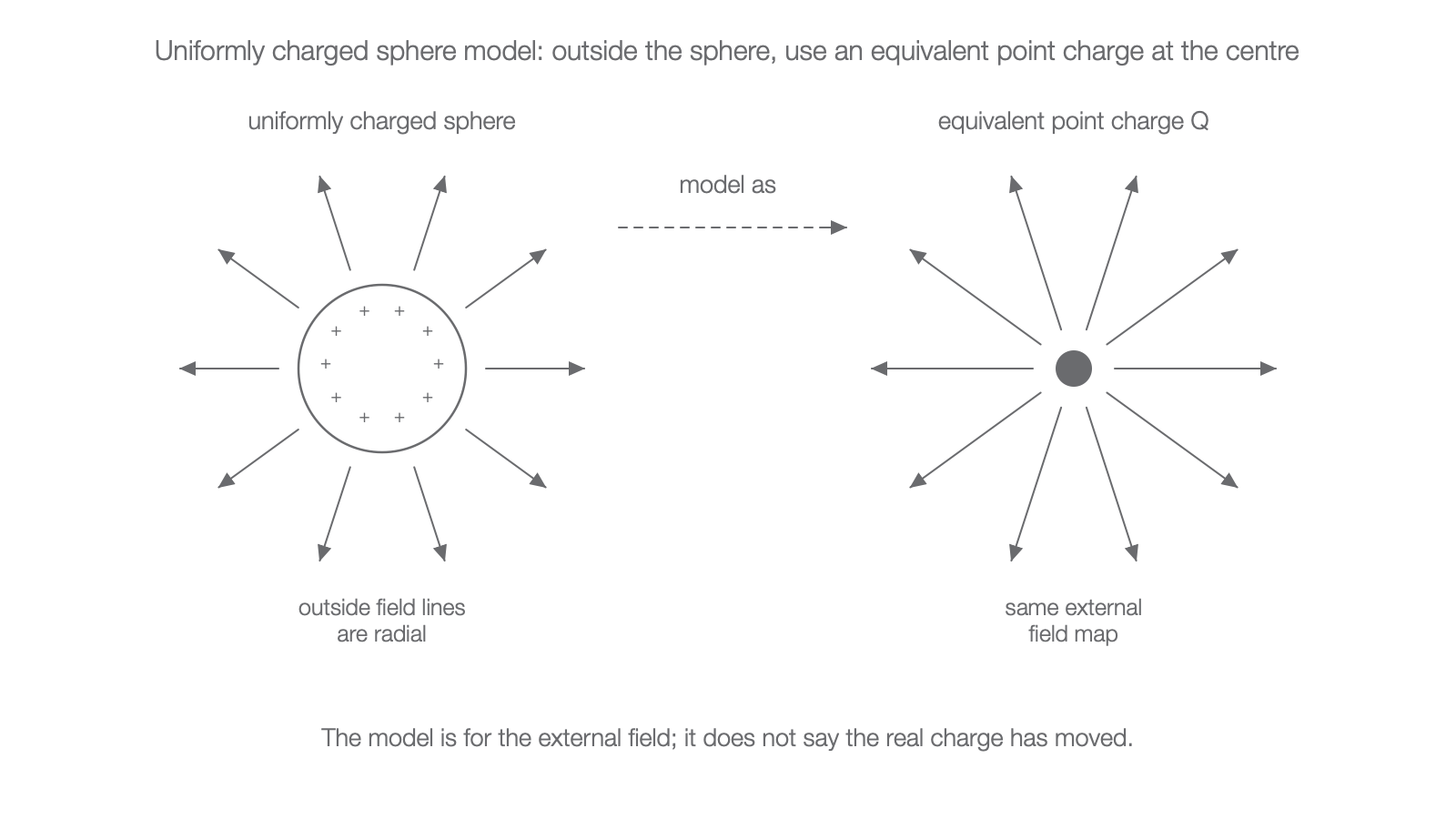
For points outside a uniformly charged sphere, the electric field can be modelled as if the whole charge were concentrated at a point at the centre of the sphere. The field is then drawn radially outwards from a positive central point charge or radially inwards towards a negative one.
[DIAGRAM: asset_name: 6.2.1 - Electric fields and field strength - diagram 2; asset_slug: 6_02_1_electric_fields_and_field_strength__diagram_02; recommended_method: drawn_physics; caption: A uniformly charged sphere and an equivalent central point charge have the same external field.; description: Clean 16:9 model diagram comparing a uniformly charged sphere with an equivalent point charge at its centre. Left panel: circle labelled uniformly charged sphere, outside radial field lines perpendicular to surface. Right panel: small point at centre labelled equivalent point charge Q; matching outside radial field lines. Add note "outside the sphere, same field model". Use only #6A6B6E on white with thin lines, true arrowheads and readable sans-serif labels.]
Continue this lesson.
You’re previewing NovaLearn without an account. Create a free account to read the rest.
Create free account