6.4.1 - The nuclear atom, radius and density
The nuclear atom is a model built from evidence, not a picture someone simply guessed. In this lesson you will use alpha-particle scattering to explain why the atom has a tiny charged nucleus, then connect nuclear notation, the strong nuclear force, nuclear radius and density into one coherent model. The main calculation idea is that nuclear radius grows with the cube root of nucleon number, so nuclear density is roughly constant from one nucleus to another.
Scattering evidence for the nucleus
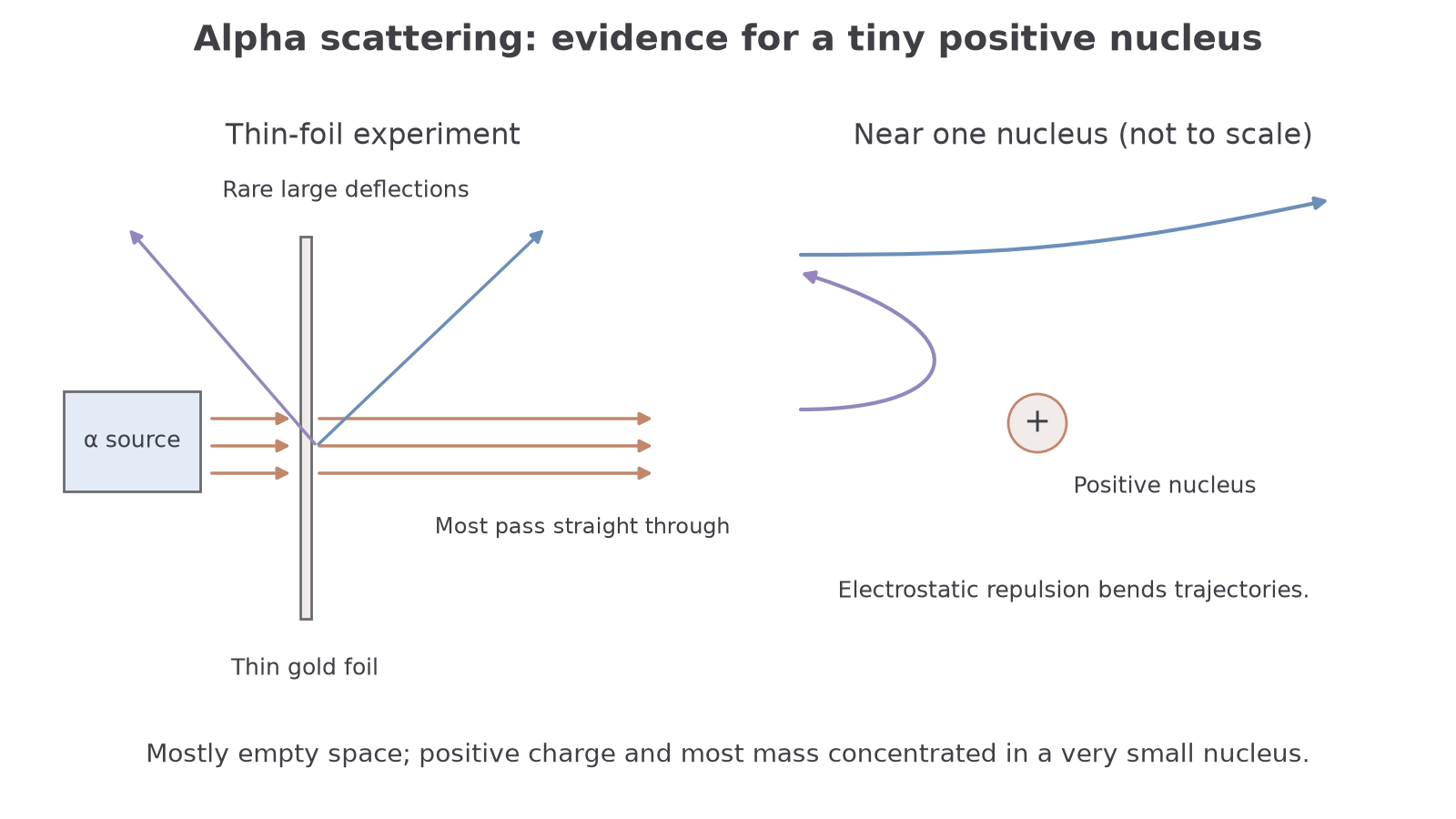
Before Rutherford's scattering experiment, a plausible model was that positive charge and mass were spread through the atom, with electrons embedded in that spread-out structure. The alpha-particle scattering experiment tested this model by firing a narrow beam of fast, positively charged alpha particles at very thin gold foil and detecting the angles through which they were scattered.
The observations have three important consequences.
Most alpha particles passed straight through the foil. That means the atom is mostly empty space on the scale of the alpha particle path. If the atom were full of spread-out positive matter, many alpha particles would be slowed or deflected slightly by that material.
A small fraction of alpha particles were deflected through large angles, and a very small number were scattered backwards. Because alpha particles are positively charged, this requires a strong electrostatic repulsion from a concentrated positive charge. The fact that large deflections are rare tells us that this positive charge occupies a very small fraction of the atom's volume.
The alpha particles are much more massive than electrons, so electrons cannot explain the rare large deflections. The evidence points to a small, positive, dense nucleus containing most of the atom's mass, with electrons outside it.
Rutherford scattering is evidence for a nuclear atom: most of the atom is empty space, and nearly all the positive charge and mass are concentrated in a tiny central nucleus.
OCR questions often give scattering data rather than asking for the story from memory. For example, a table might show many counts at small scattering angles and very few counts at large scattering angles. The physics link is the same: high count at small angle means most particles are undeflected; low but non-zero count at large angle means rare close encounters with a small positive nucleus.
[DIAGRAM: asset_name: 6.4.1 - The nuclear atom, radius and density - diagram 1; asset_slug: 6_04_1_nuclear_atom_radius_and_density__diagram_01; recommended_method: drawn_physics; description: Separate thin-foil and nuclear-scale views show most straight paths and rare repulsive large deflections.; caption: Most alpha particles pass straight through thin foil. Rare large deflections reveal a concentrated positive nucleus.]
Nuclear model and notation
The simple nuclear model separates the atom into a central nucleus and the surrounding electrons.
Nuclear model of the atom
An atom has a small central nucleus containing protons and usually neutrons; the hydrogen-1 nucleus is a single proton with no neutron. Electrons occupy the region outside the nucleus.
Protons have positive charge, neutrons have no charge, and electrons have negative charge. In a neutral atom, the number of electrons is equal to the number of protons. This lesson is about the structure and scale of the atom; decay equations and particle transformations belong to later nuclear physics lessons.
Two numbers describe a nucleus.
Proton number
The proton number, , is the number of protons in the nucleus.
Nucleon number
The nucleon number, , is the total number of protons and neutrons in the nucleus.
The neutron number is therefore:
Nuclear notation writes a nucleus as:
Nuclear notation
Here is the chemical symbol, is the proton number, and is the nucleon number. The proton number identifies the element. If , the element is carbon, whatever the neutron number is.
Isotopes
Isotopes are nuclei of the same element with the same proton number but different numbers of neutrons.
For example, and are isotopes of carbon. Both have 6 protons. Carbon-12 has 6 neutrons, while carbon-14 has 8 neutrons. The isotope changes the nucleon number, not the element.
Worked example:
For :
- proton number , so the nucleus contains 27 protons
- nucleon number , so the nucleus contains 59 protons plus neutrons
- neutron number
- a neutral cobalt atom has 27 electrons
Size scale and strong force
The nucleus is tiny compared with the atom. A typical atomic radius is about . A typical nuclear radius is about to .
Compare these sizes using powers of ten. If an atom has radius and its nucleus has radius , then:
So the atom's radius is about times larger than the nuclear radius. The volume comparison is even more dramatic because volume depends on radius cubed.
The scale unit used for nuclei is the femtometre:
The nucleus should fly apart if only electrostatic forces acted, because protons repel other protons. The fact that nuclei exist shows that there is another force between nucleons.
Strong nuclear force
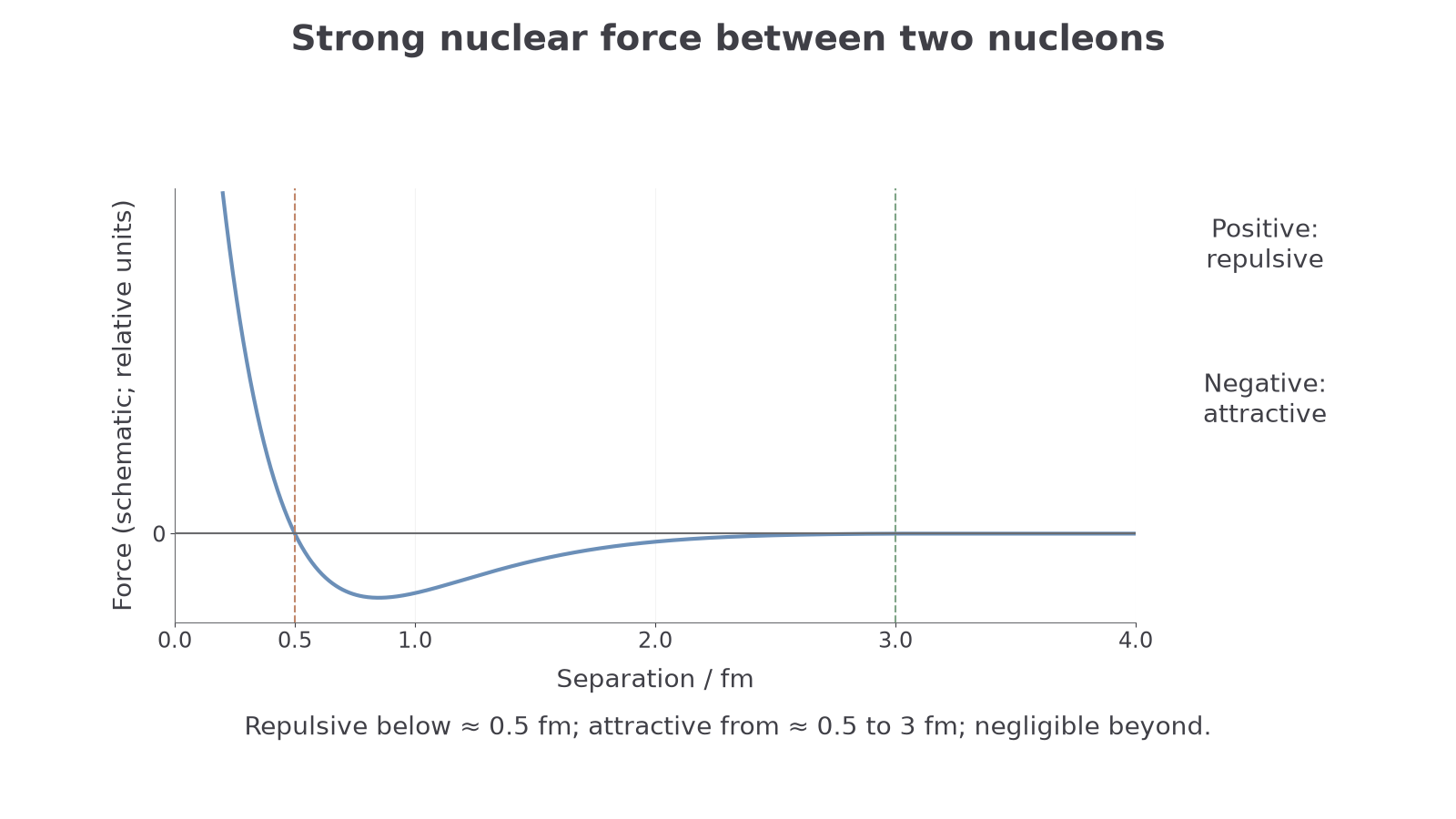
The strong nuclear force is a short-range force between nucleons. It is attractive up to about and becomes repulsive below about .
[DIAGRAM: asset_name: 6.4.1 - The nuclear atom, radius and density - diagram 2; asset_slug: 6_04_1_nuclear_atom_radius_and_density__diagram_02; recommended_method: drawn_physics; description: Schematic signed strong force: repulsive below 0.5 fm, attractive to 3 fm, zero beyond; axes and sign explanation explicit.; caption: The strong nuclear force is repulsive below about 0.5 fm, attractive from about 0.5 to 3 fm and negligible beyond.]
Continue this lesson.
You’re previewing NovaLearn without an account. Create a free account to read the rest.
Create free account