4.5.3 - Wave-particle duality and electron diffraction
Electrons are usually introduced as particles: they have charge, mass and can be accelerated through a potential difference. This lesson adds the other half of the quantum picture. Electron diffraction shows that particles can also behave like waves, and the de Broglie equation lets you calculate the wavelength associated with a moving electron.
What Diffraction Proves
Diffraction is a wave effect. A wave spreads when it passes through a gap or past regularly spaced obstacles, and strong diffraction is expected when the wavelength is comparable with the spacing involved.
For electrons, this is surprising at first. An electron has particle-like properties: it has charge , rest mass , momentum, and can arrive at a screen as a localised impact. Electron diffraction is evidence that this same electron beam also has wave-like behaviour.
Wave Particle Duality
Wave particle duality is the idea that quantum objects, such as electrons and photons, show particle-like behaviour in some experiments and wave-like behaviour in others.
The careful wording is important. Electron diffraction does not mean an electron has stopped being an electron, and it does not mean a tiny charged ball is literally bending like a water wave. It means that a particle model alone cannot explain the pattern; a wave model is needed for the propagation through the diffracting material.
The Electron Diffraction Tube
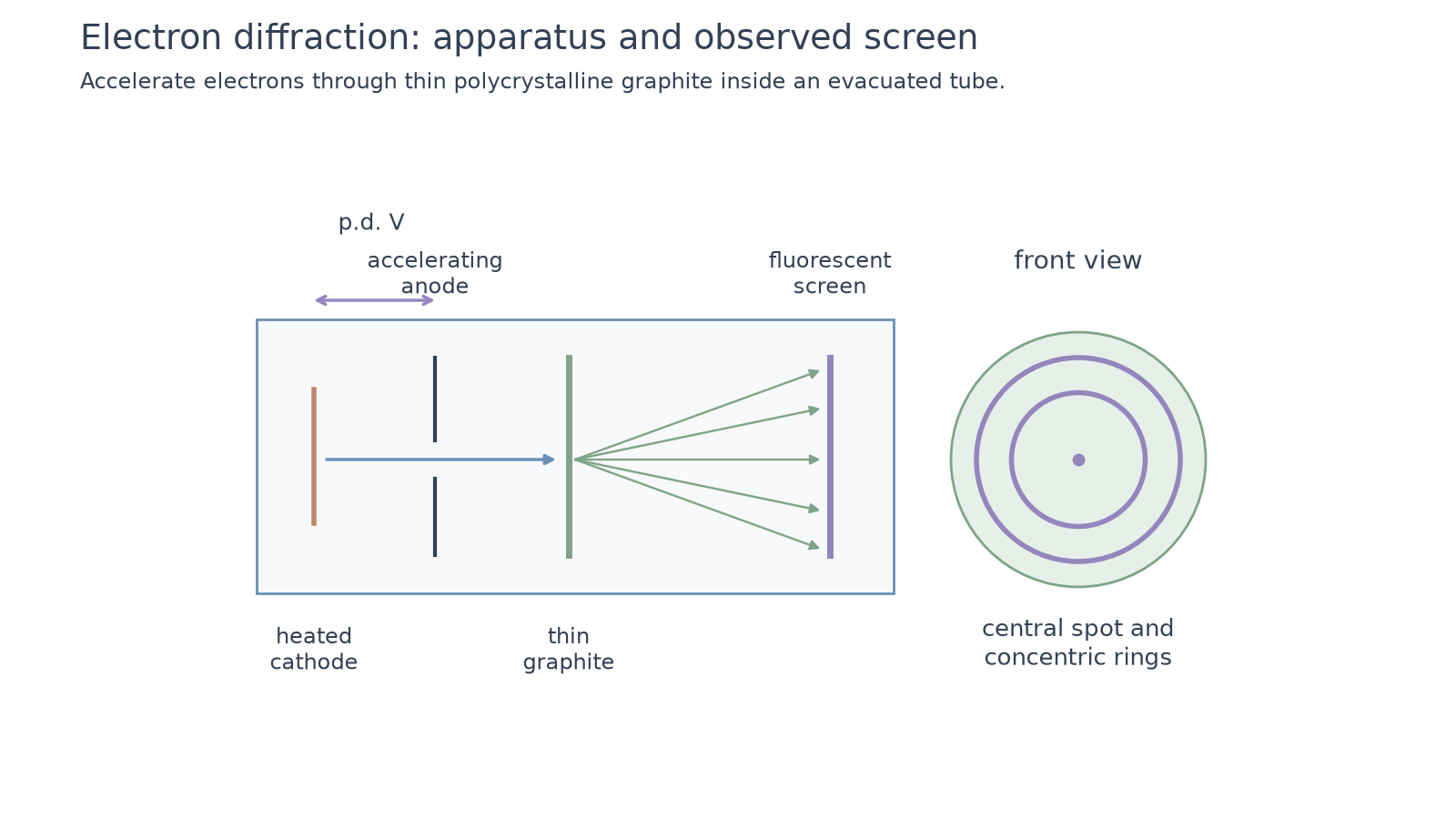
A standard electron diffraction experiment uses an evacuated tube. A heated cathode releases electrons, and an accelerating potential difference gives them kinetic energy. The electrons pass through a thin slice of polycrystalline graphite, then strike a fluorescent screen. Where electrons hit the screen, visible light is produced.
The screen pattern is not just a broad smudge. It has a central bright spot and bright rings separated by darker regions. The central spot is from electrons that travel straight through or are only slightly scattered. The rings are the wave evidence: waves scattered by the regularly spaced atoms in graphite reinforce in some directions and cancel in others.
If electrons behaved only as classical particles, you would expect a concentrated beam or a distribution caused by scattering. Alternating bright and dark rings need wave superposition: constructive interference gives bright rings, and destructive interference gives darker regions.
The apparatus also gives a useful practical warning. The electron beam is produced using high potential differences inside an evacuated tube, so school demonstrations are normally teacher-controlled and enclosed. The assessable physics is the apparatus sequence and the evidence from the pattern, not a detailed safety procedure.
[DIAGRAM: asset_slug: 4_05_3_wave_particle_duality_and_electron_diffraction__diagram_01; caption: Accelerated electrons pass through thin graphite to a fluorescent screen. The front view shows a central spot and concentric diffraction rings.; description: Electrons move from a heated cathode through an accelerating anode and thin graphite to a fluorescent screen. A separate front view shows a central spot and concentric diffraction rings.]
Why Graphite Gives Rings
Graphite is useful because its carbon atoms are arranged in a regular crystal structure. A thin slice of polycrystalline graphite contains many tiny crystals with different orientations. The electron wave is scattered by atoms and regularly spaced atomic planes in those crystals.
Only certain directions give strong reinforcement. In those directions, the scattered electron waves arrive in phase at the screen and produce bright regions. Directions where the waves arrive out of phase give much lower intensity. Because the tiny crystals are in many orientations, all equivalent diffraction directions combine to form rings rather than just a few spots.
The spacing matters. Diffraction is most noticeable when the wavelength associated with the electrons is comparable with the spacing between atoms or atomic planes in the graphite. In OCR-style estimates, it is enough to argue that the relevant spacing is of the same order of magnitude as the electron de Broglie wavelength. Exact graphite crystallography and Bragg-angle calculations are not required here.
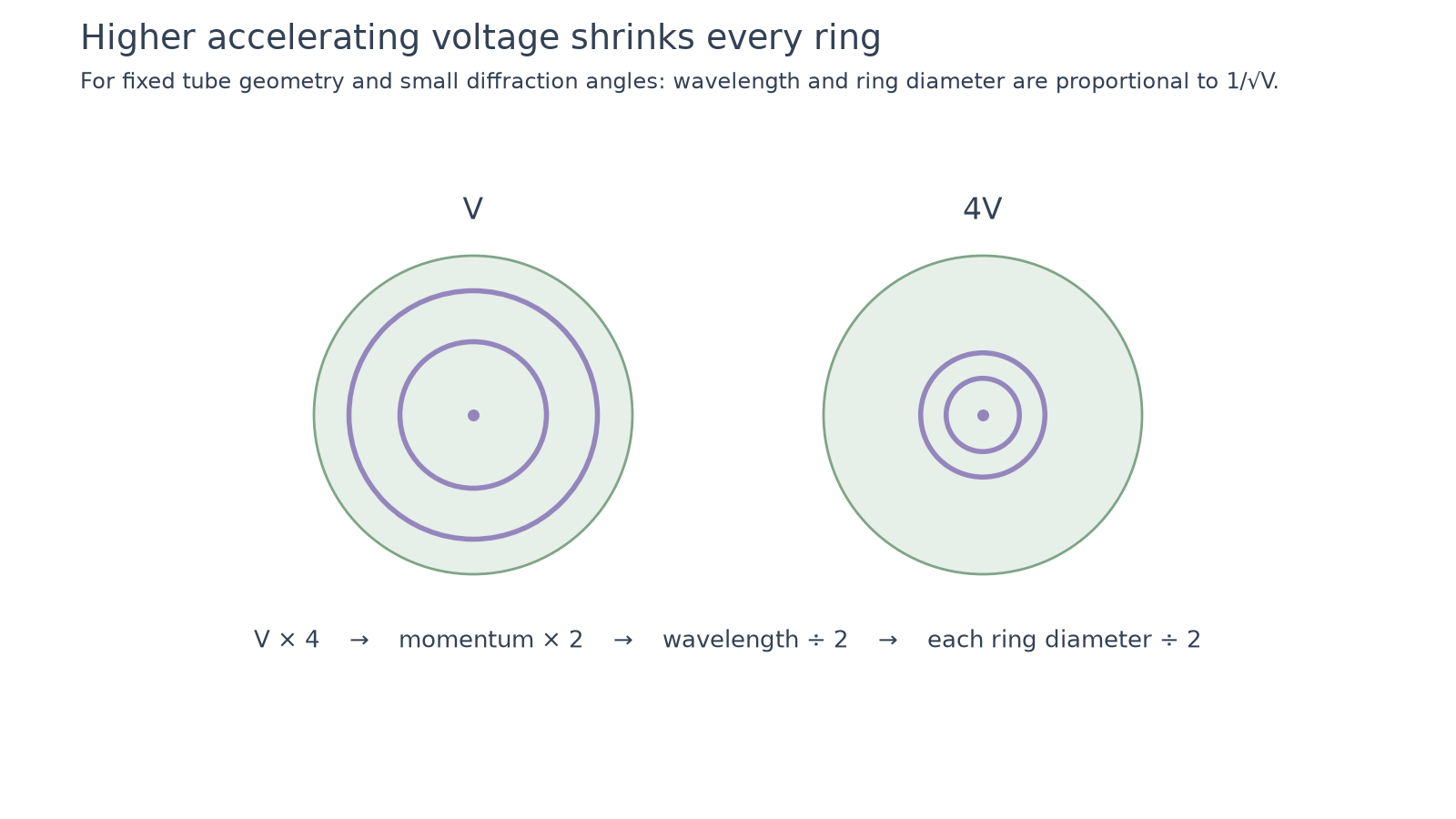
Changing the accelerating potential difference changes the pattern. A larger accelerating p.d. gives each electron more kinetic energy and therefore more momentum. You will soon see that larger momentum means a smaller de Broglie wavelength, so the diffraction angle and the ring diameters decrease.
[DIAGRAM: asset_slug: 4_05_3_wave_particle_duality_and_electron_diffraction__diagram_02; caption: Quadrupling accelerating potential doubles electron momentum and halves wavelength. Ring diameters also halve in the same small-angle geometry.; description: Identical screen outlines show that raising accelerating potential from V to 4V halves both ring diameters under the same small-angle geometry; momentum doubles and de Broglie wavelength halves.]
Continue this lesson.
You’re previewing NovaLearn without an account. Create a free account to read the rest.
Create free account