6.1.2 - Energy stored in capacitors
A capacitor stores energy when charge has been separated onto its plates. In this lesson you will connect that stored energy to the area under a p.d.-charge graph, then use the three OCR capacitor-energy equations confidently. You will also see why capacitors are useful when energy must be stored briefly and released quickly.
Charging Requires Work
A capacitor does not store energy just because charge exists somewhere. It stores energy because positive and negative charge have been separated, creating a potential difference between the plates. The separated charge has electrical potential energy, which can later be transferred to a lamp, flash tube, resistor, or another circuit component.
Energy stored in a capacitor
The energy stored in a charged capacitor is the electrical potential energy associated with the separated charges and the electric field between the plates.
As a capacitor is charged from zero, the p.d. across it is not constant. At the start there is little charge separated, so the p.d. is small. As more charge is placed on the plates, the p.d. increases, so each later small amount of charge requires more work to add.
For a small added charge moved through a p.d. , the work done is approximately:
This is the key reason the graph matters. The p.d. tells you the energy transferred per coulomb at that stage of charging. If the p.d. is changing as charge is added, the total work done is found by adding many small contributions.
A common mistake is to write for the stored energy. That would treat all the charge as if it were moved through the final p.d. . During charging from zero, the average p.d. is lower than the final p.d.
Area Under A p.d.-charge Graph
For a capacitor of constant capacitance, charge is proportional to p.d. :
Rearranging gives:
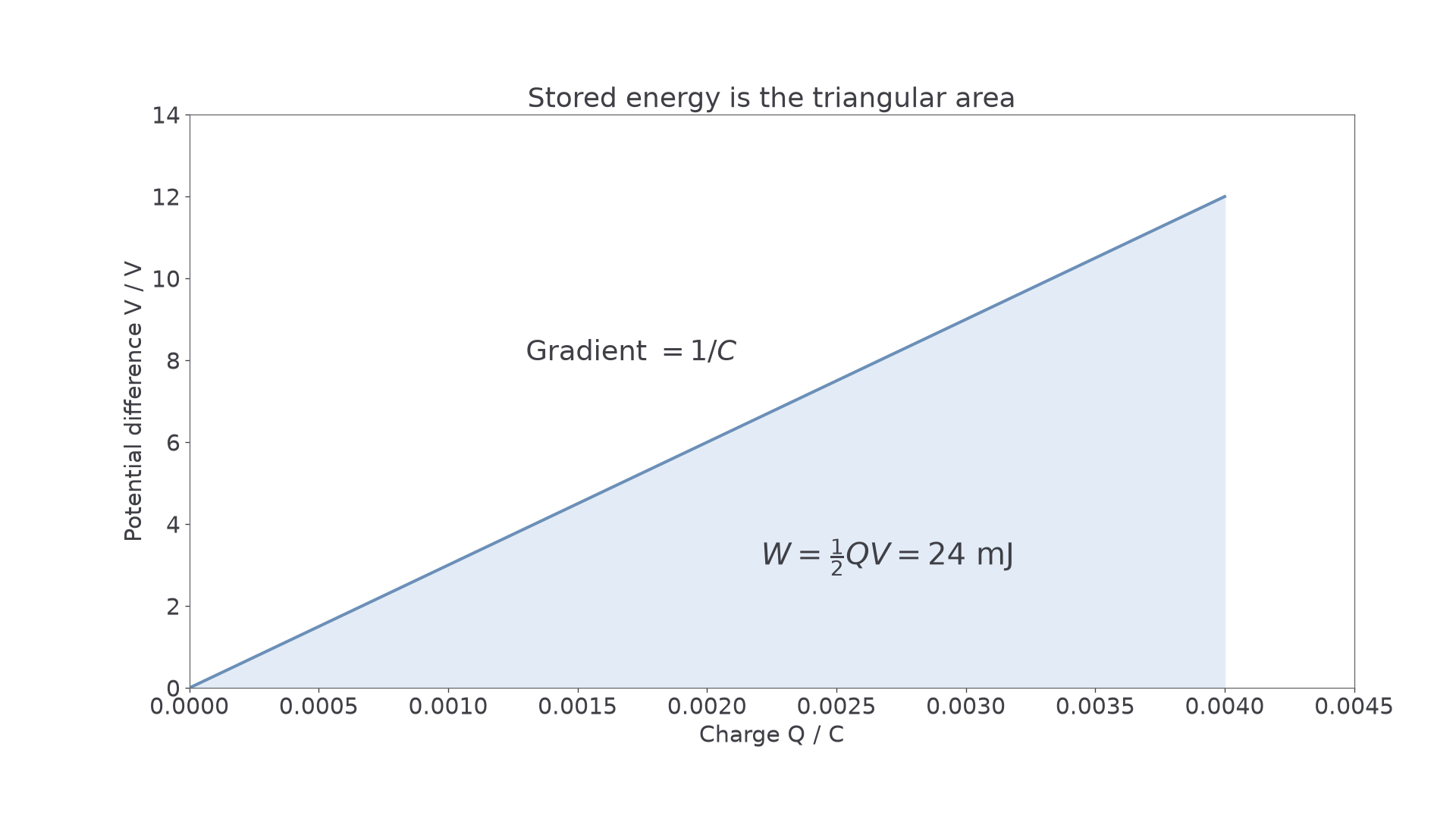
So a graph of p.d. on the vertical axis against charge on the horizontal axis is a straight line through the origin. Its gradient is . The important OCR idea is that the energy stored is the area under this -against- graph.
[DIAGRAM: asset_name: 6.1.2 - Energy stored in capacitors - diagram 1; asset_slug: 6_01_2_energy_stored_in_capacitors__diagram_01; recommended_method: drawn_physics; caption: The triangular area under a potential-difference–charge graph gives the stored energy.; description: V against Q in SI units: the triangular area for 4.0 mC and 12 V is 24 mJ; gradient is reciprocal capacitance.]
The area under a graph has units:
That unit check tells you the area is an energy.
Because the graph is a triangle:
The base is , and the height is , so:
Energy from graph area
Here is the energy stored in J, is the charge on one plate in C, and is the p.d. across the capacitor in V. The factor is not a rounding trick; it comes from the triangular area, or equivalently from the average p.d. being during charging from zero.
Worked example: graph area
A capacitor is charged until the charge on one plate is and the p.d. across it is . Determine the energy stored.
First convert the charge:
Use the triangular area:
To two significant figures, the capacitor stores .
Choosing Energy Equations
OCR lists three equivalent equations for energy stored in a capacitor. They are all the same physics written with different known quantities.
Capacitor energy equations
Here is the capacitance in F. Use when and are known directly. Use when capacitance and p.d. are known. Use when charge and capacitance are known.
You can derive the last two from the graph-area equation and .
Substitute into :
Substitute into :
The unit check is also useful:
Worked example: using capacitance and p.d.
A capacitor is charged to a p.d. of . Calculate the energy stored.
Convert capacitance into farads:
Use the equation containing and :
Continue this lesson.
You’re previewing NovaLearn without an account. Create a free account to read the rest.
Create free account