4.4.4 - Stationary waves and harmonics
Stationary waves explain why strings, microwave cavities and air columns can vibrate strongly only at certain frequencies. In this lesson you will learn how a stationary wave forms, how to identify nodes and antinodes, and how harmonic patterns fit inside strings and tubes. You will also use a resonance-tube method to determine the speed of sound in air.
Forming stationary waves
A stationary wave is not a progressive wave that has somehow stopped moving. It is a pattern produced when two progressive waves of the same frequency and equal amplitude travel in opposite directions through the same region and superpose.
The most common way to make this happen is reflection. A wave travels along a string, microwave path or air column, reflects from a boundary, then overlaps with the incoming wave. At the right frequencies the overlap is stable: some positions keep cancelling and some positions keep reinforcing.
Stationary wave
A stationary wave is a wave pattern formed by the superposition of two progressive waves of the same frequency and equal amplitude travelling in opposite directions, producing fixed nodes and antinodes.
OCR expects you to recognise the same idea in three physical settings:
- In a stretched string, a vibrator or oscillator sends transverse waves along the string and the waves reflect from fixed ends.
- With microwaves, a source sends waves towards a metal reflector; a detector moved between source and reflector finds positions of large and small signal.
- In an air column, sound waves reflect at the ends of the tube; at resonant frequencies a strong stationary sound wave is formed.
The word "stationary" describes the pattern, not the particles in the medium. Except at nodes, particles still oscillate. What stays fixed is the position of the nodes, antinodes and overall pattern.
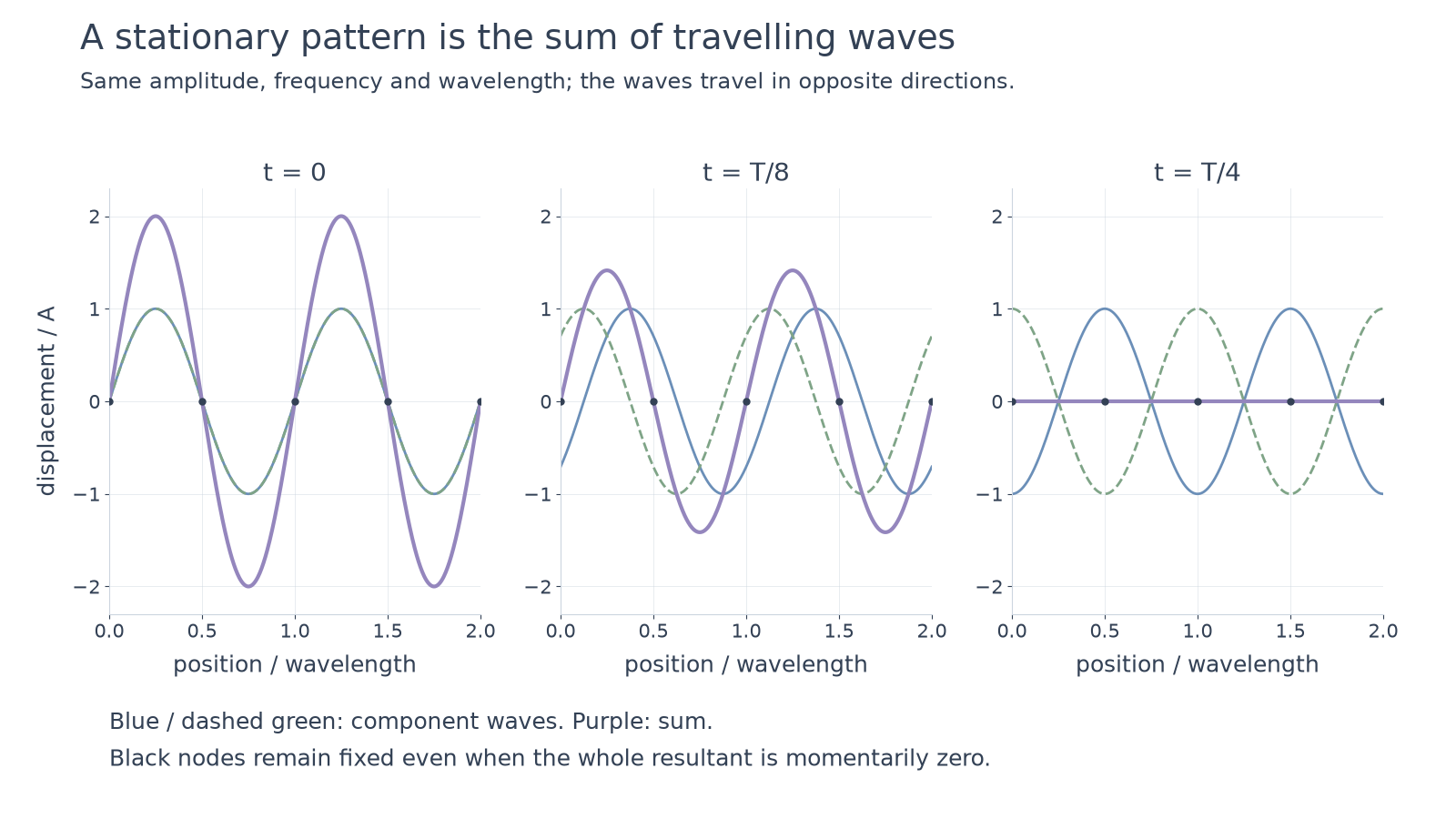
The component waves must also have the same wavelength in the same medium. A sequence of snapshots makes the distinction clear: two travelling profiles move in opposite directions, while their sum changes height without shifting its nodes. At some instants the entire resultant is at zero displacement. That does not make every position a node: a node stays at zero at every instant.
Worked reasoning: forming a pattern on a string
A string is fixed at both ends and driven by a mechanical oscillator near one end. The oscillator sends waves along the string. The wave reflects from the far fixed end and travels back. At a resonant frequency, incident and reflected waves of equal frequency and equal amplitude travel in opposite directions and superpose. Fixed points of no displacement and fixed points of maximum displacement appear: the stationary wave pattern.
[DIAGRAM: asset_slug: 4_04_4_stationary_waves_and_harmonics__diagram_01; caption: Counterpropagating waves produce fixed nodes. An instant of zero displacement everywhere does not make every point a permanent node.; description: Three matched snapshots show counter-propagating sine waves and their sum. Nodes at half-wavelength intervals remain fixed; the quarter-period zero profile does not make every point a permanent node.]
Nodes, antinodes and spacing
The two named positions in a stationary wave are nodes and antinodes. They are defined using displacement.
Node
A node is a point on a stationary wave where the displacement is always zero.
At a node the two travelling waves always cancel. A point at a node does not oscillate, even though energy is passing in the two travelling waves that formed the pattern.
Antinode
An antinode is a point on a stationary wave where the amplitude of oscillation is maximum.
At an antinode the two travelling waves reinforce to give the largest possible oscillation of the medium. In a graphical representation, the stationary wave is often drawn as an outline shape showing the largest positive and negative displacement reached at each position.
The key geometry is:
Node and antinode spacing
Here is the wavelength of either progressive wave that formed the stationary wave. It is not the distance from one end of the pattern to the other unless that whole length happens to contain one full wavelength.
The distance from a node to the next antinode is half as large:
Worked example: using node spacing
In a microwave stationary-wave experiment, adjacent detector minima are separated by . The minima are electric-field nodes. Determine the wavelength of the microwaves.
Adjacent nodes are separated by , so:
If the frequency were supplied, you could then use , the wave equation from the OCR data booklet, to determine the wave speed.
Stationary and progressive waves
Stationary and progressive waves use the same basic wave quantities, such as frequency, wavelength and amplitude, but they behave differently.
A progressive wave transfers energy from one place to another. Its crests, troughs, compressions or rarefactions move through the medium. If you take a displacement-distance graph at later times, the shape has moved along.
A stationary wave has a fixed pattern. There is no net transfer of energy along the stationary pattern from one end to the other. The amplitude depends on position: it is zero at nodes and maximum at antinodes.
| Feature | Progressive wave | Stationary wave |
|---|---|---|
| Formation | A travelling disturbance | Superposition of two equal-amplitude, same-frequency waves travelling in opposite directions |
| Energy transfer | Transfers energy through the medium | No net energy transfer along the pattern |
| Amplitude | Same amplitude along an ideal wave | Varies from zero at nodes to maximum at antinodes |
| Phase relationship | Points one wavelength apart are in phase | Points between adjacent nodes oscillate in phase; points in neighbouring loops on opposite sides of one node are in antiphase |
| Pattern | Moves through the medium | Nodes and antinodes stay at fixed positions |
The phase idea is useful but easy to overcomplicate. In one loop between two adjacent nodes, every point reaches maximum displacement in the same direction at the same time, although different points have different amplitudes. Cross a node into the next loop and the motion is in antiphase: when one loop is displaced upward, the next is displaced downward.
This is why a stationary-wave drawing often shows loops above and below the centre line. The drawing is not a path followed by one particle; it is a maximum-displacement envelope for many particles at different positions.
Strings, tubes and harmonics
Only certain stationary-wave patterns fit a given string or air column. The allowed patterns are set by the boundary conditions: what the ends of the medium are forced to do.
Continue this lesson.
You’re previewing NovaLearn without an account. Create a free account to read the rest.
Create free account