4.4.2(a)-(c) - Electromagnetic spectrum and polarisation
Electromagnetic waves include radio waves, microwaves, infrared, visible light, ultraviolet, X-rays and gamma rays. In this lesson you will learn what all electromagnetic waves have in common, how to place the main regions of the spectrum on a wavelength scale, and how polarisation shows that electromagnetic waves are transverse. The aim is not to memorise every boundary perfectly, but to become fluent with the order and the powers of ten.
Electromagnetic Wave Model
An electromagnetic wave is a progressive wave made from oscillating electric and magnetic fields. Unlike a wave on a string or a sound wave in air, it does not need a material medium: it can travel through a vacuum.
Electromagnetic Wave
An electromagnetic wave is a transverse wave consisting of oscillating electric and magnetic fields that are perpendicular to each other and perpendicular to the direction of travel.
For OCR, the most important common properties are:
- electromagnetic waves are transverse;
- they can travel through a vacuum;
- in a vacuum they all travel at the same speed, ;
- they can transfer energy from one place to another;
- they are described by wavelength , frequency and speed , as for other progressive waves.
The wave equation from the previous wave lesson still applies:
Wave equation for electromagnetic waves
Here is the speed of electromagnetic waves in a vacuum, is frequency in hertz, and is wavelength in metres. This equation means that, in a vacuum, a shorter wavelength goes with a higher frequency.
Do not confuse the wavelength with the direction of oscillation. The wavelength is a distance along the direction of travel; the electric and magnetic field oscillations are sideways to the direction of travel.
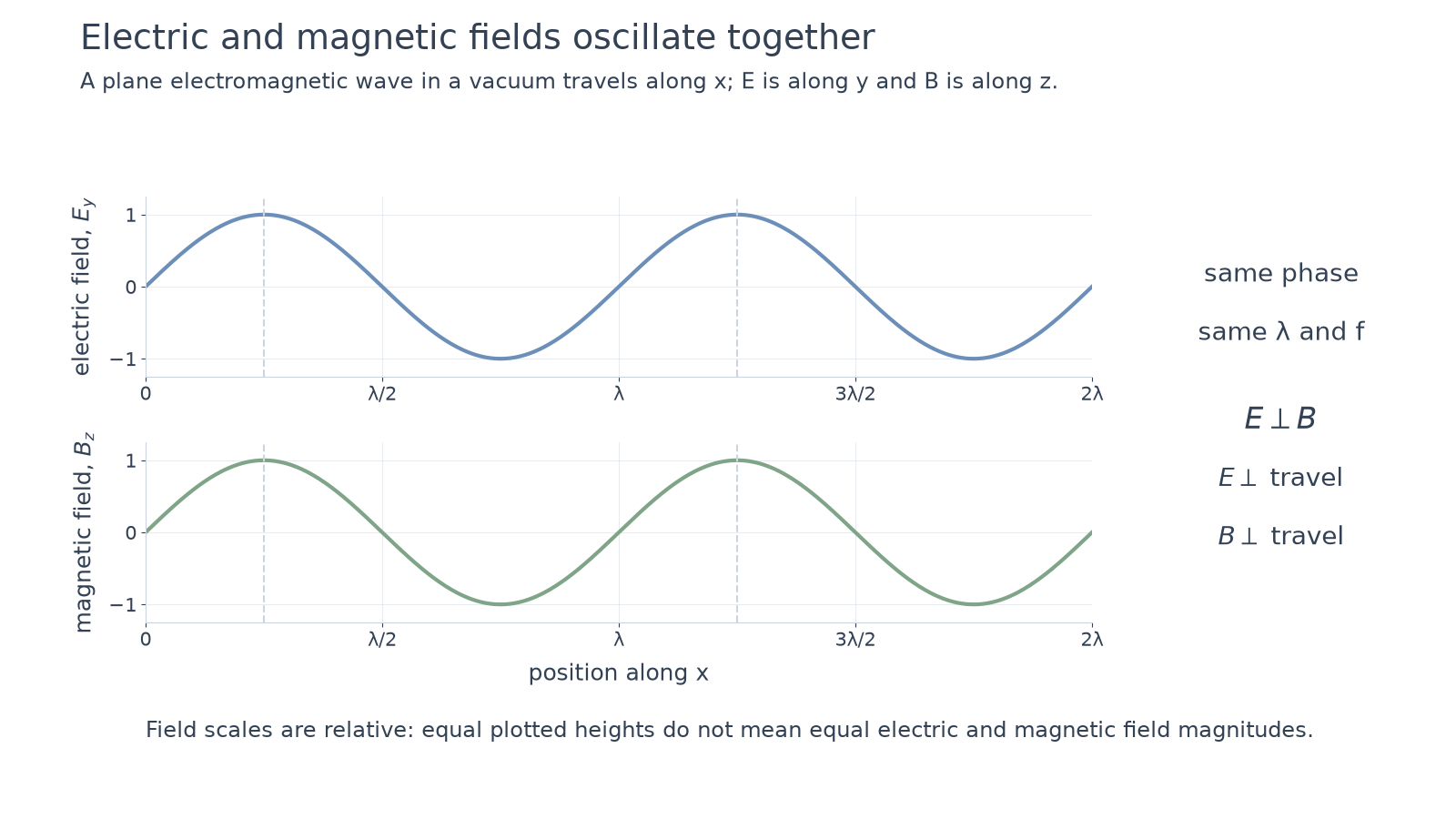
For a plane electromagnetic wave in a vacuum, the electric and magnetic fields oscillate in phase and have the same frequency and wavelength. Both are perpendicular to the direction of propagation and to each other. The sinusoidal curves represent field values at positions along the beam; they are not paths followed by particles of a medium.
[DIAGRAM: asset_slug: 4_04_2a_electromagnetic_spectrum_and_polarisation__diagram_01; caption: Electric and magnetic fields have the same phase and wavelength, with mutually perpendicular field and propagation directions.; description: Aligned field graphs have identical phase and wavelength. Electric field, magnetic field and propagation form mutually perpendicular directions; their relative plotted scales are not physical equal units.]
Spectrum Order and Wavelengths
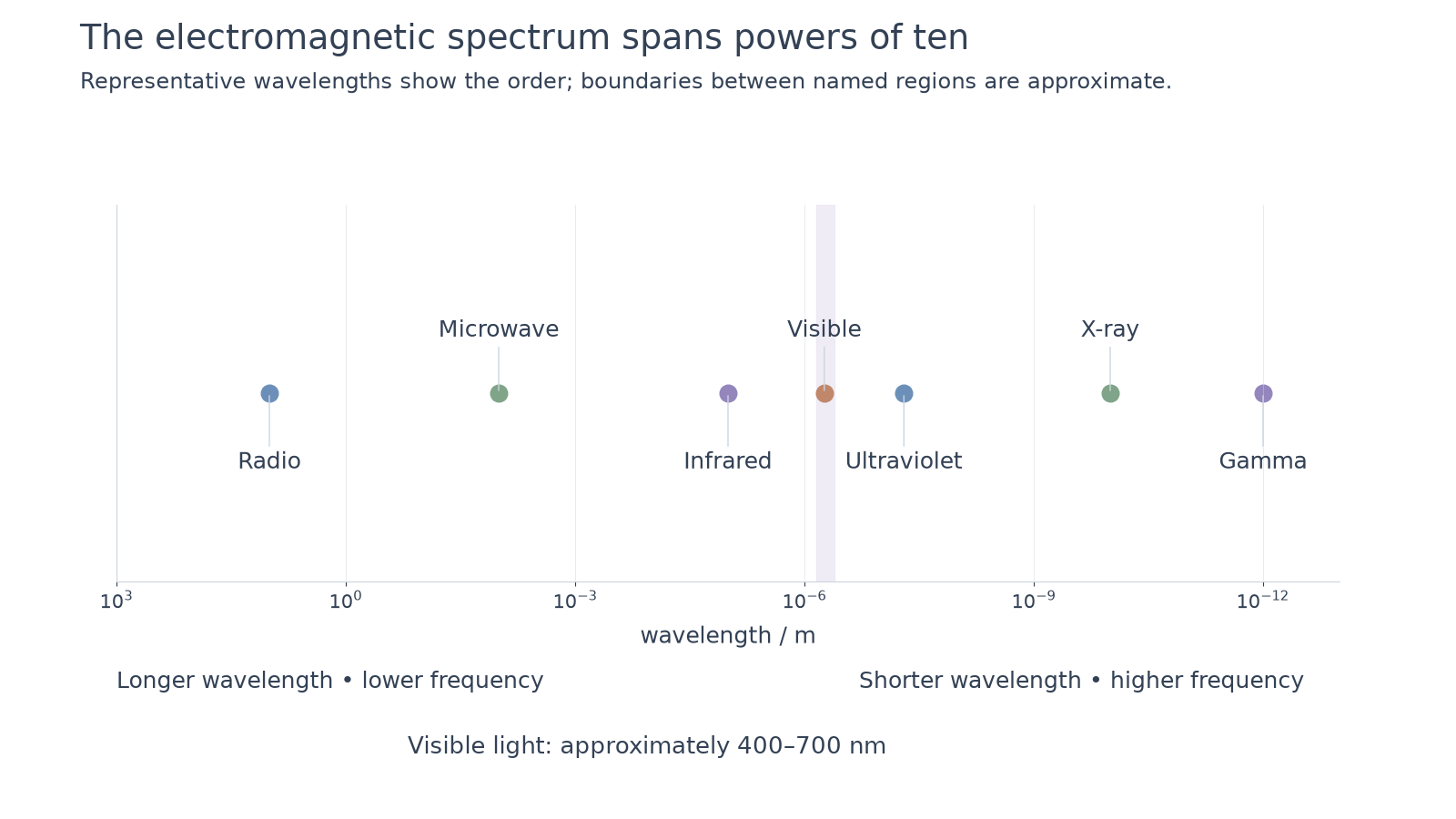
The electromagnetic spectrum is one continuous family. The names are labels for broad regions, not separate types of substance.
From longest wavelength to shortest wavelength, the principal regions are:
- radio waves
- microwaves
- infrared
- visible light
- ultraviolet
- X-rays
- gamma rays
Approximate wavelength orders are enough for this lesson:
| Region | Representative wavelength scale |
|---|---|
| radio | and longer, often metres to kilometres |
| microwave | about to |
| infrared | about to |
| visible light | about to |
| ultraviolet | about to |
| X-rays | about to |
| gamma rays | about or shorter |
The exact edges vary a little between sources and applications. OCR's phrase "orders of magnitude" is the clue: you should know the scale and sequence, not a long list of sharp borders.
Worked example: identifying regions from wavelength
A radiation has wavelength .
This is between and , so it is visible light.
A radiation has wavelength .
This is , or , so it is in the microwave region.
[DIAGRAM: asset_slug: 4_04_2a_electromagnetic_spectrum_and_polarisation__diagram_02; caption: Representative wavelengths decrease from radio waves to gamma rays on a logarithmic scale. Visible light spans about 400–700 nm.; description: A descending logarithmic wavelength axis places representative radio, microwave, infrared, visible, ultraviolet, X-ray and gamma wavelengths. Visible light occupies about 400–700 nm; named boundaries are approximate.]
Using Orders of Magnitude
An order of magnitude is a factor of about 10. If two wavelengths differ by a factor of , they differ by six orders of magnitude.
This skill is useful because the electromagnetic spectrum covers a huge range. A radio wavelength might be metres long, while a gamma-ray wavelength may be on atomic or nuclear length scales. A normal linear scale would be almost useless, so physicists often think in powers of ten.
Worked example: comparing visible light and gamma rays
Take a typical visible wavelength as:
Take a typical gamma-ray wavelength as:
The ratio is:
This is close to , so the visible-light wavelength is about six orders of magnitude larger than the gamma-ray wavelength.
Worked example: linking wavelength and frequency
In a vacuum, a wave with wavelength has frequency:
Continue this lesson.
You’re previewing NovaLearn without an account. Create a free account to read the rest.
Create free account