5.4.1 - Gravitational fields and field strength
Gravity is not just a force that appears when two objects touch. In this lesson you will learn how physicists describe the space around a mass using a gravitational field, how field lines map that field, and how gravitational field strength tells you the force per unit mass. The key equation is short, , but the important skill is knowing what the symbols mean physically.
Fields From Mass
Mass is the source quantity for a gravitational field. The field model assigns a gravitational field strength and direction to each position around the source mass. If another mass is placed in that region, it experiences a gravitational force.
Gravitational Field
A gravitational field is a region of space in which a mass experiences a gravitational force.
The word field matters. It lets us talk about a force before choosing a particular object to put there. For example, Earth's mass is the source quantity, and the field model describes positions around Earth. A mass, a mass and a satellite experience different forces there, but the field strength and direction at a given position do not depend on which test mass is used.
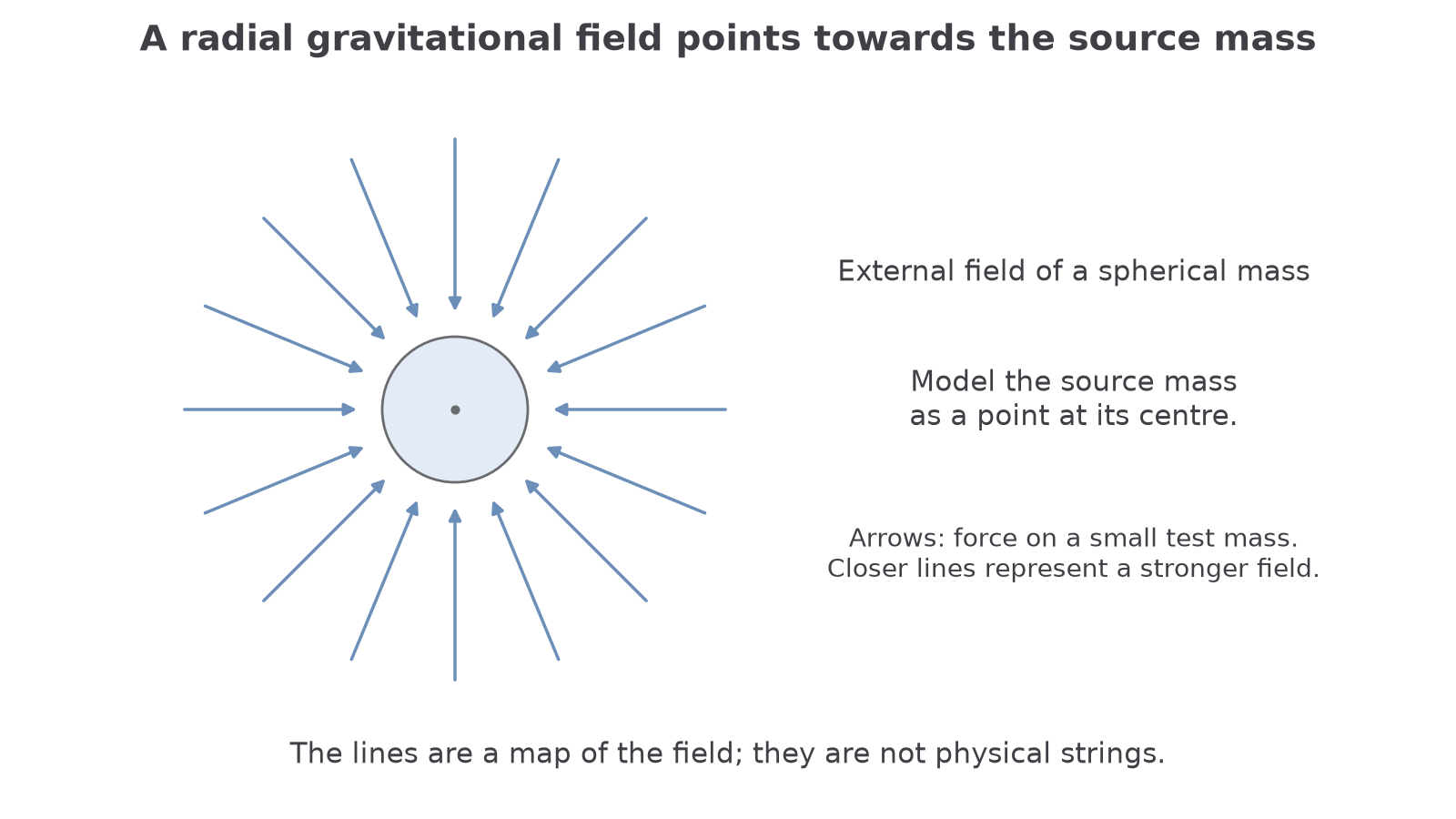
The direction of a gravitational field is the direction of the force on a small test mass placed at that point. For a single isolated spherical mass, that direction is towards the mass, because gravity is attractive.
A useful check on the language is this:
- The source quantity is mass. Physicists often use the shorthand that a mass "creates" or "produces" a gravitational field.
- The field model assigns a field strength and direction at positions around the source; it is not material emitted by the mass.
- A test mass placed in the field experiences a gravitational force.
- The field is not the same thing as the force on one particular object.
One common misconception is that "there is no gravity in space". A spacecraft in low Earth orbit is still in Earth's gravitational field. Apparent weightlessness in orbit is about free fall, not about the field disappearing.
Mapping The Field
Field lines are a model for showing a gravitational field. They are not physical strings or material emitted by the source mass. They are a map: the arrow on a field line shows the direction of the gravitational force on a small test mass at that point.
For a spherical mass such as a planet, OCR expects you to model the mass as if it were concentrated at a point at the centre of the sphere. This is a model of the external field, not a claim that the planet's matter is literally at the centre.
There are three field-line rules to keep tidy:
- Field-line arrows show direction of force on a small mass.
- Closer field lines represent a stronger field.
- Field lines do not cross, because the field cannot have two different directions at exactly the same point.
Near a small patch of Earth's surface, field lines are often drawn almost parallel and evenly spaced. That is a local approximation: over a classroom height the direction and strength of Earth's field change too little to matter for most calculations. Around the whole Earth, the better model is radial lines pointing towards the centre.
Do not over-read a field-line sketch. It tells you direction and relative strength. It does not, by itself, give an exact numerical value for the field strength unless a scale or equation is supplied.
[DIAGRAM: asset_slug: 5_04_1_gravitational_fields_and_field_strength__diagram_01; description: A spherical mass has an inward radial gravitational field; line density decreases with distance.; caption: A spherical mass produces an inward radial gravitational field whose strength decreases with distance.]
Field Strength
A field map tells you direction and relative strength. To put a number on the field at a point, use gravitational field strength.
Gravitational Field Strength
Gravitational field strength, , at a point is the gravitational force per unit mass on a small test mass placed at that point.
Gravitational Field Strength
: gravitational field strength (); : gravitational force on the test mass (N); : mass of the small test mass (kg). Direction: that of the force on the test mass.
The equation can also be rearranged to . This is the same equation you have used for weight, but here the meaning is sharper: describes the field at the object's position, while is the force on that particular mass.
The unit is equivalent to , because . In this lesson, prefer when you are talking about field strength, because it keeps the "force per unit mass" meaning visible.
Worked Example: Finding From Force And Mass
A small probe of mass experiences a gravitational force of towards a planet.
Continue this lesson.
You’re previewing NovaLearn without an account. Create a free account to read the rest.
Create free account