6.1.1 - Capacitance and capacitor combinations
Capacitors store separated charge, so they bring charge, potential difference and circuit timing together. In this lesson you will define capacitance, describe how electrons move during charging and discharging, and calculate the total capacitance of series and parallel combinations. You will also connect those ideas to OCR-style circuit analysis and PAG9 investigations using ammeters and voltmeters.
Capacitance and Stored Charge
A capacitor is a circuit component that can store charge by separating electrons. A simple capacitor has two conducting plates separated by an insulating material. When it is charged, one plate has excess electrons and the other has a shortage of electrons.
The whole capacitor is still approximately neutral overall. The stored charge means the magnitude of the charge on either plate: one plate is , the other is .
Capacitance
Capacitance is the charge stored per unit potential difference across a capacitor.
Capacitance
Here is capacitance in farads, is charge in coulombs, and is the potential difference across the capacitor in volts. This formula is in the OCR data booklet, but you must still recognise when to use the charge on one plate and the p.d. across the capacitor.
Farad
One farad is one coulomb per volt: .
One farad is a large capacitance for ordinary school-lab components, so values are often given in microfarads:
Worked example: charge on a capacitor
A capacitor has a p.d. of across it. Calculate the charge stored on either plate.
Convert the capacitance first:
Use :
So the charge stored is to two significant figures. That means one plate carries about and the other about .
Electron Flow During Charging and Discharging
The phrase "charging a capacitor" can sound as if charge is being created. It is not. Electrons are moved around the external circuit so that the two plates end up with equal and opposite charges.
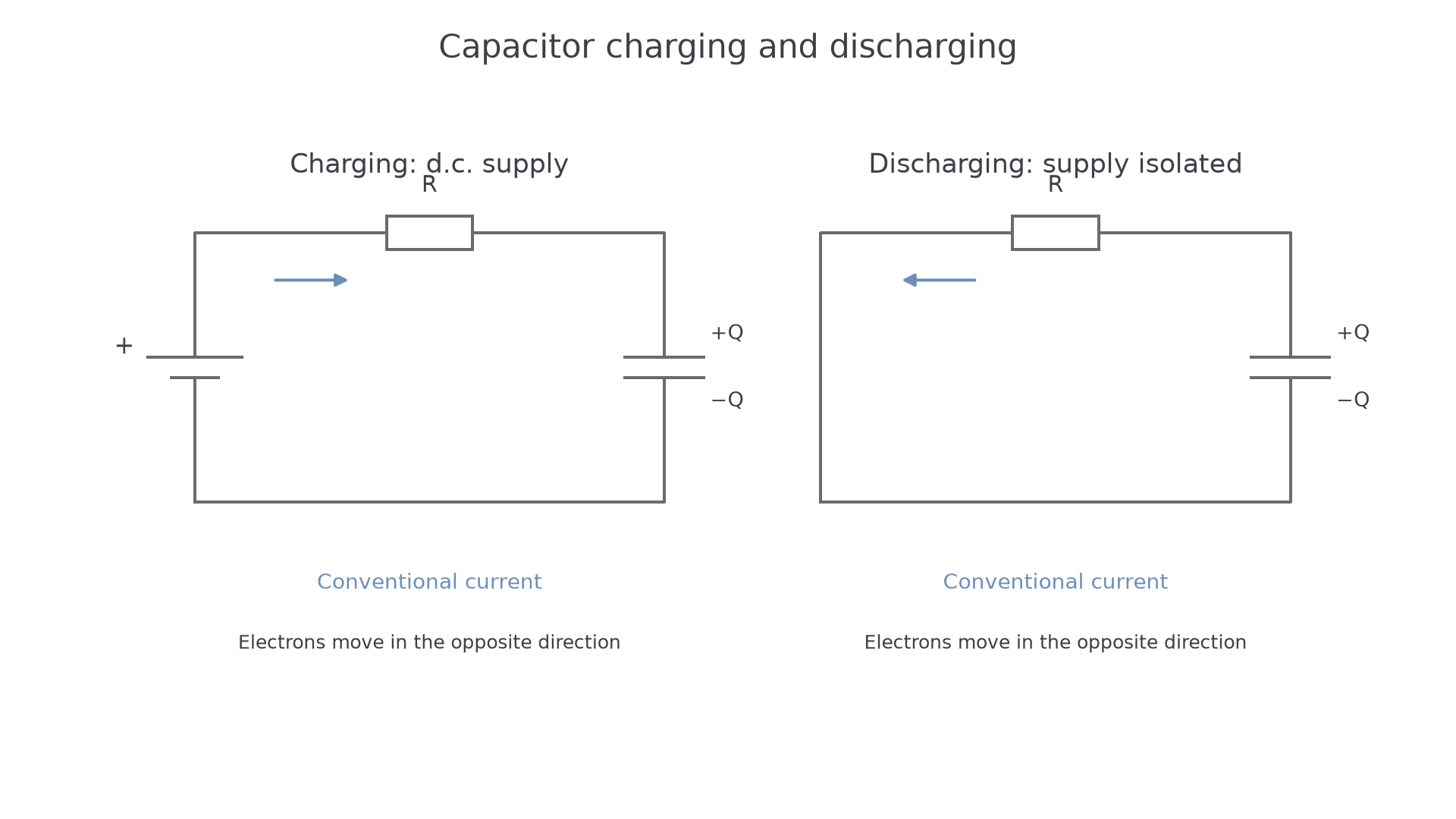
During charging, electrons are pushed through the conducting wires by the source. Electrons are deposited on one capacitor plate, making it negative. Electrons are removed from the other plate, making it positive. The insulating gap between the plates means electrons do not cross through the capacitor itself.
As the separated charge builds up, the p.d. across the capacitor builds up. In a simple d.c. charging circuit, the current eventually becomes zero once the capacitor is fully charged. At that point the charged capacitor behaves like an open gap in the steady d.c. circuit, even though current did flow while it was charging.
During discharging, the plates are connected by an external conducting path, often through a resistor. Electrons move from the negative plate through the external path towards the positive plate. The plate charges and the p.d. across the capacitor both decrease until the capacitor is discharged.
The resistor matters because it limits the current during charging or discharging. The detailed exponential equations and time constant belong to 6.1.3, Capacitor charging and discharging; here the key idea is the electron movement and the final charge-p.d. relationship.
Misconception contrast: conventional current direction is the direction positive charge would move. Electron flow is opposite to conventional current. OCR may accept either description when it is internally consistent, but do not swap the sign of the plates halfway through an explanation.
[DIAGRAM: asset_name: 6.1.1 - Capacitance and capacitor combinations - diagram 1; asset_slug: 6_01_1_capacitance_and_capacitor_combinations__diagram_01; recommended_method: drawn_physics; caption: Charging and discharging circuits show opposite conventional current directions.; description: Closed charging and discharging circuits; conventional current reverses, with electrons moving oppositely in the external wires.]
Capacitors in Parallel
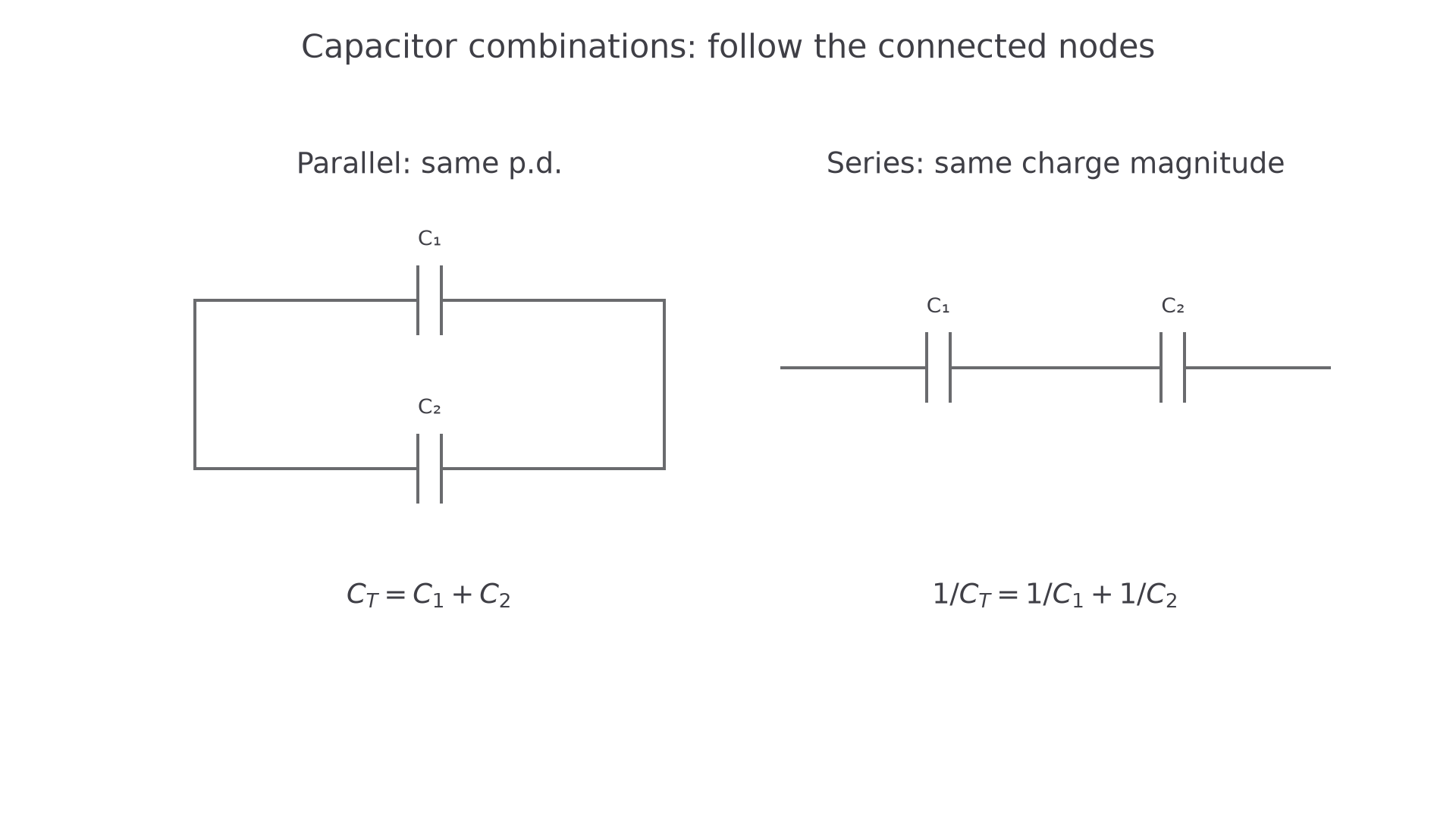
Capacitors are in parallel when each capacitor is connected across the same two nodes. That means each capacitor has the same potential difference across it.
If two capacitors are connected in parallel across a supply of p.d. , then:
The total charge supplied to the parallel combination is:
Substitute the charge expressions:
Since ,
Capacitors in Parallel
Parallel capacitors therefore have a total capacitance greater than any individual capacitor in the combination. For a given p.d., the combination can store more charge.
Worked example: parallel capacitors
A capacitor and a capacitor are connected in parallel across a supply. Find the total capacitance and the total charge stored.
The total charge stored is to two significant figures.
[DIAGRAM: asset_name: 6.1.1 - Capacitance and capacitor combinations - diagram 2; asset_slug: 6_01_1_capacitance_and_capacitor_combinations__diagram_02; recommended_method: drawn_physics; caption: Parallel capacitors share a potential difference, while series capacitors carry equal charge magnitudes.; description: Correctly connected series and parallel capacitor networks, with equal charge in series and equal p.d. in parallel.]
Continue this lesson.
You’re previewing NovaLearn without an account. Create a free account to read the rest.
Create free account