6.3.1 - Magnetic fields and force on a conductor
Magnetic fields turn compass needles and exert forces on current-carrying wires. This lesson explains the field patterns around wires and coils, Fleming's left-hand rule for force direction, and how force depends on magnetic flux density, current, wire length and the angle to the field. It also shows how to measure magnetic flux density using a digital balance.
Magnetic fields and field patterns
A magnetic field is a region where a permanent magnet, a moving charge, or a current-carrying conductor can experience a magnetic force. OCR 6.3.1 begins with the source of the field: magnetic fields are due to moving charges or permanent magnets.
Permanent magnets have a magnetic field even when there is no external circuit attached. A current-carrying wire also has a magnetic field because current is a flow of charge. The important A-level move is to stop thinking of a magnet as simply "attracting things" and start thinking of the field as a directional pattern in space.
Magnetic field line
A magnetic field line is a line used to show the direction of a magnetic field. The tangent to the line gives the field direction, and closer field lines represent a stronger magnetic field.
Field lines are a model, not physical strings. They help you map direction and relative strength. Outside a bar magnet, the field direction is from the north pole to the south pole. Around a current-carrying wire, the direction is found using the right-hand grip rule: point the right thumb in the direction of conventional current and the curled fingers show the magnetic field direction.
There are three field patterns in this lesson boundary.
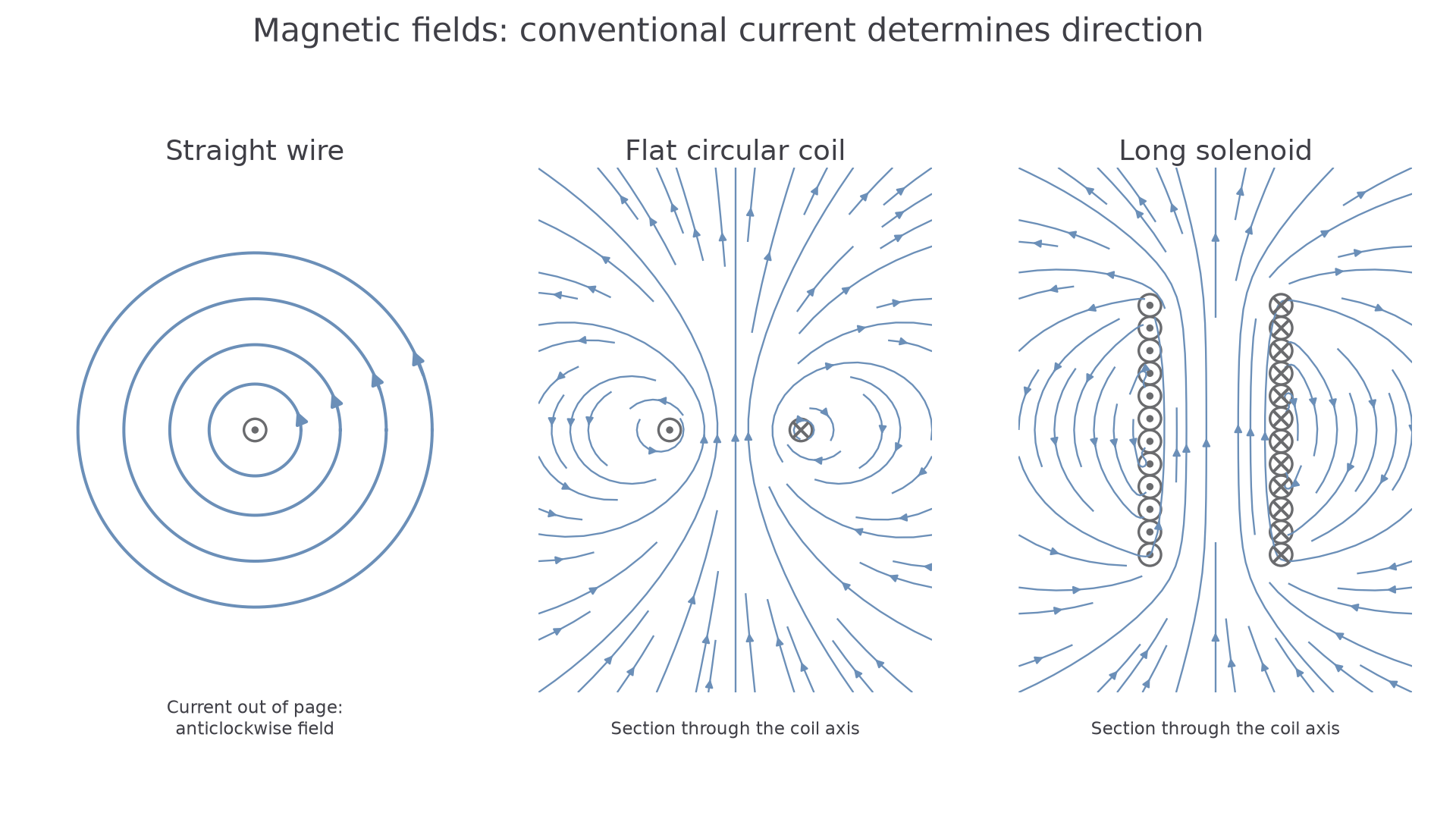
For a long straight current-carrying conductor, the magnetic field lines are concentric circles centred on the wire. The field is stronger close to the wire, so the circles should be drawn closer together near the wire.
For a flat coil, the fields from different parts of the loop combine. Through the centre of the coil the pattern is like the field through a small bar magnet: one face behaves like a north pole and the other like a south pole. You do not need a formula for the field in this lesson; you do need the shape and direction pattern.
For a long solenoid, the field inside is strong and nearly uniform. The field lines inside are almost straight, parallel and equally spaced. Outside, the field loops back around more weakly, giving a pattern like a bar magnet.
A common error is to draw field lines radiating away from a current-carrying wire as if the wire were an electric charge. For magnetism around a straight current, the lines are circular, not radial.
Magnetic field lines form closed loops: outside a bar magnet they run from N to S; inside it they return from S to N. A coil face with anticlockwise conventional current is a north face; a clockwise face is south. Use the viewing direction explicitly. Near the centre of a long solenoid, the contributions of many turns reinforce to make an approximately uniform axial field; outside, the return field is weaker and non-uniform.
[DIAGRAM: asset_name: 6.3.1 - Magnetic fields and force on a conductor - diagram 1; asset_slug: 6_03_1_magnetic_fields_and_force_on_a_conductor__diagram_01; recommended_method: drawn_physics; caption: Magnetic field patterns around a straight wire, a flat coil and a long solenoid.; description: Calculated field patterns of a straight wire, flat coil and solenoid. Arrows show conventional magnetic field direction.]
Force direction on a current-carrying conductor
When a current-carrying conductor is placed in an external magnetic field, the field due to the current and the external field interact. The conductor experiences a force. This is the motor effect.
The force direction is perpendicular to both the magnetic field direction and the conventional current direction. OCR names Fleming's left-hand rule for this direction.
Fleming's left-hand rule
For a current-carrying conductor in a magnetic field, hold the left thumb, first finger and second finger at right angles. The first finger points in the magnetic field direction, the second finger points in the conventional current direction, and the thumb points in the force or motion direction.
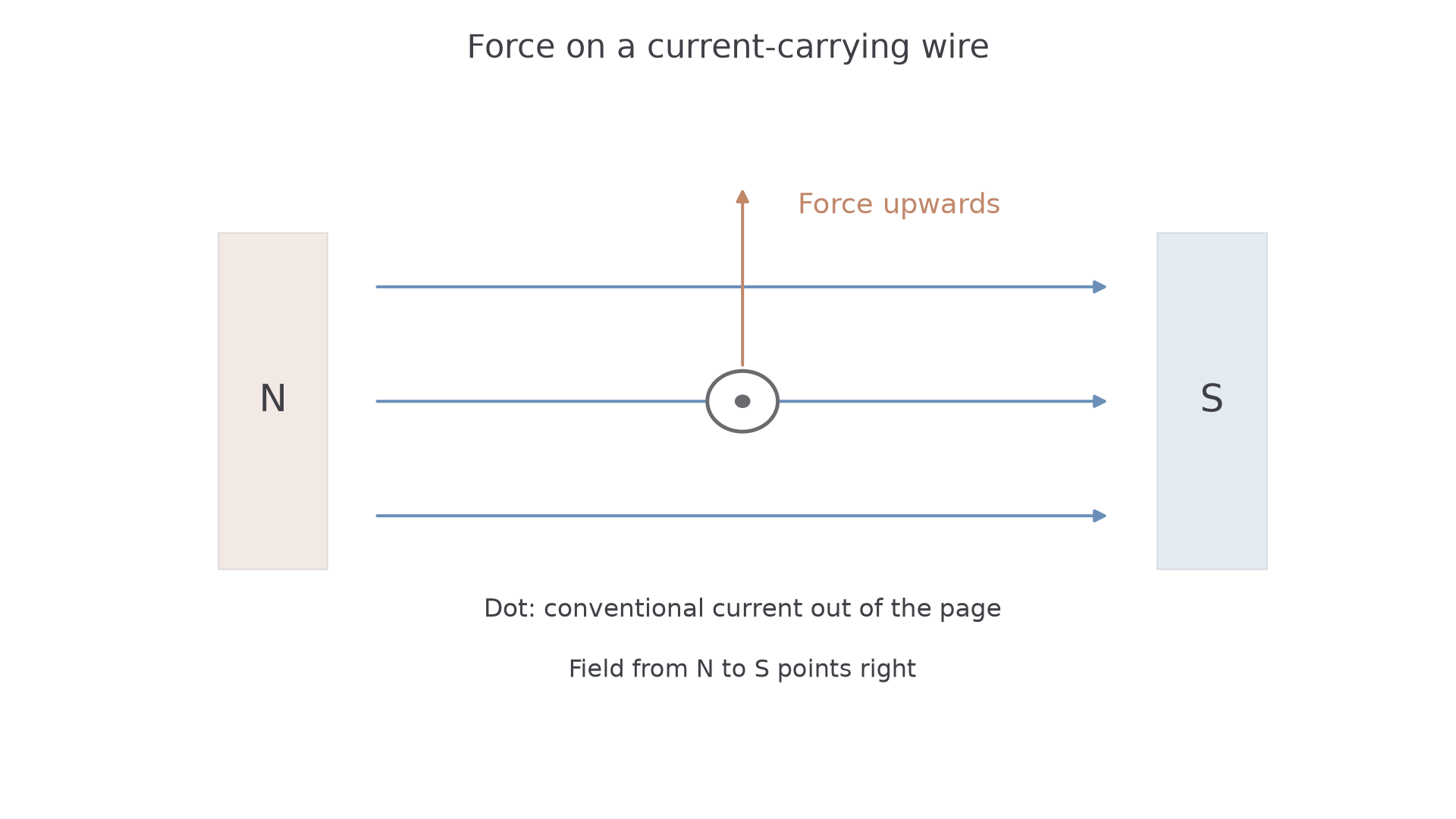
[DIAGRAM: asset_name: 6.3.1 - Magnetic fields and force on a conductor - diagram 2; asset_slug: 6_03_1_magnetic_fields_and_force_on_a_conductor__diagram_02; recommended_method: drawn_physics; caption: Current out of the page in a rightward magnetic field produces an upward force.; description: Conventional current out of the page, magnetic field right and force upwards.]
Use conventional current, not electron flow. Reversing the current reverses the force. Reversing the magnetic field also reverses the force. Reversing both gives the original force direction again.
Worked direction example
A wire is placed between magnet poles. The magnetic field is from left to right. Conventional current is out of the page. Use Fleming's left hand: first finger to the right, second finger out of the page, thumb upward. The force on the wire is upward.
If the current were into the page instead, the force would be downward. The field has not changed; only the current direction has changed.
The force is zero if the conductor is parallel to the magnetic field. In that case, Fleming's left-hand rule cannot make three perpendicular directions because current and field are along the same line.
Force, magnetic flux density and the tesla
The size of the force on a straight current-carrying conductor depends on the magnetic flux density, the current, the length of wire in the field, and the angle between the conductor/current direction and the field.
Magnetic flux density
Magnetic flux density, , is the quantity that measures the strength of a magnetic field by the force it produces on a current-carrying conductor. Its SI unit is the tesla, .
Force on a current-carrying conductor
Here is force in newtons (N), is magnetic flux density in tesla (T), is current in amperes (A), is the length of conductor inside the magnetic field in metres (m), and is the angle between the conductor/current direction and the magnetic field.
Only the part of the wire inside the uniform field counts for . The total length of wire in the circuit is not the same quantity.
The angle factor matters:
- if the wire is perpendicular to the field, , so and
- if the wire is parallel to the field, , so and
- between these extremes, the force depends on the perpendicular component of the current direction relative to the field
The tesla can be defined from the perpendicular case:
So one tesla is the magnetic flux density that produces a force of on a length of conductor carrying a current of , when the conductor is perpendicular to the field.
Worked example: force on a wire
A current passes through a straight wire. A length of the wire is at right angles to a uniform magnetic field of flux density . Calculate the force on the wire.
Convert the length:
The wire is perpendicular to the field, so .
The force on the wire is .
Worked example: angle not equal to
A length of wire carries in a magnetic field. The wire makes an angle of with the field. Then:
Continue this lesson.
You’re previewing NovaLearn without an account. Create a free account to read the rest.
Create free account