5.1.4(a)-(d) - Ideal gas model and gas experiments
Ideal gases give us a clean model for connecting microscopic particle motion to measurable quantities such as pressure, volume, temperature and amount of substance. In this lesson you will learn the assumptions behind the model, use the equation of state , and connect the equation to Boyle's law, the pressure law and the OCR PAG8 gas practicals. The aim is not just to substitute into a formula, but to know what must be kept constant and how the evidence is collected.
Moles And The Ideal Gas Model
A gas sample contains a huge number of atoms or molecules. Counting individual particles directly is not practical, so we use amount of substance, measured in moles.
Amount Of Substance
Amount of substance is a measure of how many elementary entities are present. For a gas, the entities may be atoms or molecules, depending on the gas.
One mole contains Avogadro's constant number of particles:
Avogadro Constant
If a sample contains moles, the number of particles is:
For example, of helium atoms contains:
So the sample contains helium atoms.
The word ideal tells you that we are using a simplified model. In the OCR model of an ideal gas:
- there is a large number of molecules in random, rapid motion
- the particles occupy negligible volume compared with the volume of the gas
- collisions are perfectly elastic
- the time taken during collisions is negligible compared with the time between collisions
- there are negligible forces between particles except during collisions
These assumptions are not claiming that real gases are perfect. They tell us when the model is expected to work well. Real gases behave more like ideal gases when the pressure is not too high and the temperature is not too low, because the particles are then far apart and intermolecular forces matter less.
Pressure From Molecular Collisions
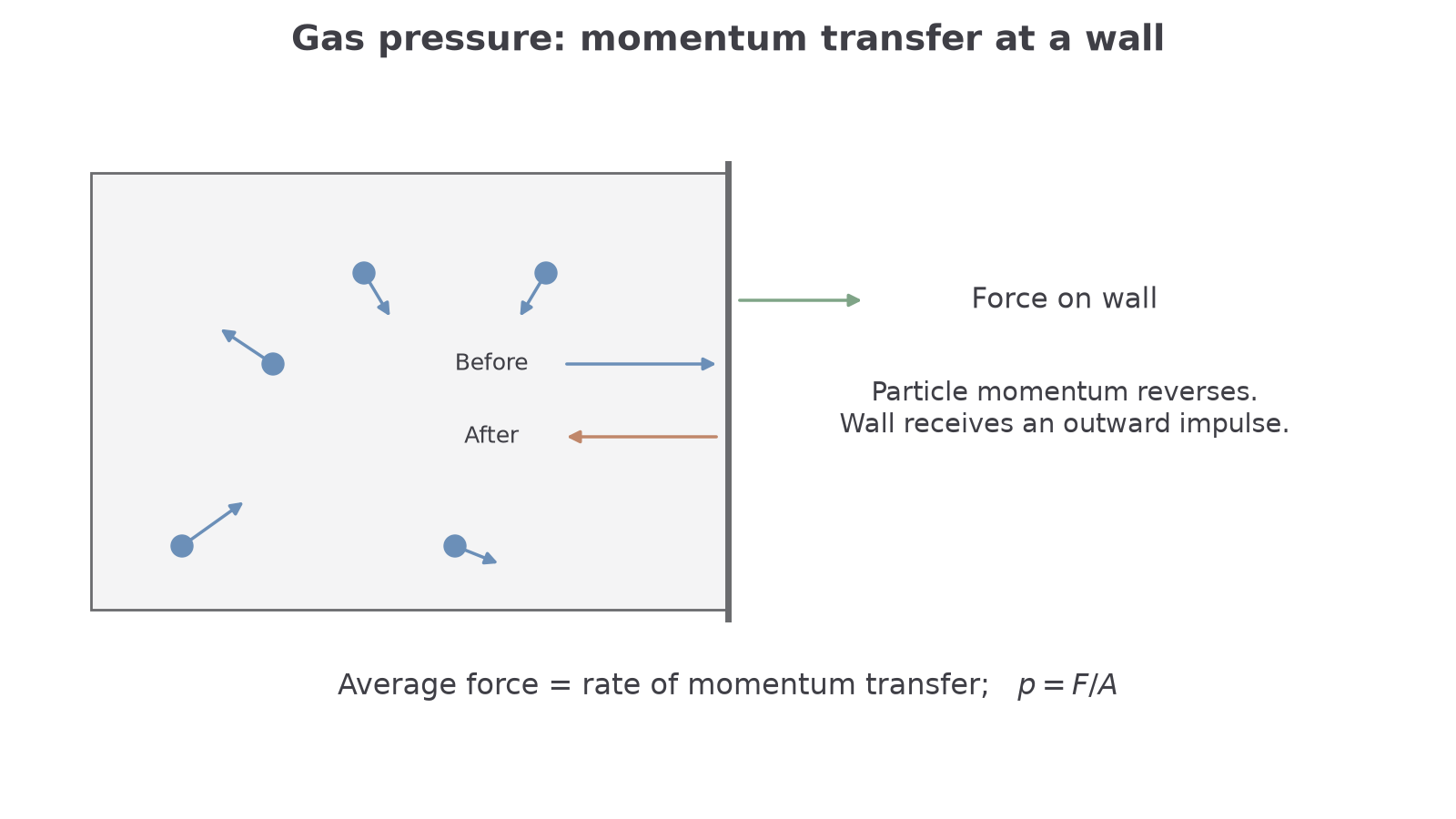
Gas pressure is explained by many molecules colliding with the walls of a container. Each molecule has momentum. When it hits a wall and rebounds, the component of its momentum perpendicular to the wall changes direction.
Newton's second law links force to rate of change of momentum. The wall exerts a force on the molecule to reverse its motion, and by Newton's third law the molecule exerts an equal and opposite force on the wall. Billions of these collisions each second produce a steady average force on each patch of wall.
Pressure is force per unit area, so the gas pressure is:
This model explains the two gas-law trends needed in this lesson.
If the volume is decreased at constant temperature and fixed amount of gas, the particles have less distance to travel between wall collisions. The collisions with the walls become more frequent per unit area, so the pressure increases. This is the particle explanation behind Boyle's law.
If the temperature is increased at constant volume and fixed amount of gas, the particles move faster on average. Collisions with the walls become both more frequent and more forceful, so the pressure increases. This is the particle explanation behind the pressure law.
A useful misconception contrast: increasing the number of particles does not make each individual collision more forceful at the same temperature, but it does increase the number of collisions with the walls per second, so the total force and pressure increase if the volume is fixed.
[DIAGRAM: asset_slug: 5_01_4a_ideal_gas_law_and_gas_practicals__diagram_01; description: Molecular impacts change momentum and exert an outward force on the wall.; caption: Molecular impacts change momentum and exert an outward force on the wall.]
Using The Ideal Gas Equation
The equation of state for an ideal gas connects the measurable state of the whole gas sample:
Equation Of State Of An Ideal Gas
Here:
- is the absolute pressure in pascals,
- is the volume in cubic metres,
- is the amount of substance in moles,
- is the molar gas constant,
- is the absolute temperature in kelvin,
OCR gives this equation and the value of in the data booklet, but exam answers still depend on choosing the correct quantities and using SI units. The most common traps are using instead of , using instead of , and using temperature in degrees Celsius instead of kelvin.
Temperature conversion:
For most A-level calculations, is treated as about .
Worked example: finding the amount of gas
A flask of volume contains gas at pressure and temperature . Calculate the amount of gas in moles.
Convert first:
Now rearrange:
Substitute:
The amount of gas is , to three significant figures.
If you also wanted the number of molecules:
The equation is for the whole gas sample. The molecular-form equations involving , , r.m.s. speed and mean kinetic energy belong to the next split lesson.
Useful SI conversions are , , and .
Boyle's Law From Data
Boyle's law is a special case of the ideal gas equation. For a fixed amount of gas at constant temperature:
The right-hand side is constant, so:
Boyle's Law
This means pressure is inversely proportional to volume:
So a graph of against is a curve, but a graph of against should be a straight line through the origin for an ideal gas.
A suitable OCR-style method for investigating Boyle's law is:
- Trap a fixed mass of air in a gas syringe connected to a pressure sensor or gauge.
- Set the syringe to a measured volume and record the gas pressure.
- Change the volume in steps, taking care not to over-pressurise the apparatus.
- After each change, wait briefly so the gas temperature returns close to room temperature.
- Record repeated readings where possible, then plot against .
Continue this lesson.
You’re previewing NovaLearn without an account. Create a free account to read the rest.
Create free account