5.4.2 - Newton's law of gravitation
Gravity is not just a force near the Earth's surface. Newton's law of gravitation models the attraction between any two masses, and it explains why the gravitational field gets weaker with distance. In this lesson you will use the inverse-square law, convert it into gravitational field strength, and see why the familiar value of near the Earth's surface can be treated as almost uniform.
The Law And Its Direction
In the previous gravitational-fields lesson, you met the idea that a spherical mass can be modelled as if its mass were concentrated at its centre. Newton's law of gravitation now gives the size and direction of the force between two point masses, or between two spherical masses treated as point masses at their centres.
Newton's law of gravitation
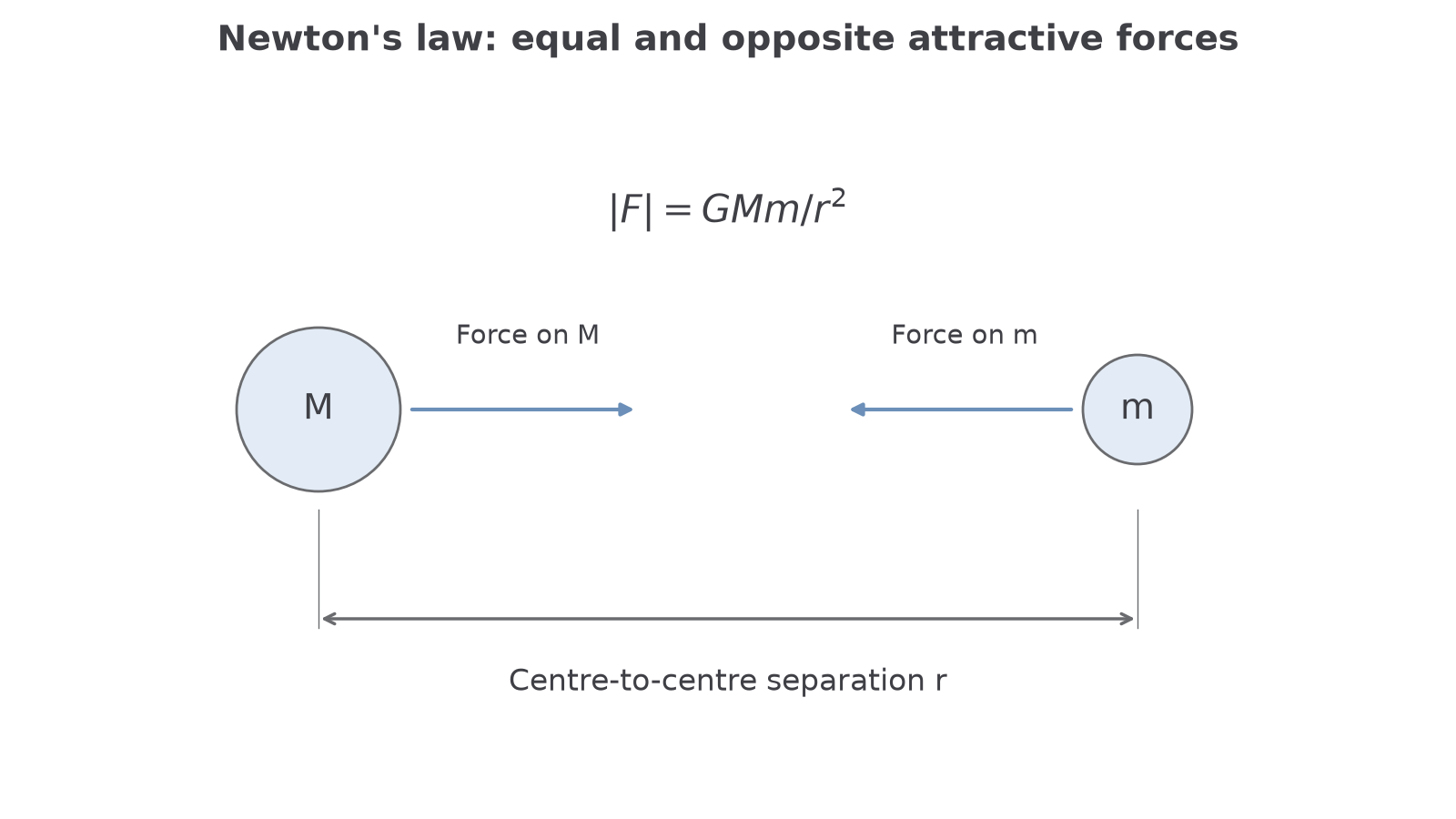
The gravitational force between two point masses acts along the line joining their centres. Its magnitude is proportional to the product of the masses and inversely proportional to the square of their separation.
Newton's Law Of Gravitation
: gravitational force on one mass due to the other (N); , : the two point masses (kg); : centre-to-centre separation (m); . Applies to point masses, or spheres treated as point masses at their centres.
The negative sign is a direction sign. If the positive radial direction is chosen outwards from the source mass, gravity acts inwards, so the force is negative in that coordinate system. When an OCR calculation asks for the magnitude of the gravitational force, use:
and then state the direction separately as towards the other mass.
The inverse-square part is the most important shape of the law. If doubles, becomes four times larger, so the force becomes one quarter as large. If one mass doubles, the force doubles. These changes combine multiplicatively: doubling one mass and tripling the separation changes the force by a factor of .
[DIAGRAM: asset_slug: 5_04_2_newtons_law_of_gravitation__diagram_01; description: Equal and opposite gravitational forces act along the line joining the centres of the masses.; caption: Equal and opposite gravitational forces act along the line joining the centres of the masses.]
Using The Law
The value of is often the trap. It is not usually the height above a surface; it is the distance from the centre of one mass to the centre of the other. For a satellite near Earth, for example, is the Earth's radius plus the satellite's height above the surface.
Worked example: a spacecraft is above the Earth's surface. Use , , and to calculate the magnitude of the gravitational force on the spacecraft.
First find the centre-to-centre separation:
Now substitute into Newton's law:
The force is towards the centre of the Earth. Notice that the force is still large because the Earth has a huge mass, even though is very small.
A useful check on any answer is proportionality. If the spacecraft moved further away, would increase and the force must decrease. An answer that increases just because the object is "higher" has the wrong physical direction.
Continue this lesson.
You’re previewing NovaLearn without an account. Create a free account to read the rest.
Create free account