4.4.3(a)-(e) - Superposition, interference and coherence
When waves overlap, the medium does not have to choose which wave to follow. The displacements add, and that simple idea explains loud and quiet regions in two-speaker sound experiments, strong and weak microwave signals, and the conditions needed for a stable interference pattern. In this lesson you will learn how to add waves graphically, how coherence makes interference observable, and how path difference and phase difference predict maxima and minima.
Adding Displacements
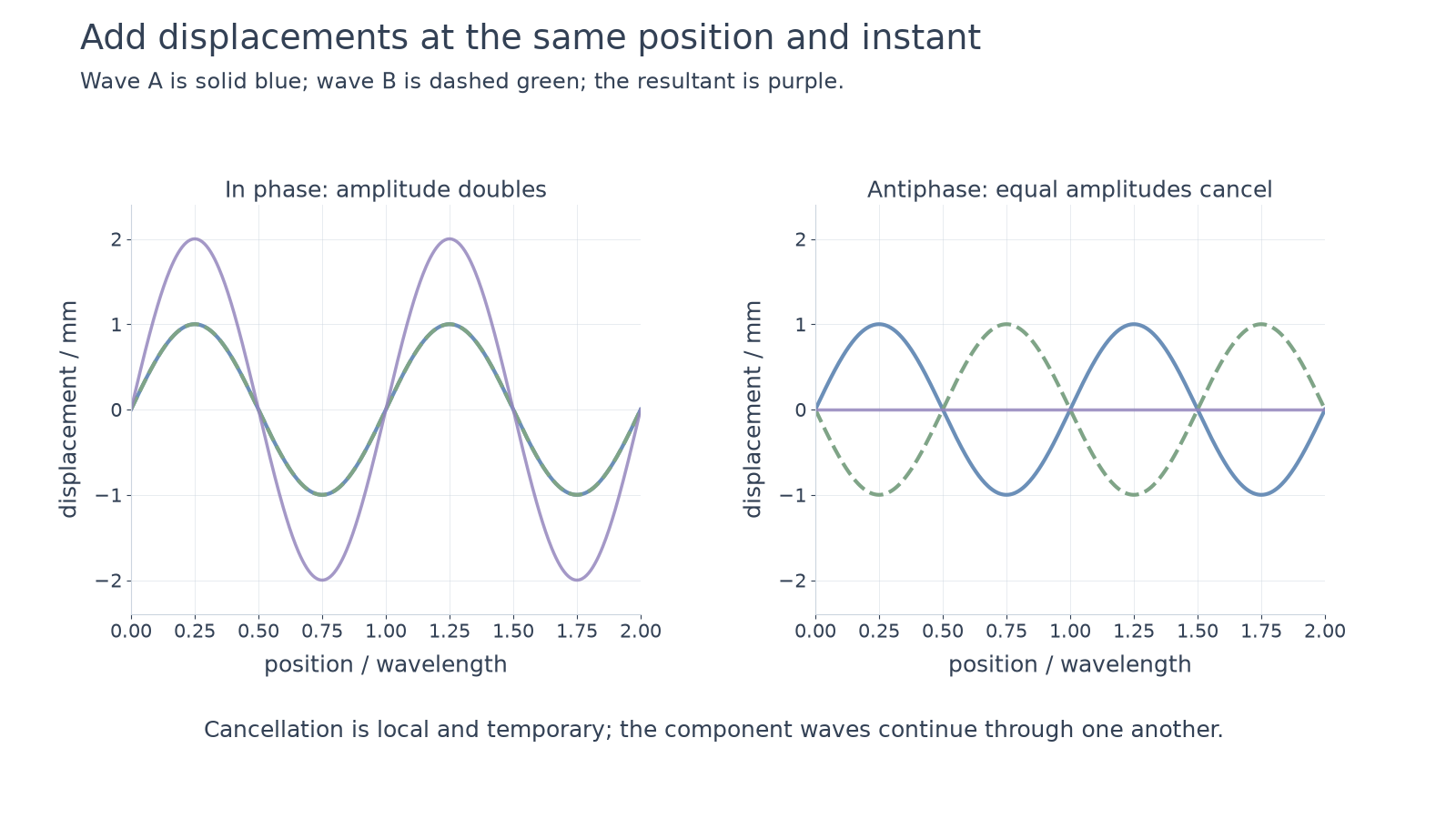
The principle of superposition is about displacement. At one point in space, at one instant in time, each wave would give the medium its own displacement. The actual displacement is the signed sum of those displacements.
Principle of Superposition
When two or more waves meet at a point, the resultant displacement at that point is the vector sum of the displacements of the individual waves.
"Vector sum" matters because displacement has direction. A crest may be positive and a trough may be negative, so a positive displacement and a negative displacement can partly or completely cancel. The waves do not permanently destroy each other; after overlapping, each wave continues to travel.
Graphically, superposition is done by adding ordinates: choose a position, read the displacement of wave A, read the displacement of wave B, then add them with signs. Repeating this for several positions gives the resultant wave shape.
Worked example: at a particular point, wave A gives a displacement of and wave B gives a displacement of . The resultant displacement is:
At a different point, if wave A gives and wave B gives , the resultant displacement is zero at that instant. That is cancellation at that point, not the disappearance of the waves everywhere.
[DIAGRAM: asset_slug: 4_04_3a_superposition_interference_and_coherence__diagram_01; caption: Equal in-phase waves add to double amplitude. Equal waves in antiphase cancel.; description: Equal in-phase sinusoidal waves sum to twice the amplitude. Equal antiphase waves sum to zero; line styles identify the two components separately.]
Interference and Coherence
Interference is the observable effect of superposition when waves overlap and produce regions where the resultant amplitude is larger or smaller. A single point may receive a large resultant displacement at one instant and a smaller one later, but a useful interference pattern needs the maxima and minima to stay in fixed places long enough to detect.
Interference
Interference is the formation of a resultant wave pattern when waves superpose, producing regions of reinforcement and cancellation.
To get a stable pattern, the sources must be coherent.
Coherent Sources
Coherent sources have the same frequency and a constant phase difference.
The phrase "constant phase difference" is more precise than just "in phase". Two coherent sources may be in phase, or one may always lag the other by a fixed phase angle. What matters for a stable pattern is that the phase relationship does not drift randomly.
In the laboratory, two independent signal generators or two unrelated loudspeakers are usually poor coherent sources because their phase relationship can drift. A single signal generator feeding two loudspeakers is much better. For microwaves, one transmitter and a barrier with two slits can make the slits act like coherent sources because both slits are driven by the same incoming wave.
Path and Phase Difference
At a point in an interference pattern, the two waves may have travelled different distances from their sources. The difference between these distances is the path difference.
Path Difference
Path difference is the difference between the distances travelled by two waves from their sources to the same point.
The path-difference conditions below assume sources that emit in phase. Coherent sources with another fixed initial phase difference still give a stable pattern, but their maxima and minima are shifted. Phase difference describes how far through its cycle one wave is compared with another. One complete wavelength corresponds to one complete cycle, so:
That gives the key interference conditions.
Constructive and destructive conditions
Here is path difference in m, is wavelength in m, and is an integer: . Constructive interference means the waves arrive in phase, with phase difference . Destructive interference means they arrive in antiphase, with phase difference .
Worked example: two coherent microwave waves emitted in phase, of wavelength arrive at a detector. At one detector position the path difference is .
The path difference is , an integer number of wavelengths, so the waves arrive in phase and give constructive interference.
At another position the path difference is .
Continue this lesson.
You’re previewing NovaLearn without an account. Create a free account to read the rest.
Create free account