5.5.2(i)-(k) - Wien's law, Stefan's law and stellar radius
Stars are too far away for us to measure their sizes directly in the laboratory sense, but their light carries quantitative clues. In this lesson you will use the peak wavelength of a star's continuous spectrum to estimate its surface temperature, use Stefan's law to connect temperature, luminosity and radius, and combine the two ideas to estimate stellar radius.
Blackbody Curves And Wien's Law
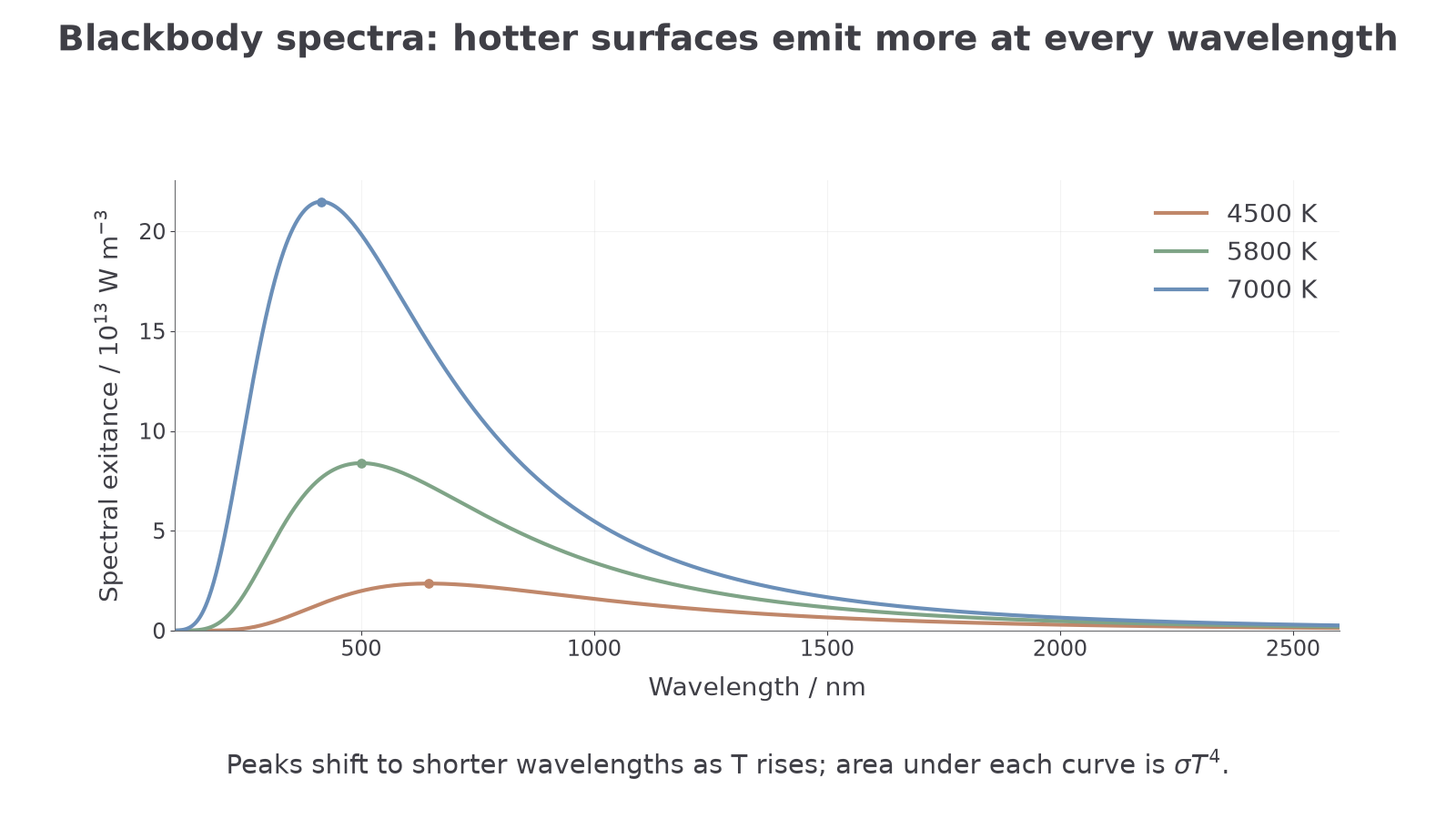
A star's continuous spectrum can be modelled, to a useful first approximation, as blackbody radiation. A blackbody curve is a graph of intensity against wavelength for radiation emitted by an object at a particular absolute temperature.
The peak of the curve is important. The wavelength at the peak is written . A hotter star has its peak at a shorter wavelength; a cooler star has its peak at a longer wavelength. This is the physical idea behind Wien's displacement law.
Peak Wavelength
is the wavelength at which the intensity of the emitted radiation is greatest for the blackbody curve.
Wien's law is usually used in two equivalent ways:
Wien's Displacement Law
Here is the absolute surface temperature in kelvin, is in metres, and is Wien's displacement constant. A useful value is . OCR's data booklet gives the proportional form, so in some questions you compare two stars without needing the numerical constant.
Worked example: a star has . Estimate its surface temperature.
First convert the wavelength:
Then use :
The answer is an estimate because real stars are not perfect blackbodies, and the measured peak may be affected by the star's atmosphere and the quality of the spectrum.
[DIAGRAM: asset_slug: 5_05_2b_wiens_law_stefans_law_and_stellar_radius__diagram_01; description: Planck spectra on a common physical scale: hotter surfaces emit more at every wavelength and peak at shorter wavelengths.; caption: Hotter blackbodies emit more at every wavelength and have their intensity peak at a shorter wavelength.]
Luminosity And Stefan's Law
Luminosity is the total radiant power output of a star. It is not the same as how bright the star looks from Earth, because apparent brightness also depends on distance.
Luminosity
The luminosity of a star is the total power radiated by the star. Its SI unit is the watt, W.
Stefan's law links luminosity to the star's surface area and absolute surface temperature. For a spherical star, the surface area is , where is the stellar radius.
Stefan's Law For A Star
In this equation, is luminosity in W, is radius in m, is temperature in K, and is the Stefan constant:
The fourth power matters. If two stars have the same radius but one has twice the surface temperature, its luminosity is times greater. If two stars have the same temperature but one has twice the radius, its luminosity is times greater.
Worked example: estimate the luminosity of a Sun-like star with and .
This is a total power output. It is much larger than the power received by a telescope, because the radiation spreads over an enormous spherical area as it travels through space.
Estimating Stellar Radius
To estimate a star's radius, you need its luminosity and surface temperature. Wien's law can provide the temperature from the peak wavelength. Stefan's law can then be rearranged for radius.
In some exam contexts, luminosity is given directly. In others, you may first use earlier wave-intensity knowledge: if the received intensity at distance is known, then . That step is prior work from wave intensity; the new astrophysics step is using and to estimate .
Worked example: a red giant has a peak wavelength of and luminosity . Estimate its radius.
First use Wien's law:
Now use Stefan's law:
That is about times the Sun's radius, which is a sensible order of magnitude for a red giant. Notice the route: wavelength gives temperature; luminosity and temperature give radius.
Continue this lesson.
You’re previewing NovaLearn without an account. Create a free account to read the rest.
Create free account