6.4.4(a)-(f) - Mass-energy, binding energy and nuclear reactions
Nuclear reactions are a place where a very small change in rest mass can correspond to a large amount of energy. In this lesson you will use Einstein's mass-energy equation, connect it to particle-antiparticle pairs, and calculate binding energy from masses. You will also learn how the binding-energy-per-nucleon curve predicts whether a supplied nuclear reaction can release energy.
Mass-energy accounting
The key idea is not that mass simply disappears. In nuclear and particle reactions, rest mass can be converted into other forms of energy, such as kinetic energy of products or photon energy. The reverse can also happen: energy can be absorbed to create extra rest mass.
Einstein's mass-energy equation
Here . The OCR data booklet gives this relationship, but you need to choose the correct mass difference and use SI units unless the question clearly gives another route.
For an energy-releasing reaction,
so is positive when the products have less rest mass than the reactants. The energy released is then . If the products have greater rest mass, the reaction has absorbed energy instead.
[DIAGRAM: asset_name: 6.4.4(a)-(f) - Mass-energy, binding energy and nuclear reactions - diagram 1; asset_slug: 6_04_4a_mass_energy_binding_energy_and_nuclear_reactions__diagram_01; recommended_method: drawn_physics; description: Distinct reactant/product rest masses with positive mass decrease supplying kinetic/photon energy; reverse condition stated.; caption: A decrease in total rest mass supplies the kinetic and photon energy released by a nuclear reaction.]
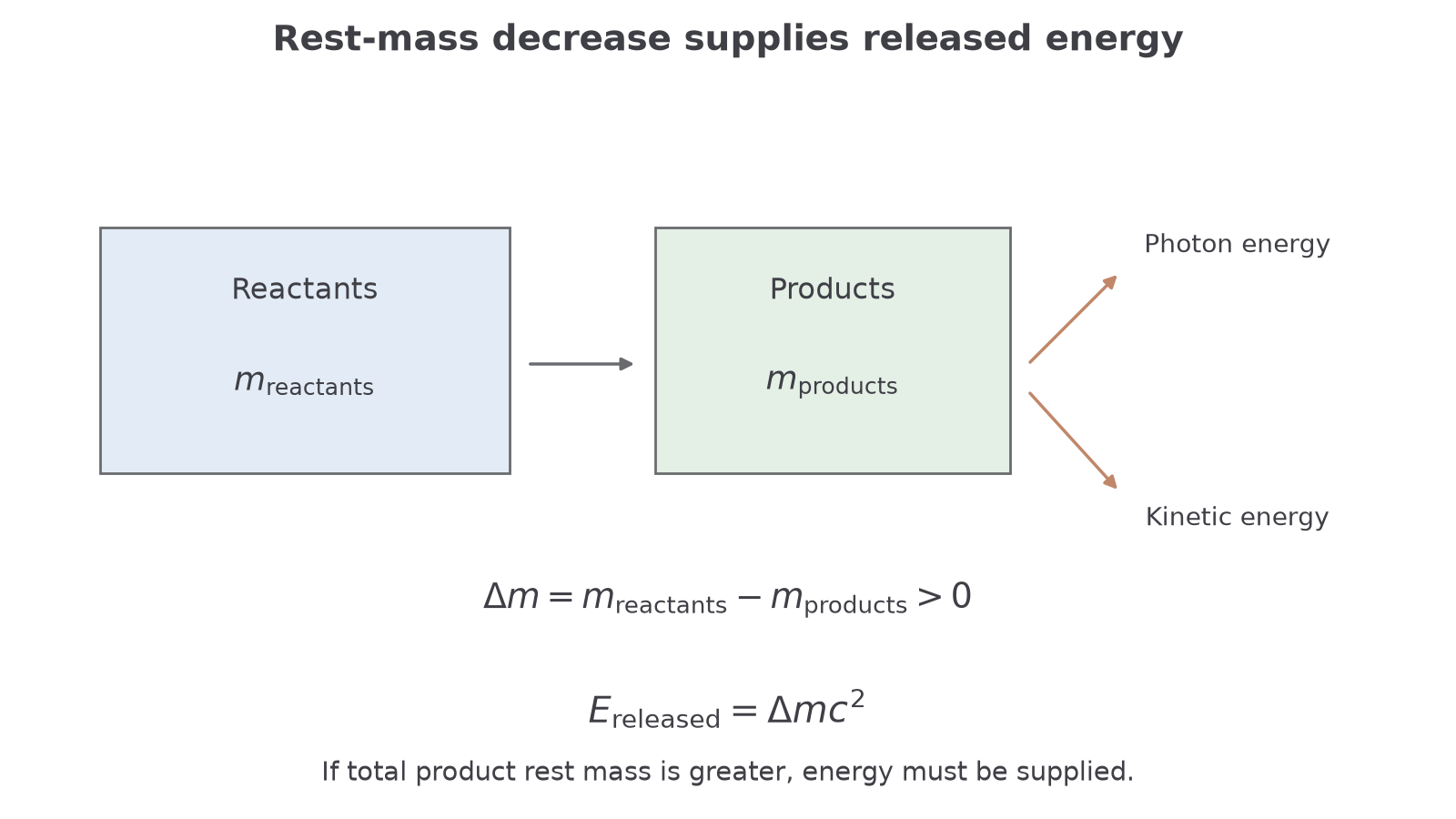
Worked example: a supplied nuclear reaction has products whose total rest mass is less than the total rest mass of the reactants. Calculate the energy released.
Since ,
The joule is the SI answer. The MeV value is often a more convenient nuclear-scale value.
Pairs and photons
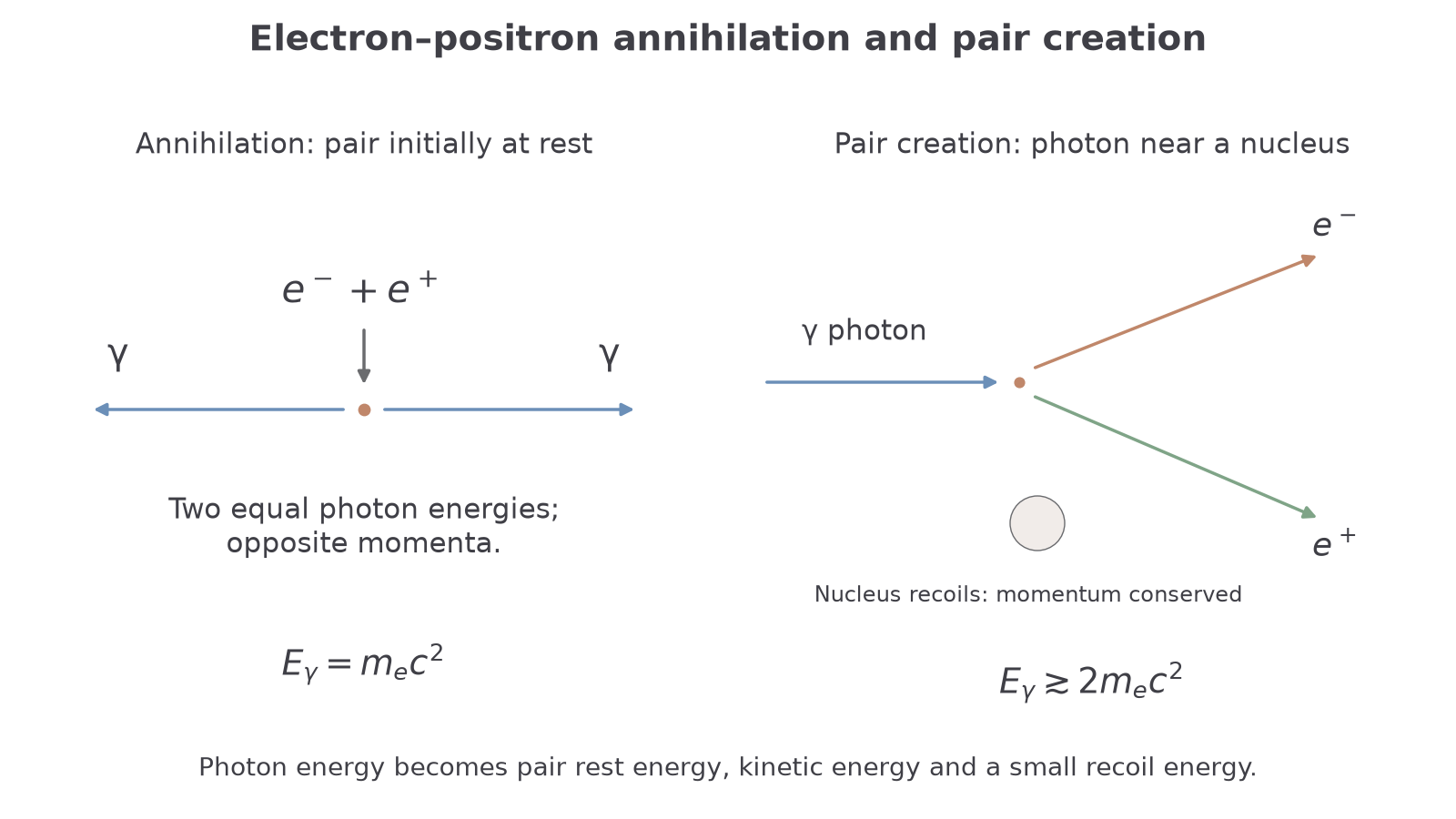
A particle and its antiparticle have the same rest mass. Charged partners such as an electron and a positron have opposite electric charges; neutral partners both have zero net electric charge. When a particle-antiparticle pair annihilates, their rest mass energy is converted into photon energy. For an electron and a positron initially with negligible kinetic energy, the total energy available is
where .
Two photons are usually emitted in opposite directions. This is not just a tidy diagram convention: it helps conserve momentum when the electron and positron were initially close to rest.
Pair creation is the reverse process. A photon with sufficient energy can create a particle-antiparticle pair, but momentum must still be conserved, so this occurs near another body such as a nucleus. For electron-positron pair creation, the minimum photon energy is the rest energy of both particles:
Any photon energy above this minimum can appear as kinetic energy of the created particles.
[DIAGRAM: asset_name: 6.4.4(a)-(f) - Mass-energy, binding energy and nuclear reactions - diagram 2; asset_slug: 6_04_4a_mass_energy_binding_energy_and_nuclear_reactions__diagram_02; recommended_method: drawn_physics; description: Opposite equal-energy annihilation photons; pair creation near a separately drawn recoil nucleus with threshold condition.; caption: Pair annihilation at rest produces opposite photons. Pair creation near a nucleus produces an electron and positron.]
Worked example: find the minimum photon energy needed to create an electron-positron pair.
In electronvolts,
For annihilation of a stationary electron-positron pair into two equal photons, each photon has half the total energy: . If asked for the wavelength of each photon, use , so .
Mass defect and binding energy
A nucleus has less mass than the total mass of the separated protons and neutrons that make it up. That difference is the mass defect.
Mass defect
The mass defect of a nucleus is the difference between the total mass of its separated nucleons and the mass of the nucleus.
For a nucleus with proton number and nucleon number , the number of neutrons is . If nuclear masses are being used,
where is the proton mass and is the neutron mass.
The mass defect corresponds to binding energy.
Binding energy
The binding energy of a nucleus is the minimum energy needed to separate the nucleus completely into its individual protons and neutrons, with the separated nucleons far apart. The same amount of energy is released when the nucleus is formed from those separated nucleons.
Binding energy per nucleon
Binding energy per nucleon is the total binding energy of a nucleus divided by its nucleon number .
Continue this lesson.
You’re previewing NovaLearn without an account. Create a free account to read the rest.
Create free account