5.1.3 - Specific heat capacity and latent heat
Thermal energy can raise a temperature, or it can change the state of a substance while the temperature stays constant. In this lesson you will learn how to calculate both kinds of energy transfer, how to determine the relevant constants using electrical methods, and how OCR-style questions hide the same idea inside heating curves and practical data.
Specific Heat Capacity
Different materials need different amounts of energy for the same temperature rise. A pan made from a low heat capacity metal warms quickly; the same mass of water warms more slowly because water has a much larger specific heat capacity.
Specific Heat Capacity
The specific heat capacity of a substance is the energy required to raise the temperature of of the substance by , without a change of state.
The OCR thermal-physics relationship is:
Specific heat capacity
: energy transferred (J); : mass (kg); : specific heat capacity (); : temperature change (K or ). Only for a temperature change with no change of state.
The interval is what matters: a rise of is the same size as a rise of .
Read the equation as a statement about proportionality. For the same material, doubling the mass doubles the energy needed. For the same mass, doubling the temperature rise doubles the energy needed. For the same mass and temperature rise, the material with larger needs more energy.
Worked example: heating a metal block
A aluminium block is heated from to . Take the specific heat capacity of aluminium as . Calculate the energy transferred to the block.
The temperature change is:
Then:
To two significant figures, the energy transferred is:
Notice that the calculation uses a temperature change, not the final temperature itself.
Electrical Method For Specific Heat Capacity
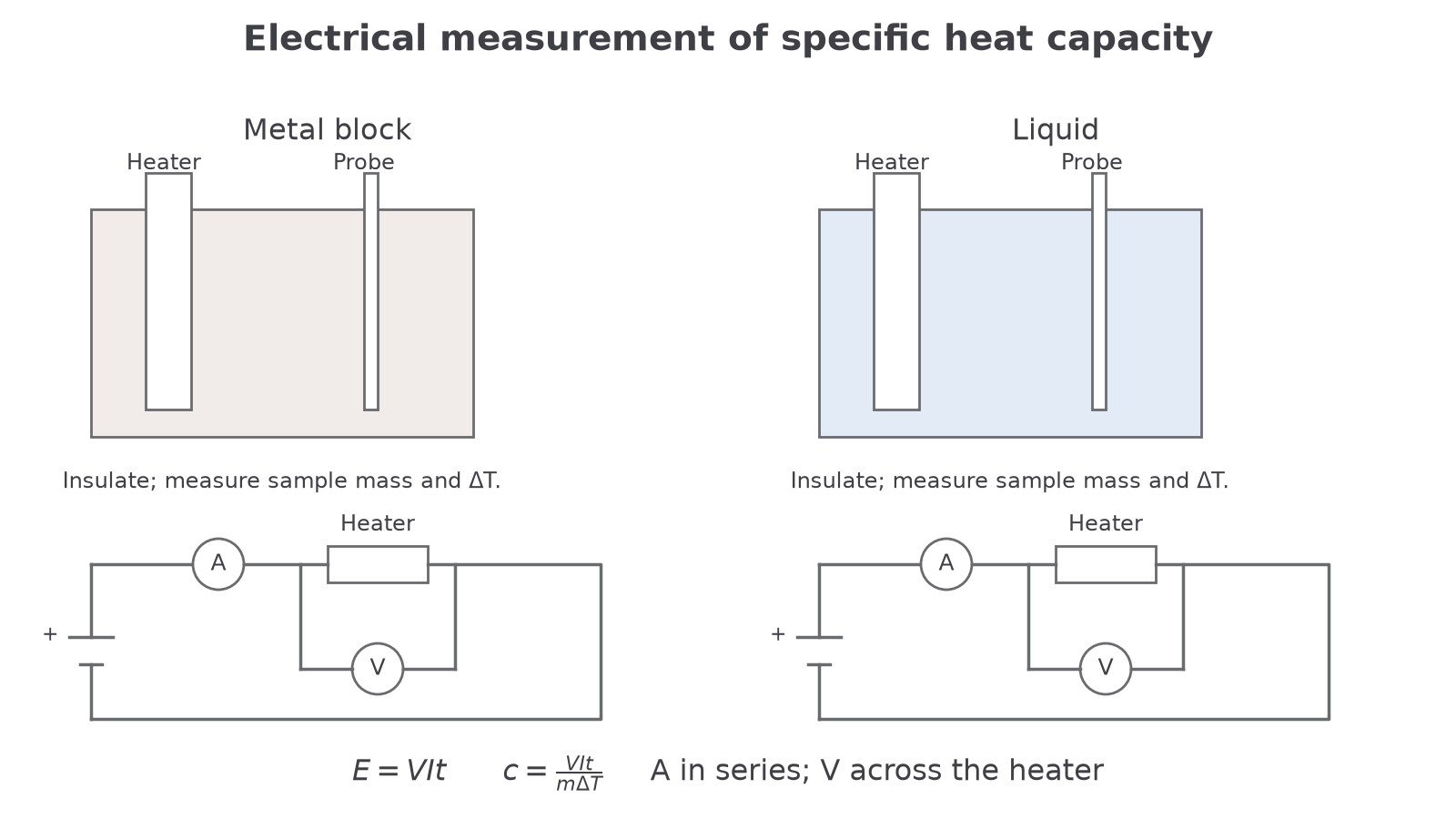
An electrical method is useful because the energy supplied by a heater can be calculated from electrical measurements. If the p.d. across the heater is , the current through it is , and it is switched on for time , then:
If the energy all went into the sample:
For a metal block:
- Measure the mass of the block.
- Place a low-voltage immersion heater and a temperature probe or thermometer into holes in the block.
- Add a small amount of oil or water in the holes to improve thermal contact, if appropriate for the apparatus.
- Wrap the block in insulation and record the initial temperature.
- Switch on the heater, measure , , and , then record the final temperature.
- Use .
For a liquid, the idea is the same, but the liquid should be in an insulated container with a lid. Measure the mass of the liquid, keep the heater fully immersed, and stir gently so the temperature probe measures a representative temperature rather than a hot region near the heater.
There is also a mixture method for estimating specific heat capacity. A hot object of known mass and temperature is transferred into a cooler liquid of known mass and temperature. If heat losses and the calorimeter's heat capacity are small or corrected for, then:
This method is an estimate because transferring the hot object takes time and some energy is lost to the surroundings. OCR's additional guidance names it because it is a good way to test energy conservation and experimental evaluation.
In the electrical method, a graph can improve the analysis. If and are constant, plotting temperature rise against time should give an approximately straight line. Since:
the gradient is , so:
An alternative is to plot electrical energy on the vertical axis against temperature rise on the horizontal axis. The gradient is then , so .
Using a mixture quantitatively. A metal sample at is placed into of water at . The final temperature is . Neglect heat loss and the container's heat capacity. With ,
The two temperature changes differ. If the container absorbs appreciable energy, add to the right-hand side; otherwise the estimate of the metal's specific heat capacity is too low.
[DIAGRAM: asset_slug: 5_01_3_specific_heat_capacity_and_latent_heat__diagram_01; description: Electrical heating arrangements for a metal block and a liquid; measure current in series and potential difference across the heater.; caption: Electrical heating arrangements measure current through the heater and potential difference across it.]
Specific Latent Heat
When a substance changes state, energy is transferred even though the temperature can stay constant. Melting ice at produces water at ; boiling water at produces steam at at normal pressure. The energy is not raising temperature during that stage. It is changing the arrangement and separation of the molecules.
Specific Latent Heat
The specific latent heat of a substance is the energy required to change the state of of the substance without a change in temperature.
There are two OCR terms you must keep separate:
- specific latent heat of fusion: solid to liquid, or liquid to solid
- specific latent heat of vaporisation: liquid to gas, or gas to liquid
The equation is:
Specific latent heat
: energy transferred (J); : mass that changes state (kg); : specific latent heat of fusion or of vaporisation (). Only for a change of state at constant temperature.
Worked example: melting ice at its melting point
A sample of ice at melts completely to water at . Take the specific latent heat of fusion of ice as . Calculate the energy required.
Because the temperature does not change, use , not .
To three significant figures:
Continue this lesson.
You’re previewing NovaLearn without an account. Create a free account to read the rest.
Create free account