6.4.4(g)-(k) - Fission, fusion and nuclear equations
Fission reactors and fusion reactions both involve changes inside nuclei, not chemical rearrangements of atoms. In this lesson you will learn how a neutron can induce fission, how a reactor controls a chain reaction, why nuclear waste creates environmental decisions, why fusion needs very high temperature, and how to balance nuclear transformation equations without losing track of nucleon number or proton number.
Induced fission and chain reactions
Some heavy nuclei can split into two smaller nuclei. In a nuclear reactor, this is usually induced: a neutron is absorbed by a fissile nucleus, making it unstable, and the nucleus splits.
Induced nuclear fission
Induced nuclear fission is the splitting of a heavy nucleus after it absorbs a neutron. The products are two smaller nuclei, further neutrons, and energy.
A typical fission reaction can be represented as:
The exact smaller nuclei are not always the same, but the central idea is stable: one neutron is absorbed, a heavy nucleus splits, and more neutrons are released. Those emitted neutrons matter because they can induce fission in other uranium nuclei.
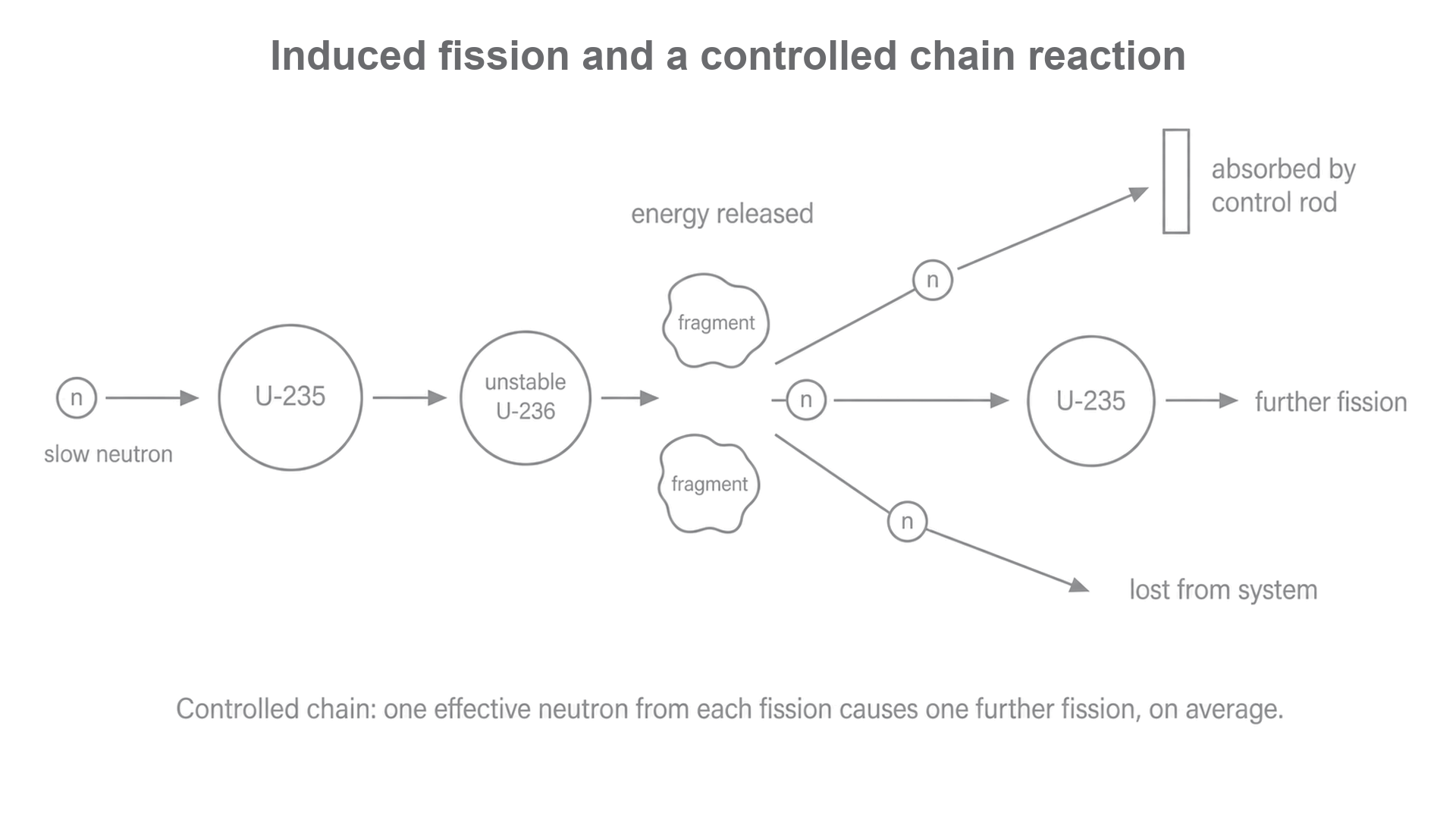
[DIAGRAM: asset_name: 6.4.4(g)-(k) - Fission, fusion and nuclear equations - diagram 1; asset_slug: 6_04_4b_fission_reactors_fusion_and_nuclear_equations__diagram_01; recommended_method: drawn_physics; description: Retained accurate chain-reaction schematic; follow-on, absorbed and leaked neutrons are distinguished.; caption: Neutrons released by fission may cause another fission, be absorbed without fission or escape from the reactor.]
Chain reaction
A chain reaction is a reaction in which neutrons released by fission go on to cause further fission reactions, releasing more neutrons.
The phrase "go on to cause" is important. A fission event may release two or three neutrons, but not all of them necessarily produce further fission. Some escape, some are absorbed by materials that do not fission, and some are absorbed deliberately by control rods.
For a steady reactor, the average number of effective neutrons from each fission that cause another fission is about one. If the average is greater than one, the rate of fission increases. If it is less than one, the chain reaction dies away.
Do not describe the fission fragments as causing the next fission. The neutrons are the carriers of the chain reaction.
Fuel rods moderator and control rods
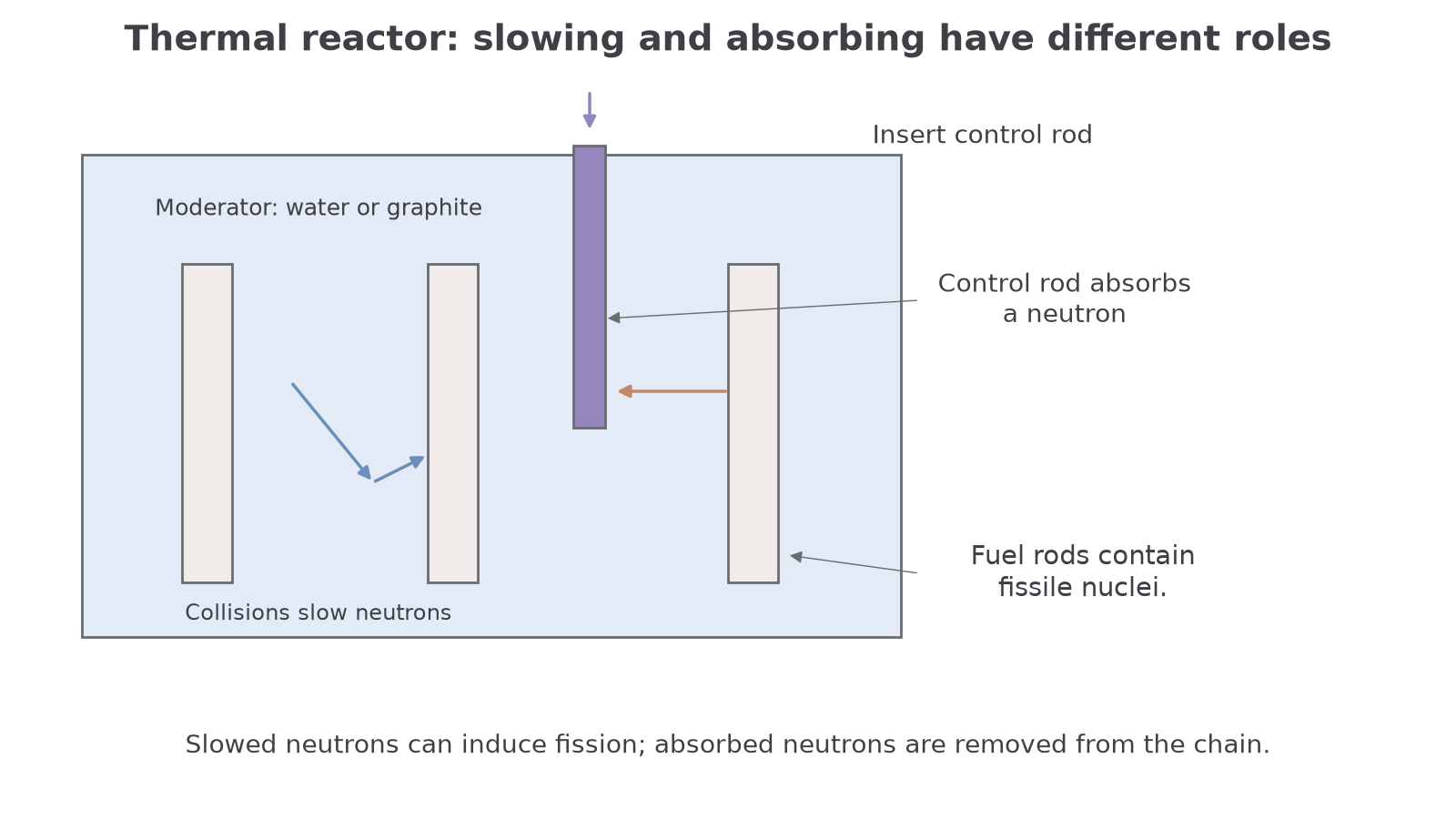
A thermal fission reactor has three distinct core components: fuel rods, moderator and control rods.
Fuel rods contain the fissile fuel, such as uranium enriched with uranium-235. Fission takes place in the fuel. The energy released appears mainly as kinetic energy of fission fragments and particles, which quickly becomes internal energy of the reactor core.
The moderator slows down the fast neutrons produced in fission. Slower neutrons are more likely to be absorbed by uranium-235 nuclei and induce further fission. In many reactor descriptions, water or graphite is used as a moderator.
Control rods absorb neutrons. Lowering the rods further into the core absorbs more neutrons, so fewer neutrons are available to cause further fission and the fission rate decreases. Raising the rods absorbs fewer neutrons, so the fission rate can increase.
[DIAGRAM: asset_name: 6.4.4(g)-(k) - Fission, fusion and nuclear equations - diagram 2; asset_slug: 6_04_4b_fission_reactors_fusion_and_nuclear_equations__diagram_02; recommended_method: drawn_physics; description: Collisions in moderator space slow a neutron before reaching fuel; a separate neutron is absorbed by control rod; insertion direction clear.; caption: The moderator slows neutrons, control rods absorb neutrons and fuel rods contain fissile nuclei.]
Keep the two neutron-control processes distinct:
- moderator: slows neutrons
- control rods: absorb neutrons
Absorbing and slowing are not the same. A slowed neutron can still go on to cause fission. An absorbed neutron in a control rod is removed from the chain reaction.
Worked reasoning: what happens if control rods are lowered?
Lowering the control rods inserts more absorbing material into the core. More neutrons are absorbed without causing fission. Therefore fewer fission reactions are induced per second, so the reactor power decreases. If the rods are fully inserted, the chain reaction can be shut down. Radioactive fission products still release decay heat, so cooling remains necessary after shutdown.
Worked reasoning: what happens if there is no moderator?
The neutrons released by fission are fast. Without a moderator in a thermal reactor, many fast neutrons are less likely to induce fission in uranium-235 before escaping or being absorbed elsewhere. The chain reaction is harder to sustain.
Nuclear waste and environmental impact
Nuclear reactors produce radioactive waste. The environmental issue is not just that the waste is radioactive now; some of it remains hazardous for a long time because radioactive decay can involve long half-lives.
Radioactive waste can emit ionising radiation. If radioactive material leaks into air, water or soil, it can contaminate the environment. Contamination is different from irradiation: contamination means radioactive material is actually present on or in something, so it can continue to irradiate surroundings until removed or decayed.
The physical risks and controls follow from the earlier radioactivity ideas:
- high activity means many decays per second, so shielding and remote handling may be needed
- long half-life means the material remains radioactive for a long time
- some waste produces heating due to radioactive decay, so cooling may be needed before long-term storage
- containment must prevent radioactive material escaping into the environment
Environmental impact therefore includes the need for secure storage, shielding, monitoring, transport controls, and eventual long-term disposal. New nuclear power station decisions also involve weighing these risks against benefits such as reliable large-scale electricity generation and low carbon dioxide emissions during operation.
A decision about a new station must compare evidence and consequences: reliable electricity and low operational carbon dioxide emissions, but also construction and decommissioning costs, waste-storage duration, transport routes and effects of cooling-water use. Low operational emissions do not mean zero environmental impact across construction and fuel processing. A coastal location may provide cooling water but still needs assessment of heat discharge and containment during flooding. The acceptable balance involves social priorities and economic costs as well as physical measurements.
Continue this lesson.
You’re previewing NovaLearn without an account. Create a free account to read the rest.
Create free account