3.5.2 - Collisions and conservation of momentum
Collisions are short interactions in which two or more bodies exchange momentum. In this lesson you will learn how to choose a collision system, apply conservation of momentum in one and two dimensions, and decide whether a collision is perfectly elastic or inelastic. The central habit is to keep direction, system boundary and kinetic energy separate in your thinking.
Closed systems and total momentum
Momentum was introduced in the previous lesson as a vector quantity. In a collision calculation, the useful object is not usually the momentum of one body; it is the total momentum of the chosen system.
Linear momentum
The linear momentum of an object is the product of its mass and velocity. Momentum is a vector, so its direction is the same as the direction of the velocity.
Momentum
Here is the mass in kg, is the velocity in m , and is the momentum in kg m . The unit kg m is equivalent to N s.
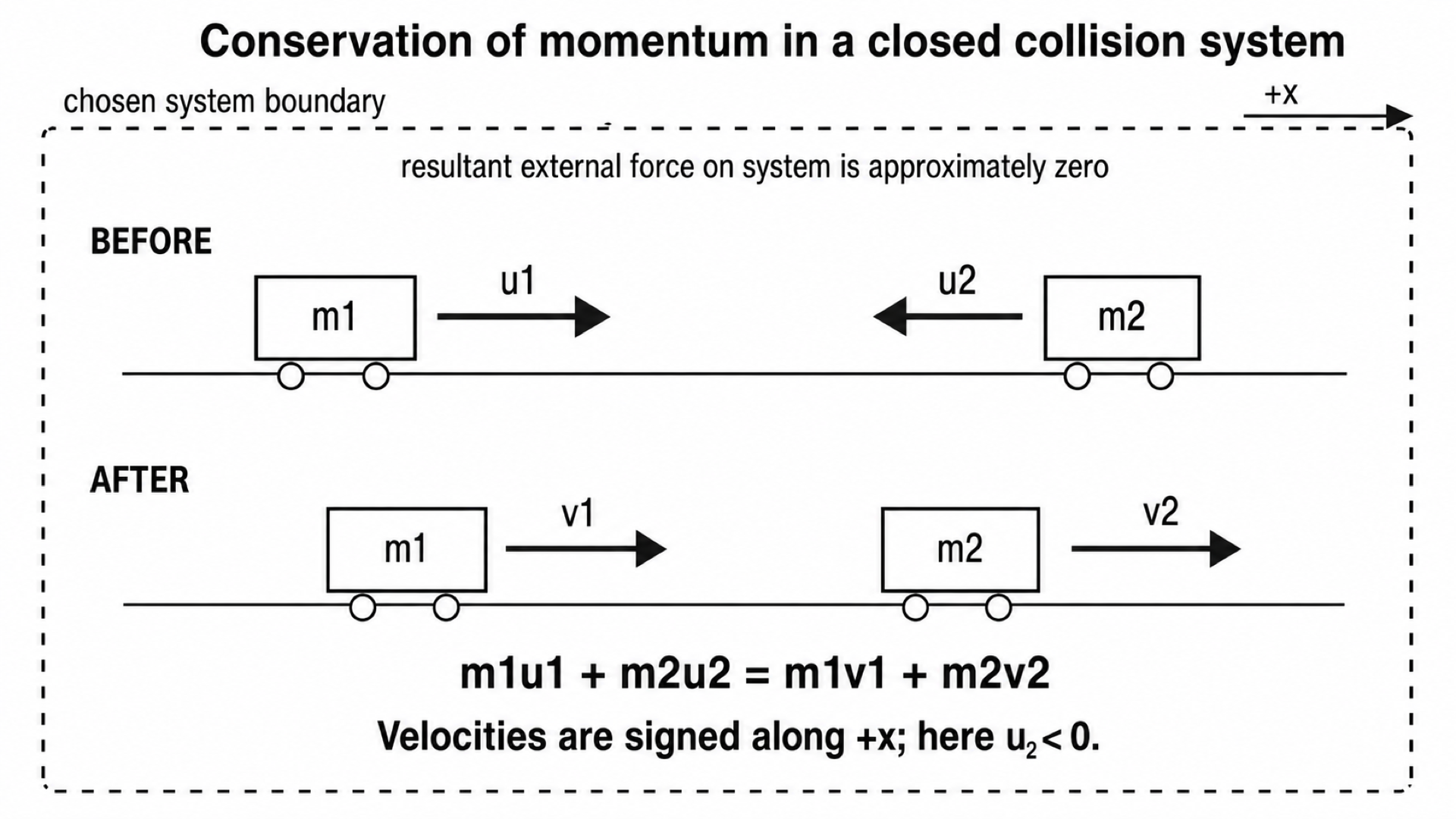
The principle of conservation of momentum says that the total momentum of a system remains constant if the resultant external force on that system is zero. During a collision, the bodies exert internal forces on each other. These internal forces change the momenta of the individual bodies, but they cannot change the total momentum of the whole two-body system.
Conservation of momentum
If no resultant external force acts on a system, the total momentum of the system before an interaction is equal to the total momentum after the interaction.
For two bodies in one dimension this is usually written as:
Total momentum before and after
The symbols and are the initial velocities; and are the final velocities. Each velocity must carry a sign. If right is chosen as positive, then a velocity to the left is negative.
[DIAGRAM: asset_name: 3.5.2 - Collisions and conservation of momentum - diagram 1; asset_slug: 3_05_2_collisions_and_conservation_of_momentum__diagram_01; recommended_method: drawn_physics; caption: Signed velocities describe a collision within a chosen system boundary.; description: Before and after collision states use signed velocities inside a chosen system boundary, with the external-force condition stated.]
Worked example: a separated collision
A trolley moves to the right at and collides with a trolley initially at rest. After the collision, the trolley continues to the right at . Find the final velocity of the trolley.
Choose right as positive.
Initial total momentum:
Final total momentum:
Set total momentum before equal to total momentum after:
The answer is positive, so the trolley moves to the right.
One-dimensional collision calculations
In a one-dimensional collision, all velocities lie along one straight line. The method is reliable if you set a positive direction first and keep that sign convention all the way through.
Use this calculation routine:
- Choose the system, usually the two colliding bodies.
- Choose a positive direction and assign signs to all velocities.
- Write total momentum before.
- Write total momentum after.
- Equate them and solve.
- Interpret the sign of the answer.
A negative final velocity is not a failed calculation. It means the body moves in the direction opposite to the one chosen as positive.
Worked example: two bodies stick together
A trolley moving to the right at collides with a trolley moving to the left at . The trolleys lock together after the collision. Determine their common final velocity.
Choose right as positive, so the second initial velocity is .
Initial total momentum:
After the collision, the combined mass is:
So:
The positive sign means the joined trolleys move to the right.
Now check the kinetic energy. This is not needed to find the velocity, but it helps classify the collision.
Before:
After:
The final kinetic energy is much smaller. Momentum is conserved, but kinetic energy is not.
Use momentum conservation to find unknown velocities. Use kinetic energy only when the question asks about energy or says the collision is perfectly elastic.
Elastic and inelastic collisions
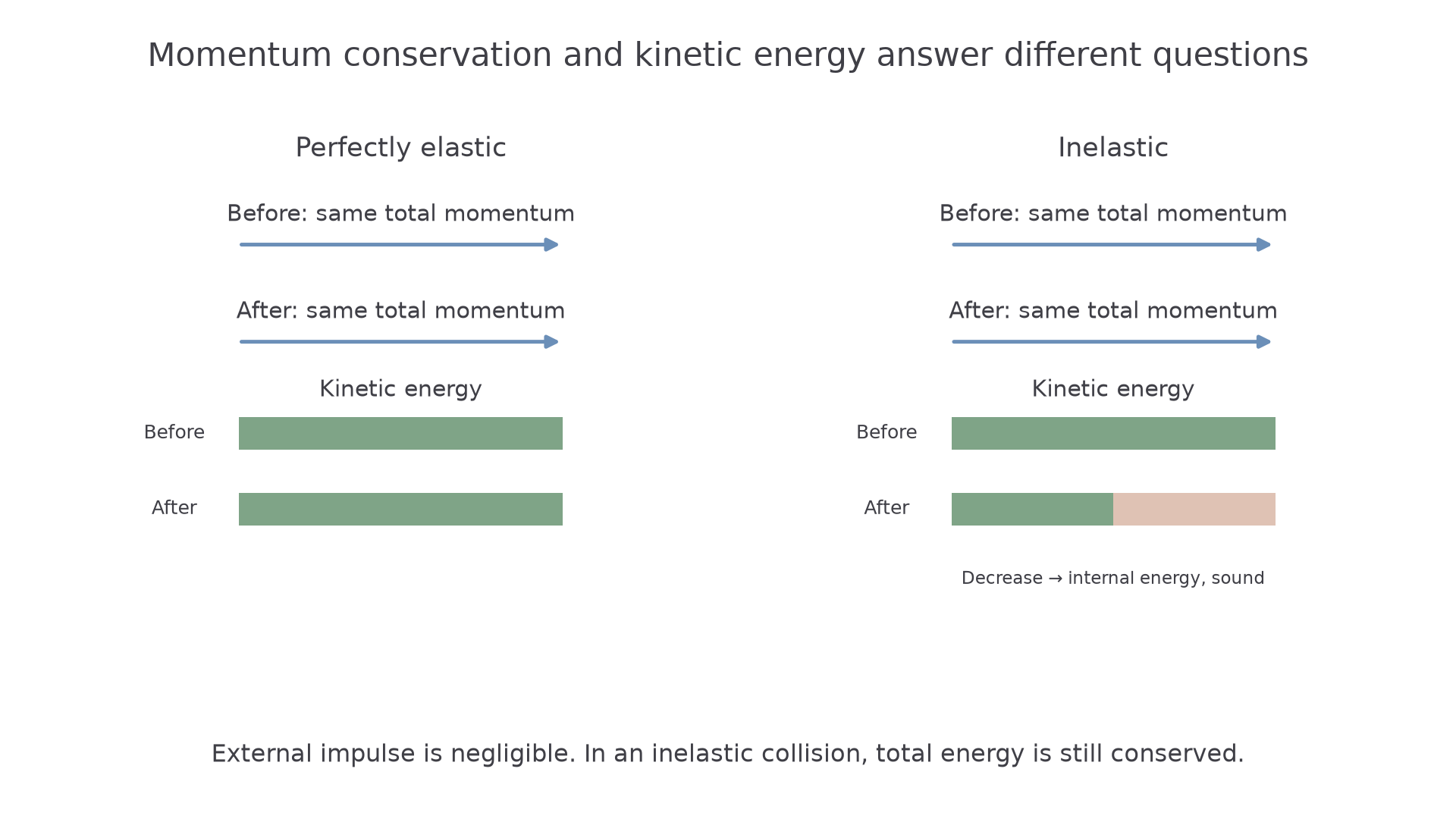
All collisions in this lesson are analysed using conservation of momentum, provided the external resultant force on the chosen system is negligible. The difference between elastic and inelastic collisions is about kinetic energy.
Perfectly elastic collision
A perfectly elastic collision is a collision in which total momentum and total kinetic energy are both conserved.
Inelastic collision
An inelastic collision is a collision in which total momentum is conserved but total kinetic energy is not conserved.
If the bodies stick together and move with one common velocity after impact, the collision is perfectly inelastic. This is a special type of inelastic collision, not the definition of every inelastic collision.
[DIAGRAM: asset_name: 3.5.2 - Collisions and conservation of momentum - diagram 2; asset_slug: 3_05_2_collisions_and_conservation_of_momentum__diagram_02; recommended_method: drawn_physics; caption: Momentum is conserved in both collisions but kinetic energy decreases in the inelastic case.; description: Equal before-and-after momentum arrows contrast with kinetic-energy bars that stay equal in an elastic collision and decrease in an inelastic collision.]
Worked example: classifying a collision
Two equal-mass trolleys are tested on a low-friction track. Trolley A has mass and moves at . Trolley B also has mass and is initially at rest. After the collision, trolley A is at rest and trolley B moves at .
Momentum before:
Momentum after:
Kinetic energy before:
Kinetic energy after:
Both total momentum and total kinetic energy are conserved, so this is a perfectly elastic collision within the precision of the data.
The phrase "within the precision of the data" matters. In a real experiment, the before and after values might differ slightly because of friction, sensor resolution, uncertainty in velocity, or a collision that is not perfectly head-on.
Continue this lesson.
You’re previewing NovaLearn without an account. Create a free account to read the rest.
Create free account