4.5.2 - The photoelectric effect
The photoelectric effect is one of the cleanest pieces of evidence that electromagnetic radiation can behave as photons. In this lesson you will connect a simple zinc-plate demonstration to the photon model, then use Einstein's photoelectric equation to calculate threshold frequency and maximum kinetic energy. The key separation is small but powerful: frequency controls energy per photon, while intensity controls the rate at which photons arrive.
Observing Electron Emission
The photoelectric effect is observed when electromagnetic radiation causes electrons to be emitted from the surface of a metal. Those emitted electrons are called photoelectrons.
Photoelectric Effect
The photoelectric effect is the emission of electrons from a metal surface when electromagnetic radiation of sufficiently high frequency is incident on the metal.
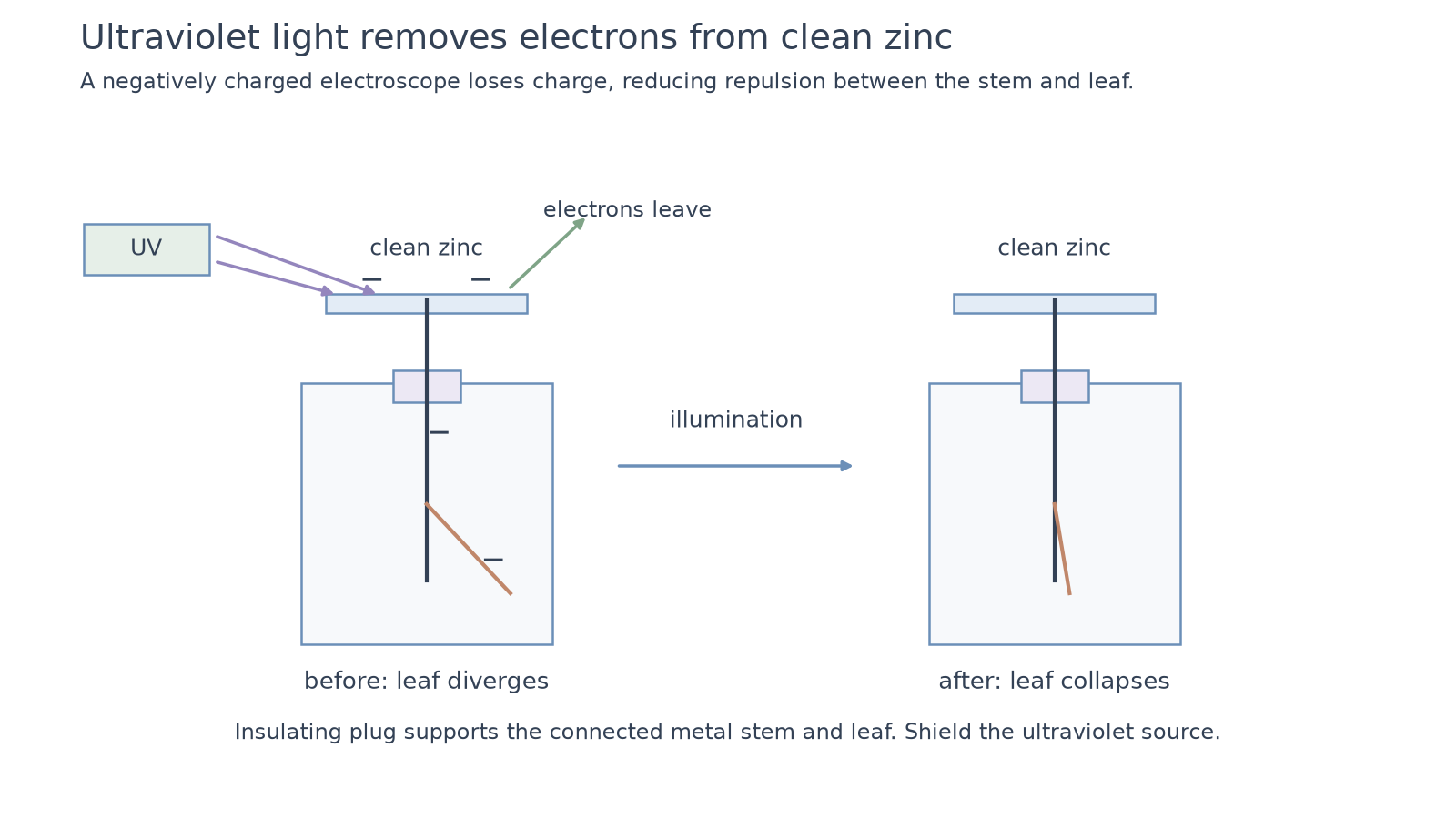
A standard demonstration uses a clean zinc plate connected to a negatively charged gold-leaf electroscope. The gold leaf initially diverges because the stem and leaf both have excess negative charge and repel each other. When ultraviolet radiation is shone onto the clean zinc plate, electrons are emitted from the zinc, the electroscope loses negative charge, and the leaf collapses.
The same demonstration also shows why the effect is not explained well by a simple continuous-wave model. Intense visible light may do nothing to the negatively charged zinc plate, while low-intensity ultraviolet radiation can discharge it quickly. The important difference is not the total brightness reaching your eye; it is the frequency of the radiation and therefore the energy of each photon.
Keep the practical detail sensible. The zinc surface should be clean because oxide or contamination can change the surface behaviour. Ultraviolet sources should be shielded and not viewed directly, and high-voltage charging should be handled as a demonstration with safe discharge of the apparatus.
The charge sign matters. With a positively charged electroscope the leaf does not collapse under the same illumination: electrons released near the surface are attracted back, and any net loss of electrons would increase the positive charge rather than neutralise it. Do not claim that positive charges leave the zinc.
Placing ordinary glass between a suitable ultraviolet source and the zinc can suppress discharge because the glass absorbs much of that ultraviolet while transmitting visible light. This control changes the radiation reaching the metal; it does not change the energy needed to release an electron from the same clean surface.
[DIAGRAM: asset_slug: 4_05_2_photoelectric_effect__diagram_01; caption: Ultraviolet light releases electrons from the negatively charged zinc plate. Reduced repulsion allows the gold leaf to fall.; description: The zinc plate, conducting stem and hinged gold leaf are electrically connected through an insulating support. UV ejects electrons from the negatively charged metal; the leaf then falls as repulsion decreases.]
One Photon, One Surface Electron
The photon model says that electromagnetic radiation arrives in packets of energy. A single photon has energy , where is the Planck constant and is the frequency of the radiation.
In the photoelectric effect, the interaction is one-to-one: one photon interacts with one surface electron. The surface electron cannot collect small amounts of energy from many low-frequency photons in the simple OCR model. If that one photon has enough energy, the electron can escape; if not, no photoelectron is emitted.
Work Function
The work function of a metal is the minimum energy required to remove an electron from the surface of that metal.
For the fastest emitted electrons, no extra energy is lost escaping from within the metal. Einstein's photoelectric equation is:
Einstein's Photoelectric Equation
Here is the energy of one incident photon in joules, is the work function in joules, and is the maximum kinetic energy of an emitted photoelectron in joules. The equation is supplied in the OCR data booklet, but exam questions still expect you to know what each term means.
Worked example: radiation of frequency is incident on a metal with work function . Calculate the maximum kinetic energy and maximum speed of the emitted photoelectrons. Use and .
First calculate the photon energy:
Then use Einstein's equation:
For the maximum speed, use :
Misconception contrast: the metal does not emit photons in this effect. The incident photons are absorbed; electrons are emitted from the metal surface.
Electrons can lose energy while travelling to the surface. The fastest emitted electrons escape with the maximum kinetic energy given by Einstein's equation.
The simple continuous-wave explanation would allow a surface electron to accumulate energy gradually: brighter light should deliver energy faster, and even low-frequency light should eventually eject electrons. The observed threshold and emission without a measurable delay above threshold contradict that prediction. Einstein’s photon explanation therefore made testable predictions connecting frequency, threshold and electron energy. Independent measurements of those relationships, with controls and openly reported methods, allowed the scientific community to test and refine the quantum account rather than accept it solely on the authority of its proposer. In the photon model one interaction supplies immediately; if , waiting or increasing intensity does not make one photon energetic enough.
Continue this lesson.
You’re previewing NovaLearn without an account. Create a free account to read the rest.
Create free account