4.2.5 - Electrical power, energy and cost
Electrical power tells you how quickly electrical energy is transferred by a circuit component. In this lesson you will connect the circuit meaning of power to the equations in the data booklet, then use the same idea to calculate energy transfer and the cost of electrical energy. The main skill is choosing the right quantities: the p.d. across the component, the current through it, and the time for which energy is transferred.
Power as Energy Transfer Rate
Power is a rate. A component with a large power transfers energy quickly; it does not necessarily transfer a large total amount of energy unless it is operating for long enough.
Power
Power is the rate of energy transfer, or the rate of doing work. Its unit is the watt, where .
In an electrical component, the p.d. tells you the energy transferred per unit charge, and the current tells you the charge passing per unit time.
- is the potential difference across the component, in volts.
- is the current through the component, in amperes.
- is the power transferred by the component, in watts.
If a charge passes through a p.d. , the energy transferred is . If the charge passes in time , then . So:
Electrical Power
The unit check is useful:
That is why a p.d. of and a current of gives a power of .
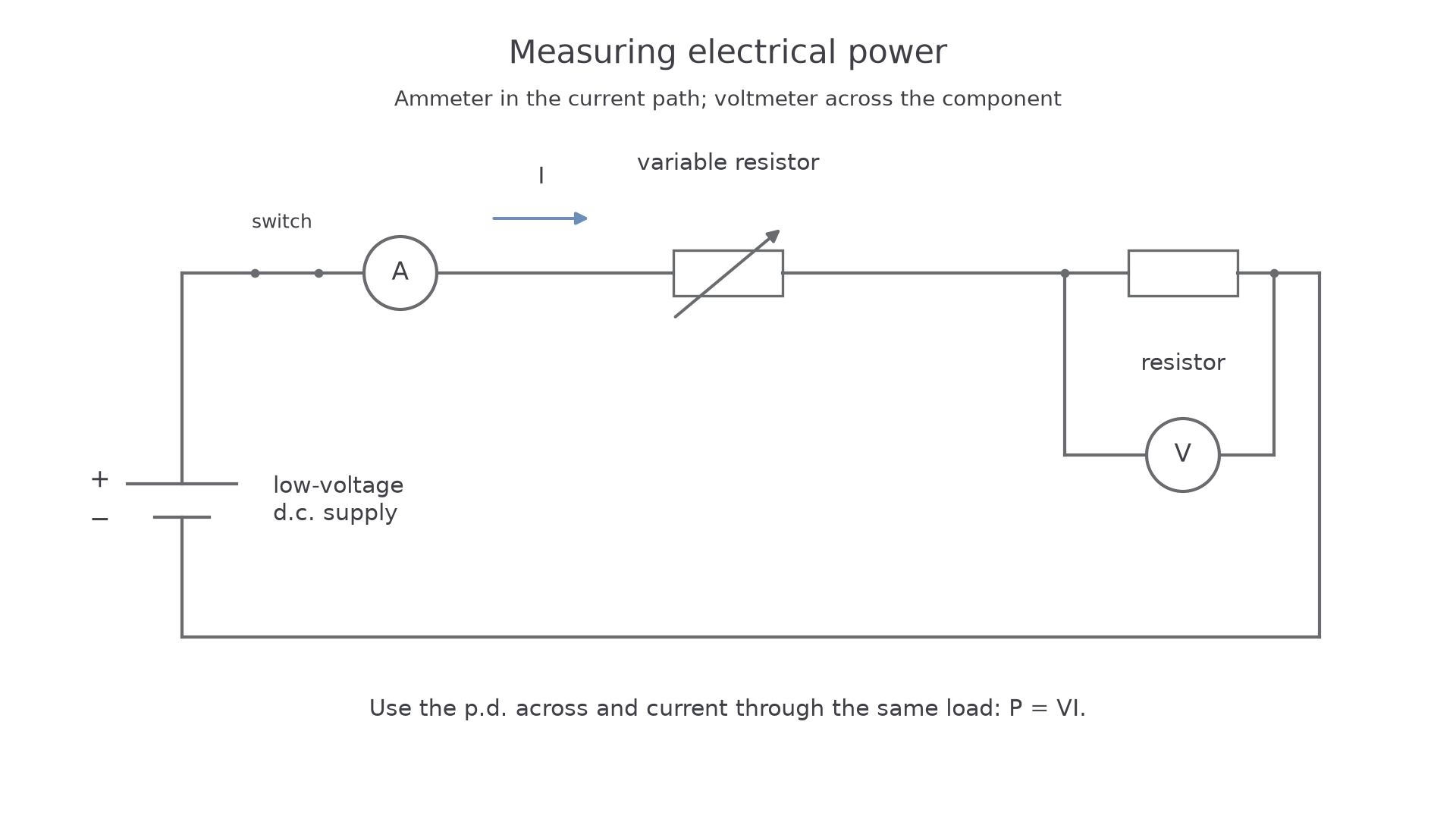
For a practical measurement of electrical power, measure the current through the component with an ammeter in series, and measure the p.d. across the same component with a voltmeter in parallel. The word same matters: using the total supply p.d. with the current through only one branch is a common circuit error.
Worked example: power of a lamp
A lamp has a p.d. of across it and a current of through it.
Use :
The measurements are both given to 2 significant figures, so:
This means the lamp transfers of energy each second.
[DIAGRAM: asset_slug: 4_02_5_electrical_power_and_energy_cost__diagram_01; description: Electrical power is calculated using the p.d. across and current through the same load.; caption: Measure current through and p.d. across the same load to determine power.]
Resistor Power Equations
For a resistor, the p.d., current and resistance are linked by . Combining this with gives two more useful forms.
Power in a Resistor
Use these with quantities for the same resistor or load:
- use when and are known
- use when and are known
- use when and are known
The two resistance forms can seem to contradict each other. They do not. They describe different controlled conditions.
- If the current is fixed, , so a larger resistance transfers more power.
- If the p.d. is fixed, , so a larger resistance transfers less power.
The control condition decides which comparison is valid.
Worked example: choosing the equation
A resistor has a current of through it.
The known quantities are and , so use :
To 2 significant figures:
As a check, the p.d. across the resistor would be:
Then , the same result.
Energy Transferred by a Circuit
Power tells you the rate of energy transfer. To find the total energy transferred, multiply by the time.
Electrical Energy Transfer
Here is the energy transferred or work done, in joules. This is a different use of the letter from the unit symbol W for watt. In written work, use context and units to keep them separate.
The equation follows from and . It is useful when a circuit question gives p.d., current and time directly.
Worked example: energy transferred by a heater
A low-voltage heater has a p.d. of across it and a current of through it. It is switched on for .
First convert the time:
Then use :
To 2 significant figures:
You can also calculate the power first:
Both routes are the same physics.
The product assumes constant power, or that is the mean power over the stated interval. If a device cycles between settings, calculate . More generally, the area under a power–time graph is the energy transferred.
Continue this lesson.
You’re previewing NovaLearn without an account. Create a free account to read the rest.
Create free account