5.1.1 - Temperature and thermal equilibrium
Temperature is more than a number on a thermometer. It tells us the direction in which thermal energy would be transferred, and a thermometer gives a reliable reading after its probe reaches thermal equilibrium with the object. In this lesson you will learn the OCR definitions and habits for thermal equilibrium, the absolute kelvin scale, and converting between degrees Celsius and kelvin.
Thermal Equilibrium
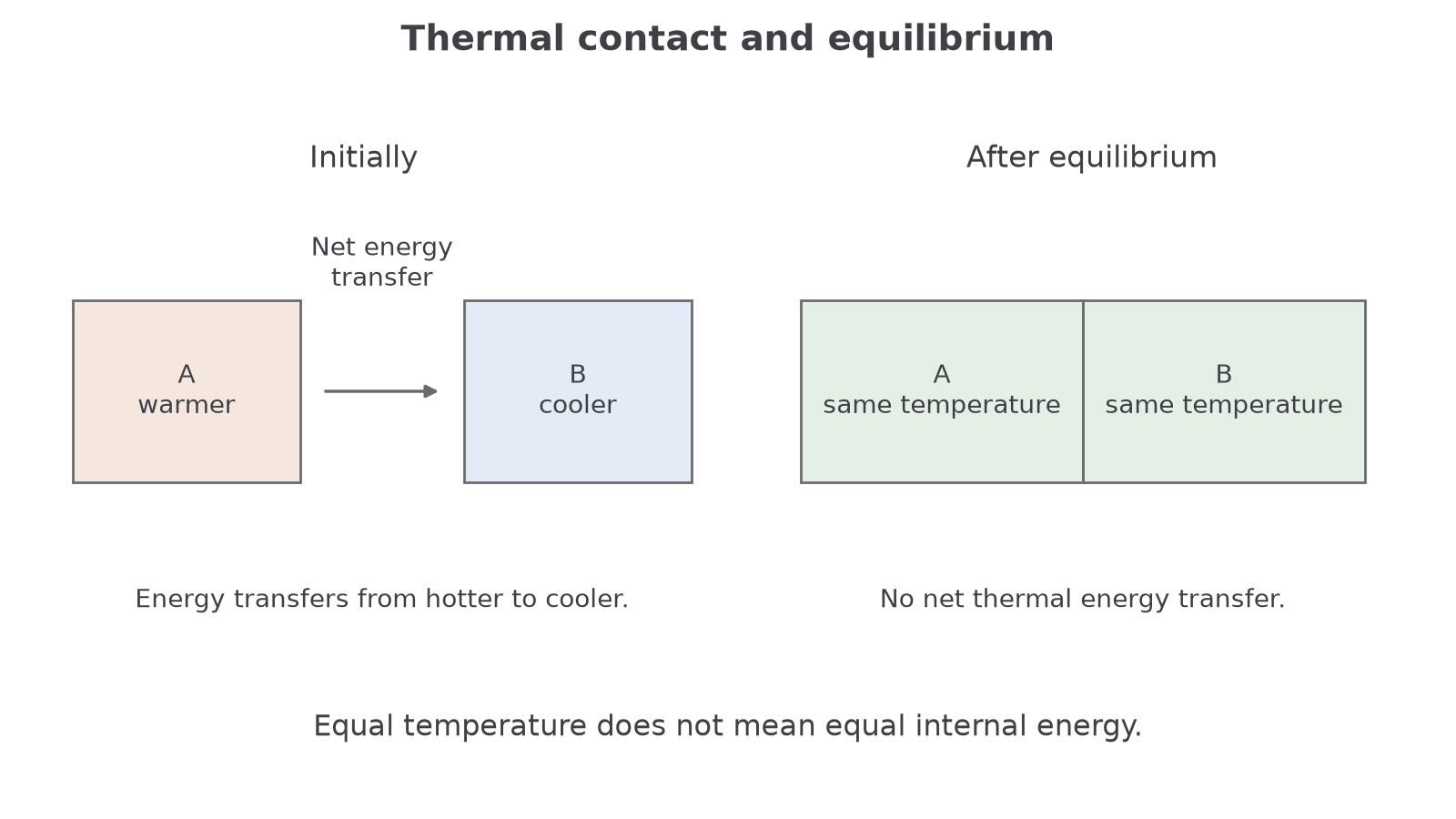
If two objects at different temperatures are placed in thermal contact, there is a net transfer of thermal energy from the object at the higher temperature to the object at the lower temperature. The warmer object cools and the cooler object warms until they have the same temperature. At that point, there is no net transfer of thermal energy between them.
Thermal equilibrium
Two systems are in thermal equilibrium when they are at the same temperature and there is no net thermal energy transfer between them.
A thermometer works by using this idea. When a thermometer is first placed in a liquid, the thermometer and the liquid are usually not yet in thermal equilibrium. The thermometer reading changes while thermal energy is transferred between them. A valid reading is taken only once the thermometer reading is steady, because then the thermometer is at the same temperature as the liquid.
This does not mean the thermometer and liquid have the same internal energy. A large beaker of water and a small thermometer can be at the same temperature while containing very different amounts of energy. Thermal equilibrium is about temperature and net transfer, not about equal stored energy.
[DIAGRAM: asset_slug: 5_01_1_temperature_and_thermal_equilibrium__diagram_01; description: Thermal energy flows from hotter to colder objects until both reach the same temperature.; caption: Thermal energy flows from hotter to colder objects until both reach the same temperature.]
The Absolute Temperature Scale
Everyday thermometers often rely on a property of a particular substance. For example, a liquid-in-glass thermometer uses the expansion of a liquid, and an electrical temperature sensor may use a resistance that changes with temperature. Those are useful practical devices, but the OCR idea here is deeper: physics needs a temperature scale that is not defined by the behaviour of any one thermometric substance.
Absolute temperature scale
The absolute, or thermodynamic, temperature scale is a temperature scale that does not depend on the property of any particular substance. Its SI unit is the kelvin, symbol .
The kelvin scale starts at absolute zero, written . In this lesson you only need the scale idea: kelvin is an absolute thermodynamic temperature, so a temperature in kelvin is measured up from zero on that scale. Do not attach a degree symbol or the word "degrees" to kelvin.
This is also a How Science Works point. Temperature scales developed from convenient fixed points and material properties toward a universal thermodynamic scale. That is why an OCR question may ask why an absolute scale is preferable to a scale based on a particular liquid, gas or resistor.
Continue this lesson.
You’re previewing NovaLearn without an account. Create a free account to read the rest.
Create free account