4.4.2(d)-(e) - Refraction and total internal reflection
Light changes speed when it enters a different transparent material, and an obliquely incident ray can change direction as a result. In this lesson you will connect the physical idea of speed change to refractive index, Snell's law, critical angle and total internal reflection. You will also learn the ray-box methods OCR expects for rectangular and semi-circular blocks.
Refractive Index as a Speed Ratio
Refraction occurs when light crosses a boundary between transparent media and changes speed. At oblique incidence its direction generally changes; at normal incidence its speed changes without bending. The boundary might be air to glass, glass to air, water to plastic, or any other pair of transparent materials.
The normal is an imaginary line drawn at right angles to the boundary at the point where the ray meets the surface. In this topic, every angle is measured between the ray and the normal, not between the ray and the surface.
Refractive Index
The refractive index of a material is the ratio of the speed of light in a vacuum to the speed of light in that material.
Refractive Index
Here is the speed of light in a vacuum, , and is the speed of light in the material. Refractive index has no unit because it is a ratio of two speeds.
A larger refractive index means light travels more slowly in that material. For ordinary transparent materials in this course, is greater than 1 because light travels slower in the material than in a vacuum.
Worked example: light travels through a glass block with refractive index . Calculate the speed of light in the glass.
Rearrange:
Substitute:
The speed of light in the glass is . This is lower than , as expected for .
Snell's Law at a Boundary
At a boundary, the ray direction is linked to the refractive indices of the two media. OCR writes this as at a boundary, where is measured to the normal.
Snell's Law
Here is the refractive index of medium 1, is the angle of the ray in medium 1 to the normal, is the refractive index of medium 2, and is the angle of the ray in medium 2 to the normal. The equation is in the OCR formula booklet; the skill is recognising which index and which angle go together.
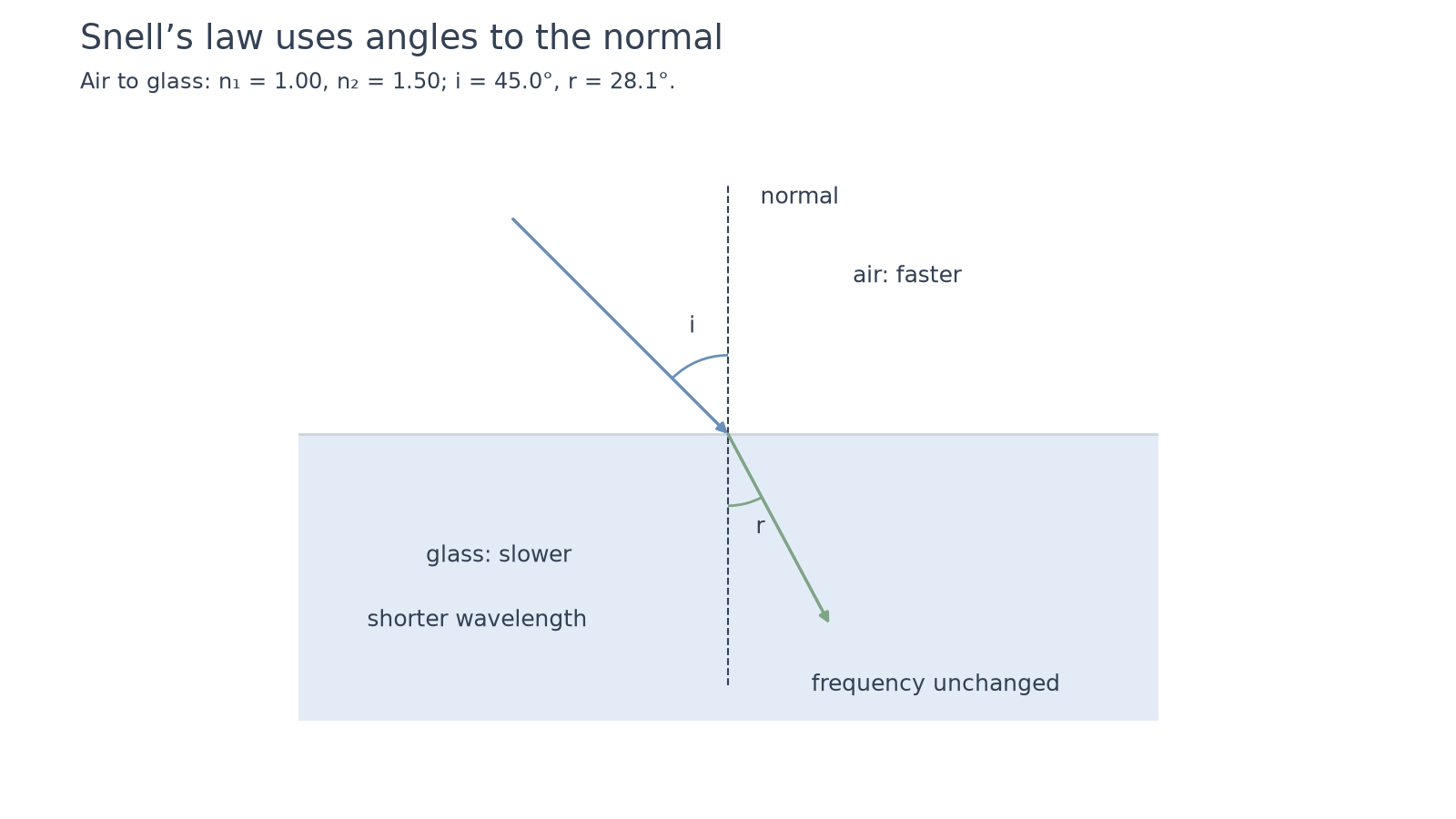
If light enters a higher refractive index material, it slows down and bends towards the normal, so the refracted angle is smaller. If light leaves a higher refractive index material for a lower refractive index material, it speeds up and bends away from the normal. A ray along the normal has , so it changes speed but does not change direction.
Worked example: a ray travels from air, , into glass, . The angle of incidence in air is . Calculate the angle of refraction in the glass.
Use Snell's law:
The ray bends towards the normal because it has entered the higher refractive index material.
A common error is to measure angles to the surface. If a ray is to the surface, it is to the normal. Snell's law needs the , not the .
The frequency stays unchanged at a stationary boundary. Since , the wavelength changes in the same ratio as speed: entering glass reduces both. If a stated ray angle is measured from the surface, first subtract it from to obtain the angle used in Snell's law.
At two perpendicular faces, the normals are perpendicular too. A ray refracted through angle to the first normal reaches the second face at to its normal. Draw both normals before transferring an angle: parallel faces instead give the same internal angle at each face.
[DIAGRAM: asset_slug: 4_04_2b_refraction_and_total_internal_reflection__diagram_01; caption: An incident angle of 45.0° in air becomes 28.1° in glass of refractive index 1.50. Both angles are measured to the normal.; description: A 45-degree incident ray bends to 28.1 degrees in index-1.50 glass. The rays meet at the boundary and both angles are measured to its normal.]
Rectangular Block Refraction Method
A rectangular glass or plastic block lets you investigate Snell's law with a ray box. The aim is to measure pairs of angles and , then use and to find the refractive index of the block.
One practical route is:
- Place the rectangular block on plain paper and draw around it.
- Use a ray box to send a narrow ray into one face of the block at a chosen angle.
- Mark the incident ray, the point where it enters, the point where it leaves, and the emergent ray.
- Remove the block and join the entry and exit points to trace the ray inside the block.
- Draw a normal at the entry point.
- Measure the angle of incidence in air and the angle of refraction in the block, both to the normal.
- Repeat for several different values of .
For air to block, take . Snell's law becomes:
So:
Instead of relying on one pair of angles, a better method is to calculate and for several readings and plot on the vertical axis against on the horizontal axis. The gradient of the best-fit line is the refractive index of the block.
Good practical technique matters. Use a thin, bright ray; keep the block fixed on its outline; mark ray positions carefully; place the protractor centre at the point of incidence; and read the protractor without parallax. The main uncertainty is usually angle measurement, often about , made worse if the ray is broad. Repeating readings and using a graph reduce the effect of random scatter.
Use a best-fit line through the measured trend, checking whether its intercept is consistent with zero within uncertainty. Forcing a line through the origin can conceal an alignment offset. Take the gradient from two widely separated points on the line, not necessarily two measured points. A systematic error can occur if the block moves after the outline has been drawn or if the normal is not perpendicular to the block face.
Continue this lesson.
You’re previewing NovaLearn without an account. Create a free account to read the rest.
Create free account