4.4.1(f)-(g) - Wave effects, polarisation and intensity
Waves are useful because they behave in predictable ways when they meet a boundary, a gap, or a filter. In this lesson you will learn how to describe reflection, refraction, diffraction and polarisation, how to demonstrate these effects with OCR-style apparatus, and how intensity connects wave power, area and amplitude. The aim is to move from what you would see in a lab to the language and calculations that earn marks.
Wave Effects At Boundaries And Gaps
A progressive wave transfers energy from one place to another. When that wave reaches a boundary or opening, the energy does not simply vanish; the wave can change direction, pass into a new region, spread out, or have its oscillations selected in one plane.
Reflection
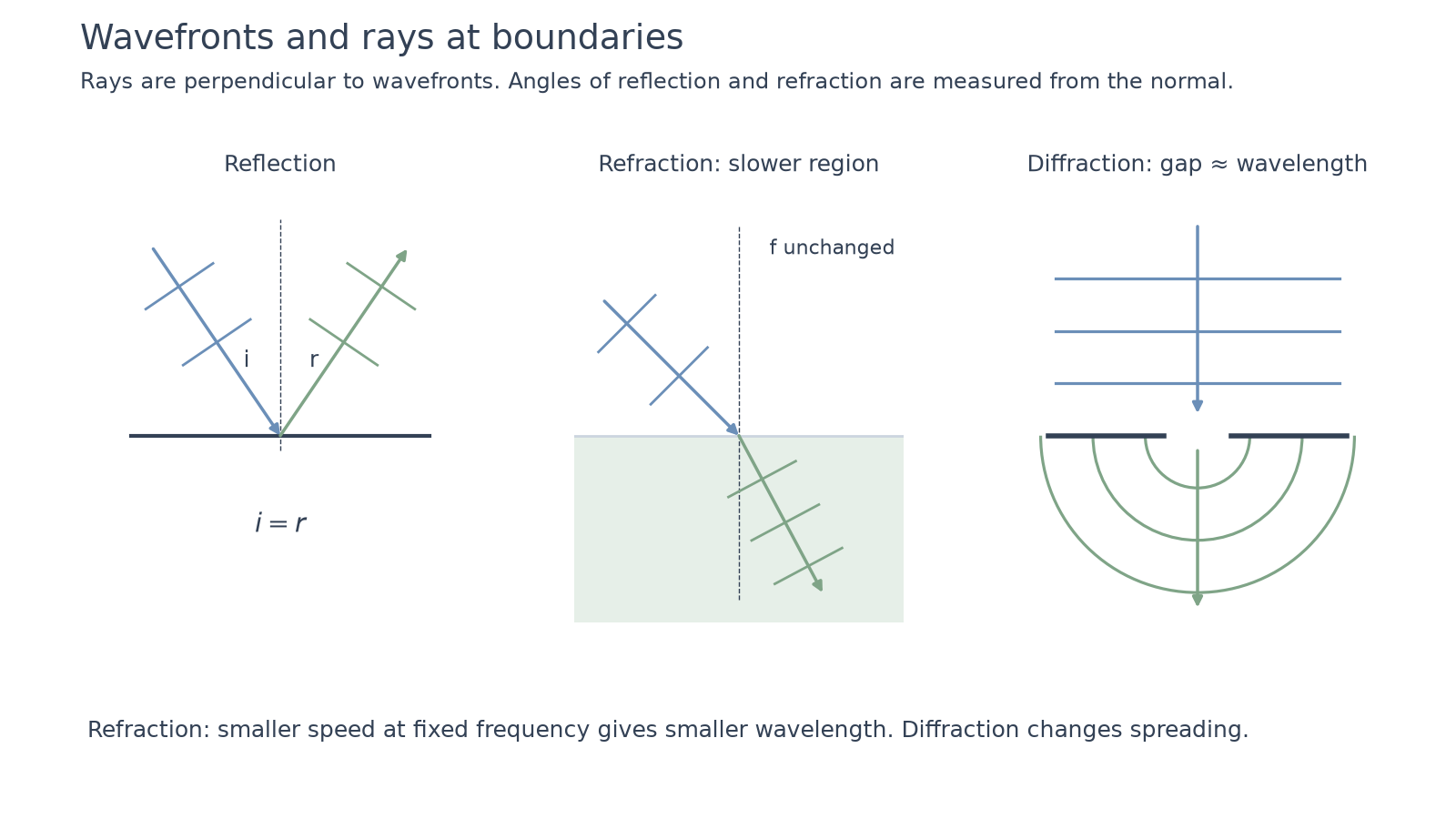
Reflection is the change in direction of a wave when it bounces from a boundary. For a straight boundary, the angle of incidence equals the angle of reflection, with both angles measured from the normal.
Refraction
Refraction occurs when a wave crosses into a region with a different wave speed. Its wavelength changes while its frequency remains set by the source. Its direction generally changes at an oblique boundary; at normal incidence the speed and wavelength change without bending.
Diffraction
Diffraction is the spreading of waves as they pass through a gap or around an obstacle. Diffraction is most significant when the wavelength is comparable with the gap width or obstacle size.
Reflection, refraction and diffraction can be shown with many wave types, including water waves, sound waves and light waves. Polarisation is different because it depends on the direction of oscillation.
Polarisation
Polarisation restricts oscillations to one fixed direction perpendicular to wave travel. That direction and the direction of travel define a fixed plane of polarisation. It is a property of transverse waves, because their oscillations are perpendicular to the direction of energy transfer.
A longitudinal wave, such as sound in air, has oscillations parallel to the direction of travel. There is no sideways plane of oscillation to select, so a longitudinal wave cannot be polarised. This is why observing polarisation is evidence that a wave is transverse.
Notice the careful wording: refraction involves a speed change across a boundary; oblique rays usually bend, while a ray along the normal does not. Diffraction is not just any bending either; OCR expects the condition that the wavelength must be comparable with the gap width for a large effect.
Ripple Tank Demonstrations
A ripple tank makes water waves visible. A shallow tray of water is placed above a screen or white sheet. A lamp shines down through the water, so the crests and troughs make moving bright and dark lines on the screen. A vibrating bar produces straight wavefronts; a point dipper produces circular wavefronts.
For reflection, place a straight barrier in the water. Use straight wavefronts and observe the wavefronts after they meet the barrier. A ray drawn perpendicular to the wavefronts changes direction at the barrier, and the angles to the normal are equal.
For refraction, place a glass or plastic sheet under part of the tank so that one region is shallower. Send straight waves at an angle to the depth boundary. In the shallower water the waves travel more slowly and their wavelength is smaller, so the wavefront spacing decreases and the direction changes.
For diffraction, use two straight barriers with a gap between them. Start with a gap much larger than the wavelength: the wavefronts mostly continue forwards with little spreading. Then reduce the gap until its width is about the wavelength: the transmitted waves spread out strongly into semicircular wavefronts.
Good practical answers include the details that make the observation reliable:
- keep the water depth and vibrator frequency steady unless that is the variable being changed
- measure several crest spacings and divide by the number of wavelengths to reduce percentage uncertainty
- use a strobe or freeze-frame video if the pattern is moving too quickly
- keep electrical equipment away from spills and use low-voltage ripple-tank apparatus
- describe what changes and what is observed, rather than just naming the effect
Worked practical description: diffraction
Set up a ripple tank with a straight vibrating bar to make plane wavefronts. Put two barriers in the tank to form a gap. Measure across several adjacent projected crests and divide by the number of crest-to-crest intervals. Compare the projected wavelength with the projected gap width on the same image, or calibrate the image scale to convert both to actual tank distances; a projection can magnify lengths. Adjust the gap width from much larger than the wavelength to approximately equal to the wavelength. The expected observation is little spreading for the wide gap, and strong spreading into curved wavefronts when the gap width is comparable with the wavelength.
A wavefront joins points in the same phase. Its direction of travel is perpendicular to the wavefront. To compare reflection angles, draw incident and reflected rays perpendicular to their respective fronts and a normal perpendicular to the barrier. To compare refraction, track how both the front orientation and the distance between fronts change while the vibrator frequency stays fixed.
[DIAGRAM: asset_slug: 4_04_1b_wave_effects_polarisation_and_intensity__diagram_01; caption: Wavefronts show equal reflection angles, shorter wavelength in the slower region and spreading beyond a narrow gap.; description: Reflection rays meet at the same point with equal angles. Refracted wavefronts are perpendicular to the bent ray and closer together in the slower region. Circular fronts spread beyond a narrow gap.]
Continue this lesson.
You’re previewing NovaLearn without an account. Create a free account to read the rest.
Create free account