5.1.2 - Kinetic model, internal energy and phase change
Thermal physics becomes much easier once you can move between two pictures: what you see in the laboratory and what the atoms or molecules are doing. In this lesson you will use the kinetic model to explain solids, liquids, gases, Brownian motion, internal energy, absolute zero and why temperature stays constant during a change of phase.
Particles In Solids, Liquids and Gases
The kinetic model describes matter as a large number of atoms or molecules in continual motion. It is a model, not a photograph: it simplifies the microscopic world so that macroscopic properties such as shape, volume, compressibility and temperature make physical sense.
Simple Kinetic Model
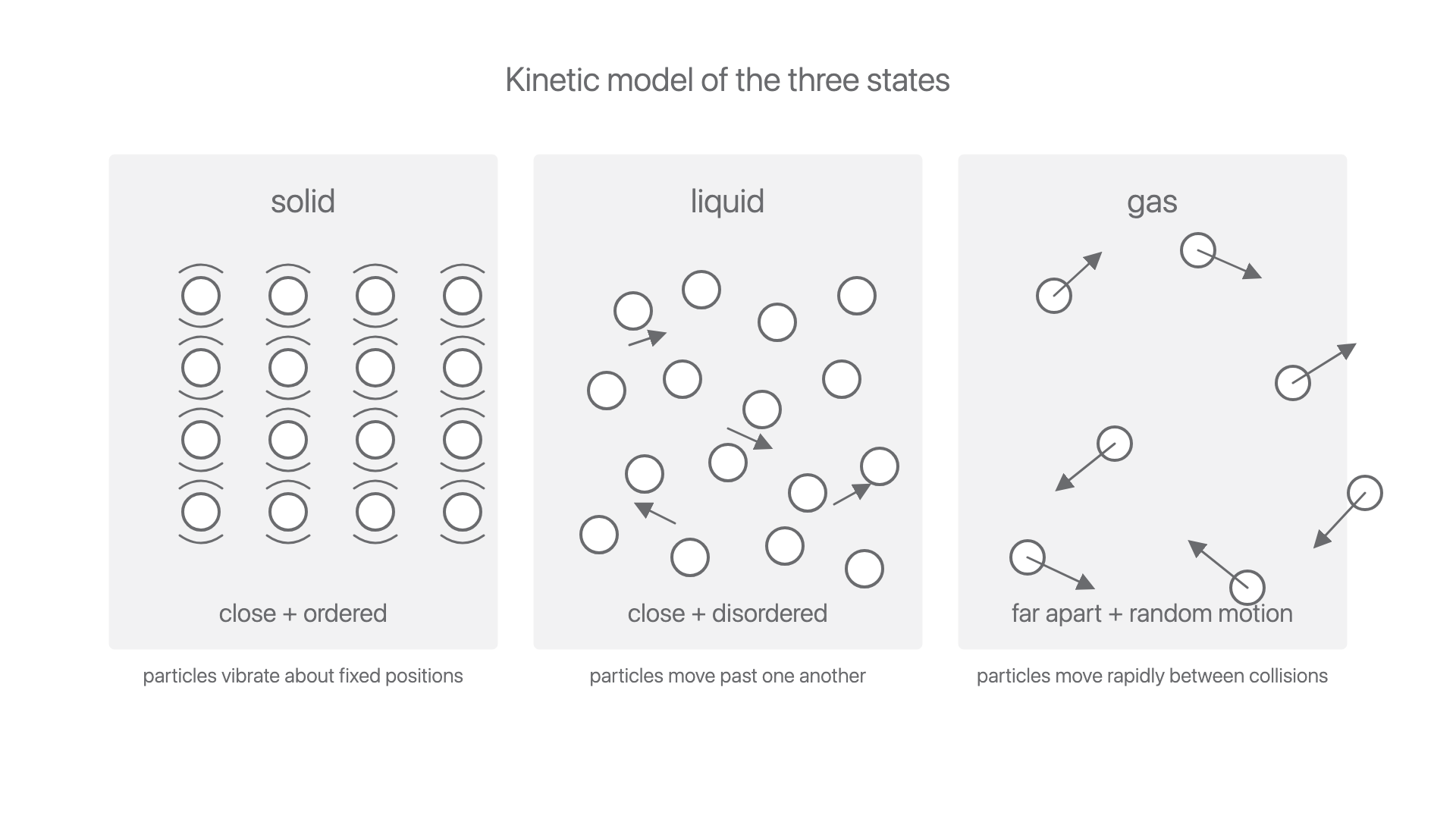
The simple kinetic model explains solids, liquids and gases in terms of the spacing, ordering and motion of their atoms or molecules.
In a crystalline solid, the particles are close together and arranged in an ordered pattern. They cannot move freely through the solid, but they vibrate about fixed equilibrium positions. This is why a solid normally keeps both a fixed shape and a fixed volume.
In a liquid, the particles are still close together, but their arrangement is disordered. They can move past one another, so the liquid flows and takes the shape of its container while keeping a nearly fixed volume.
In a gas, the particles are far apart compared with their own size and have no long-range order. They move rapidly and randomly between collisions, so a gas fills the whole container and is much easier to compress than a solid or a liquid.
The key exam habit is to describe spacing, ordering and motion separately. "The particles are more energetic" is often too vague on its own. Say whether you mean faster random motion, greater separation, weaker ordering, or the ability to move past other particles.
[DIAGRAM: asset_slug: 5_01_2_kinetic_model_internal_energy_and_phase_change__diagram_01; description: Particle spacing, arrangement and motion in solids, liquids and gases.; caption: Particle spacing, arrangement and motion in solids, liquids and gases.]
Brownian Motion As Evidence
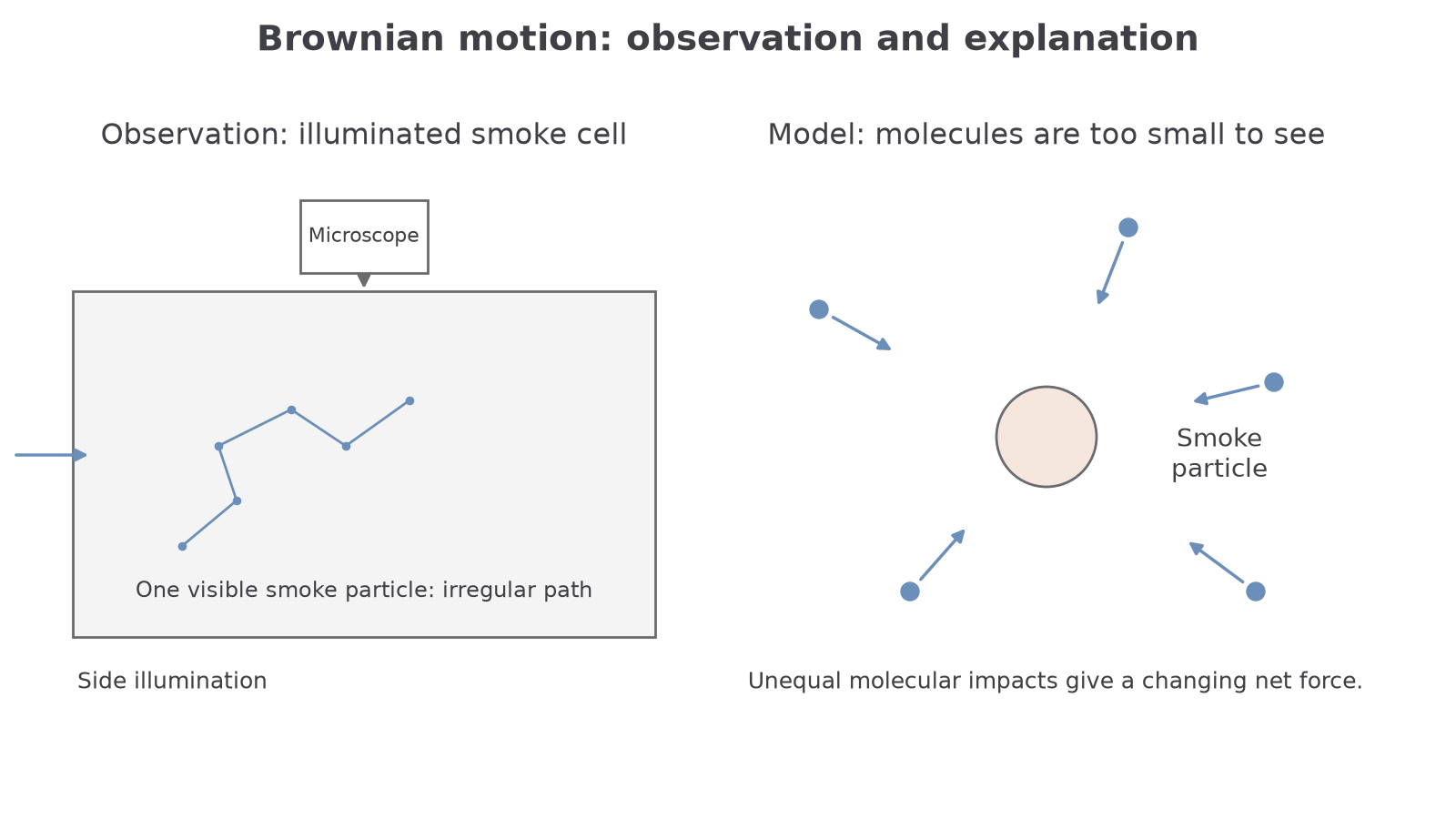
Brownian motion is the random, jerky motion of small particles suspended in a fluid. OCR names a simple demonstration using smoke particles suspended in air, because the smoke particles can be seen under a microscope while the air molecules causing the motion cannot.
Brownian Motion
Brownian motion is the irregular random motion of microscopic particles suspended in a fluid, caused by collisions with smaller randomly moving molecules of the fluid.
In a smoke-cell demonstration, a tiny amount of smoke is trapped in a transparent cell. A lamp illuminates the cell from the side, and a microscope is focused on the smoke particles. The particles appear as bright specks that move in a random zig-zag way.
The explanation is not that the smoke particle chooses a direction. It is being hit by many much smaller air molecules. At any instant the impacts are not perfectly balanced, so the net force on the smoke particle changes unpredictably. This gives the visible particle a jerky path.
This is evidence for the kinetic model because it shows that gas molecules are in continuous random motion even though the molecules themselves are too small to see directly. A smooth drift of all the smoke particles in one direction would suggest air currents or convection, not Brownian motion. Sensible practical controls are to use a closed cell, allow the apparatus to settle, and avoid draughts or strong heating from the lamp. The smoke source should be handled so that smoke is not inhaled.
[DIAGRAM: asset_slug: 5_01_2_kinetic_model_internal_energy_and_phase_change__diagram_02; description: Observed Brownian motion and the molecular-collision explanation are shown separately.; caption: Observed Brownian motion and the molecular-collision explanation are shown separately.]
Internal Energy and Absolute Zero
The kinetic model lets us be precise about the energy inside a system. Internal energy is not the kinetic energy of the object as a whole. A beaker of water sitting still on a bench has no macroscopic kinetic energy, but its molecules are still moving and interacting.
Internal Energy
The internal energy of a system is the sum of the random distribution of kinetic energies and potential energies associated with its atoms or molecules.
The random kinetic energy part is associated with molecular motion: vibration, rotation and translation depending on the substance and state. The potential energy part is associated with the positions of particles and the forces between them. If particles are moved further apart against attractive forces, their potential energy changes.
Continue this lesson.
You’re previewing NovaLearn without an account. Create a free account to read the rest.
Create free account