3.5.1(a)-(c) - Newton's laws and momentum
Forces do not just "make things move"; they change the motion of objects. In this lesson you will connect Newton's three laws to momentum, the quantity that combines mass and velocity. The central OCR idea is that resultant force is the rate of change of momentum, with as the constant-mass case you already know.
Newton's Laws As A Force Model
Newton's laws are a model for predicting how an object responds to the forces acting on it. The word resultant or net matters: individual forces can be large, but the motion changes only according to the vector sum of all external forces on the object.
Newton's First Law
An object remains at rest or continues moving with constant velocity unless acted on by a non-zero resultant external force.
Constant velocity means both constant speed and constant direction. A car moving in a straight line at constant speed can still have an engine force and resistive forces, but these forces are balanced if the resultant force is zero.
Newton's Second Law
The resultant external force on an object is equal to the rate of change of its momentum and acts in the direction of that momentum change.
For an object of constant mass, this becomes the familiar relationship . OCR expects you to know this is a special case, not the most general statement.
Newton's Third Law
When object A exerts a force on object B, object B exerts an equal and opposite force of the same type on object A.
The two third-law forces act on different objects, so they do not cancel when you draw a free-body diagram for just one object. If a swimmer pushes water backwards, the water pushes the swimmer forwards with an equal and opposite force.
Worked reasoning: constant velocity
A box is pulled across a horizontal surface at constant velocity. The pull to the right is and the frictional force to the left is .
- The resultant horizontal force is .
- By Newton's first law, the velocity remains constant.
- The box is not "force-free"; it has zero resultant force.
Newton's first and second laws connect motion to the resultant external force. The third law identifies an interaction pair acting on two different objects.
Linear Momentum Is A Vector
Linear momentum measures the quantity of motion of an object. It depends on both mass and velocity, so a heavier object at the same velocity has more momentum, and the same object has different momentum if its velocity changes direction.
Linear Momentum
Linear momentum is the product of mass and velocity. It is a vector quantity in the same direction as the velocity.
Momentum
Here is momentum in , is mass in kg, and is velocity in . Because mass is scalar and velocity is vector, momentum is vector.
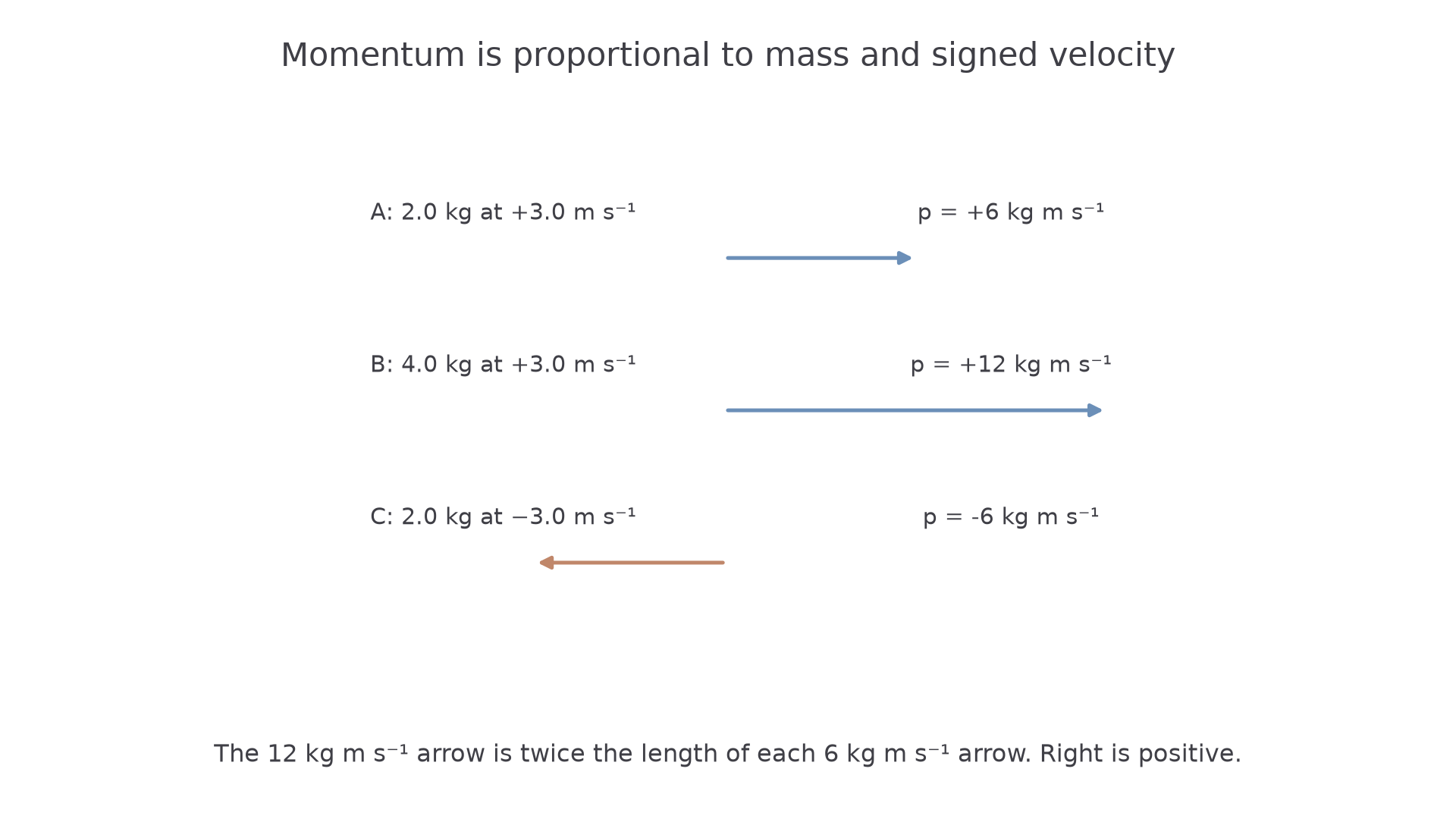
[DIAGRAM: asset_name: 3.5.1(a)-(c) - Newton's laws and momentum - diagram 1; asset_slug: 3_05_1a_newtons_laws_and_momentum__diagram_01; recommended_method: drawn_physics; caption: Scaled arrows show the magnitude and direction of momentum.; description: Scaled momentum arrows compare positive momenta of 6 and 12 kg metres per second with a negative momentum of the same magnitude as the first.]
Worked example: calculating vector momentum
A tennis ball of mass travels horizontally at to the right. Taking right as positive,
To two significant figures, to the right. If the same ball moved left at the same speed, its momentum would be using this sign convention.
The sign is not decoration. It tells you direction and it controls the change in momentum when an object reverses direction.
Momentum has size and direction. Treating it as just "mass times speed" loses half the physics.
Force Is Rate Of Change Of Momentum
Newton's second law is written most generally as a momentum statement.
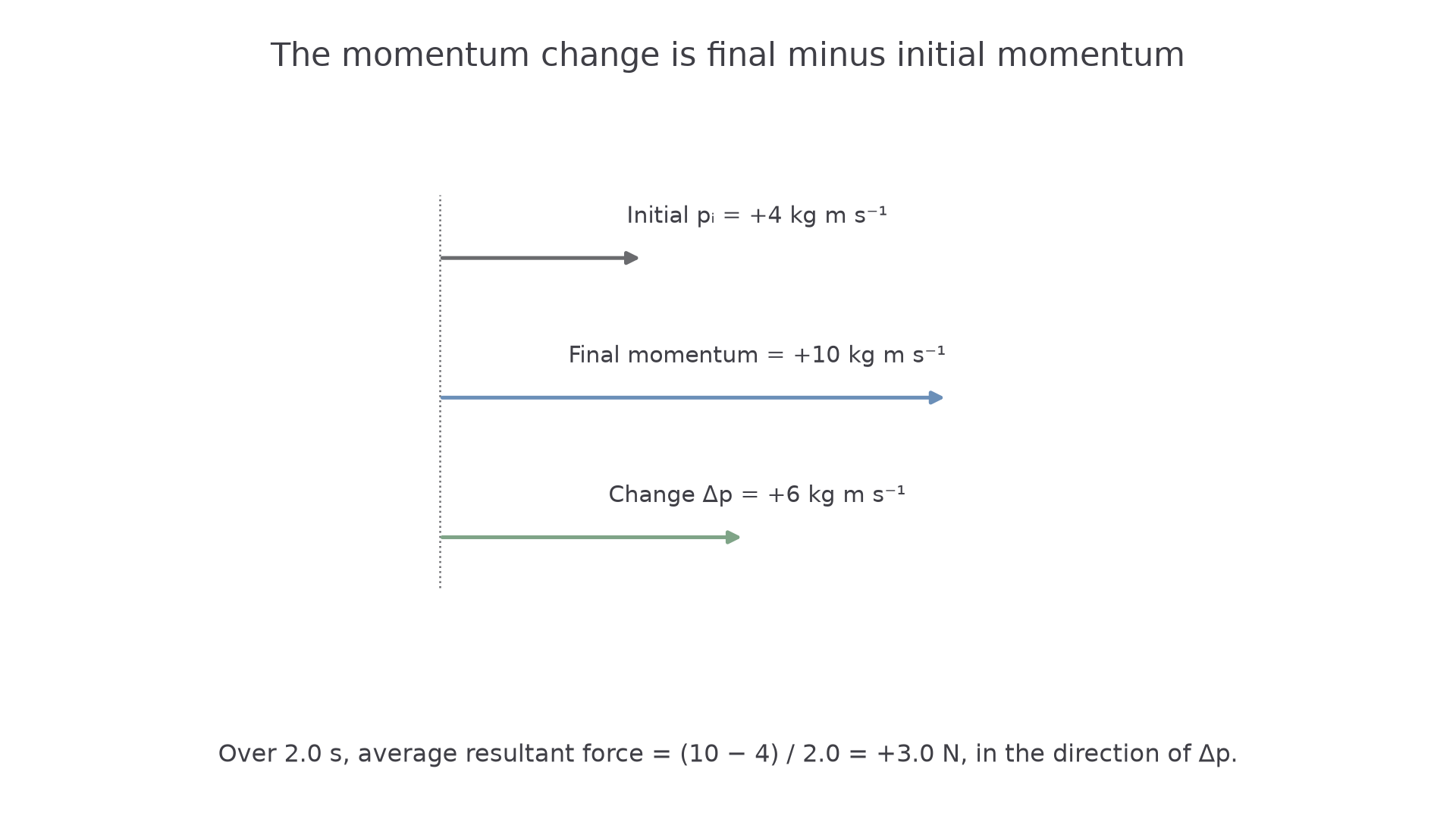
Net force and momentum change
is the resultant external force in N, is the change in momentum in , and is the time interval in s. For a finite interval this gives the average resultant force; the instantaneous force is the limiting value as becomes very small. For a continuous stream of material, such as air from a fan, use the mass flowing per second multiplied by its change of velocity.
[DIAGRAM: asset_name: 3.5.1(a)-(c) - Newton's laws and momentum - diagram 2; asset_slug: 3_05_1a_newtons_laws_and_momentum__diagram_02; recommended_method: drawn_physics; caption: Subtracting initial momentum from final momentum gives the momentum change.; description: Initial and final momentum vectors of 4 and 10 kg metres per second have a change of 6 kg metres per second, produced by a 3 N force over 2 s.]
For constant mass, the momentum form reduces to :
This derivation assumes the mass of the object is constant. In a mass-flow situation, such as a fan pushing air or a rocket ejecting gas, using carelessly can be wrong. Follow a fixed collection of matter, or explicitly account for momentum carried into and out of a chosen region. For a steady stream, the force associated with changing its velocity is mass flow rate multiplied by velocity change; do not differentiate the momentum of a changing-mass object while ignoring the expelled or incoming matter.
Continue this lesson.
You’re previewing NovaLearn without an account. Create a free account to read the rest.
Create free account