5.5.3(j)-(o) - Big Bang evidence, age and composition
The Big Bang theory is not just a dramatic name for "the start". In this lesson you will learn how the model is supported by microwave background radiation, how the expansion rate gives a simple estimate for the age of the universe, and how physicists currently describe the universe's composition. The aim is to build a careful OCR-style evidence chain: model, observation, interpretation, limitation.
The Big Bang Model
The Big Bang theory says that the observable universe has evolved from a very hot, very dense early state. Since then, space-time has expanded and the universe has cooled.
That wording matters. The Big Bang is not best imagined as matter exploding from one point into already-empty space. In the model used at this level, space itself expands, so distant galaxies become farther apart because the scale of space-time changes. There is no special centre of expansion.
The previous split lesson taught that distant galaxies generally show redshift and that Hubble's law relates recession speed to distance. This lesson uses that as a starting point: if the universe is expanding now, then running the model backwards suggests a hotter, denser past.
Big Bang theory
The Big Bang theory is the model that the universe evolved from an extremely hot, dense early state and has expanded and cooled over time.
Two pieces of language help avoid common mistakes:
- "early universe" is better than "an explosion at a point"
- "space-time expanded" is better than "galaxies flew through fixed space from the centre"
The theory is scientific because it makes testable claims. It predicts an expanding universe and a relic background of radiation from the hot early universe. The next part focuses on that radiation.
Microwave Background Radiation Evidence
The most important experimental evidence in this lesson is the cosmic microwave background radiation, usually shortened to CMB radiation.
Cosmic microwave background radiation
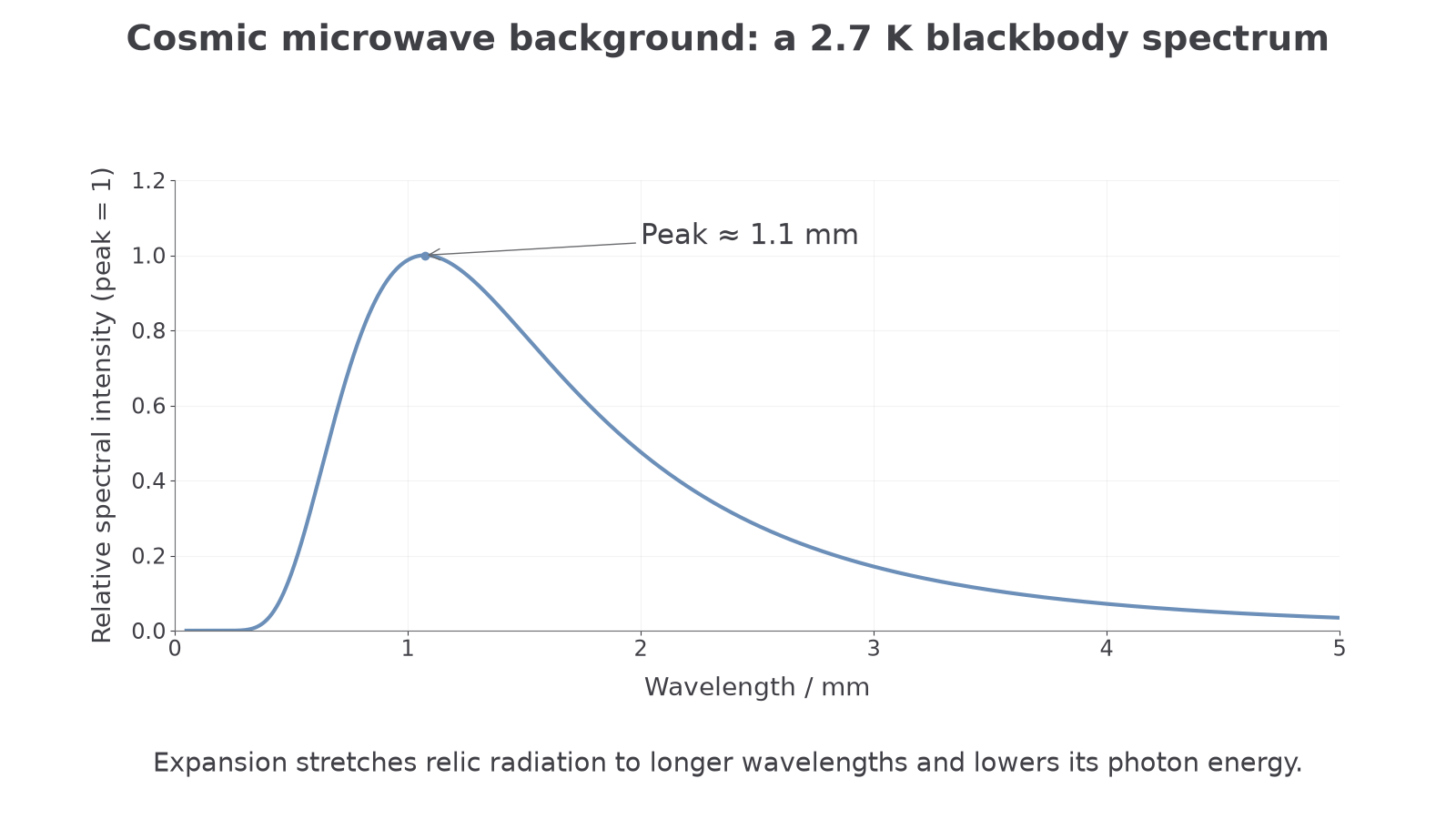
Cosmic microwave background radiation is electromagnetic radiation observed from all directions in space, now with a temperature of about , interpreted as relic radiation from the hot early universe.
In the early universe, matter and radiation were much hotter and more energetic. As the universe expanded and cooled, there came a stage when radiation could travel freely through space. Since then, the expansion of space-time has stretched the wavelengths of that radiation. Today it is detected mainly as microwaves with an equivalent temperature of about .
This is strong evidence for the Big Bang theory because a hot, dense early universe naturally predicts leftover radiation. A universe that had always existed in roughly its present state would not obviously predict a near-uniform microwave glow across the sky.
Be precise about the "cooling" language. The photons are not little objects that have physically cooled like a cup of tea. Their wavelengths have increased because of the expansion of space-time, so their photon energies are lower and the radiation is now described by a lower temperature.
OCR questions often reward a chain like this:
- Early universe was hot and dense.
- Radiation from that early state should still be present.
- Expansion stretches wavelengths/redshifts the radiation.
- We now detect it as microwave background radiation at about from all directions.
Tiny variations in the CMB are also important in modern cosmology because they relate to the later formation of structure, such as galaxies. For this lesson, the assessable point is the CMB as experimental evidence for the Big Bang theory, not the detailed satellite analysis of those variations.
[DIAGRAM: asset_slug: 5_05_3c_big_bang_evidence_age_and_composition__diagram_01; description: A 2.7 K blackbody spectrum peaks at microwave wavelengths.; caption: A 2.7 K blackbody spectrum peaks at microwave wavelengths.]
Expansion Of Space-time And Age
The Big Bang model says that the Big Bang gave rise to the expansion of space-time. The age estimate in this specification uses the present expansion rate as a simple back-extrapolation.
From the previous split lesson, Hubble's law for receding galaxies is:
where is recession speed, is distance, and is the Hubble constant. If a galaxy has taken a time to reach distance while moving at speed , then a simple estimate is:
Substitute :
Hubble-time estimate
This is why the units of must be handled carefully. OCR may give in , but only gives a time directly if has been converted to .
Worked example: estimating the age of the universe
Estimate the age of the universe using:
Use:
First convert into :
Now invert it:
Convert seconds to years using :
So this simple estimate gives an age of about 14 billion years.
This estimate is not exact. It back-extrapolates with the galaxy's present recession speed treated as approximately constant. It does not mean that the fractional rate was literally constant throughout history. The real expansion history is more complicated, but OCR expects you to understand the estimate and its units.
Continue this lesson.
You’re previewing NovaLearn without an account. Create a free account to read the rest.
Create free account