5.5.3(e)-(i) - Redshift, Hubble's law and expansion
Galaxies send us light that carries two linked messages: the pattern of spectral lines tells us what emitted the light, and the shift of those lines tells us how the source is moving relative to us. In this lesson you will use redshift to find recession speed, use Hubble's law to connect speed with distance, and interpret why that pattern supports an expanding-universe model.
Doppler shift in light
The Doppler effect is a change in the observed frequency or wavelength of a wave when there is relative motion between the source and the observer. For electromagnetic radiation, the same idea applies to light from stars and galaxies: if the source is moving away, the observed wavelength is increased; if the source is moving towards the observer, the observed wavelength is decreased.
Doppler shift of electromagnetic radiation
A Doppler shift is the change in the observed wavelength or frequency of electromagnetic radiation caused by relative motion between the source and the observer.
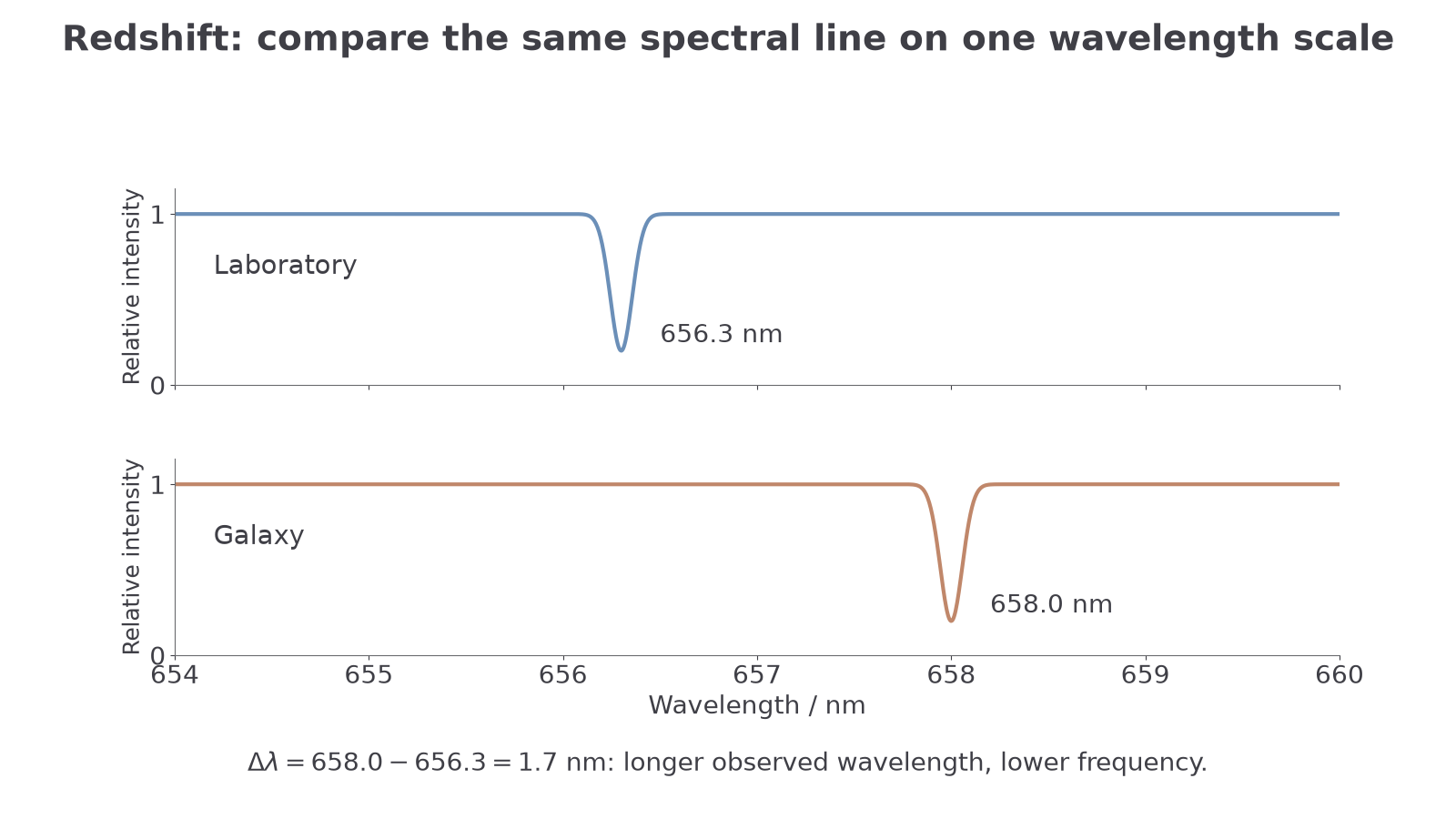
Astronomers usually notice this by comparing known spectral lines. Suppose a particular absorption line is measured in a laboratory at wavelength . If the same line in a galaxy's spectrum is observed at a larger wavelength, the line has moved towards the longer-wavelength, red end of the spectrum. That is called redshift, and for this OCR model it indicates that the galaxy is receding from us.
If the observed wavelength were smaller than the laboratory wavelength, the shift would be a blueshift. The direction matters: redshift means longer observed wavelength and lower observed frequency; blueshift means shorter observed wavelength and higher observed frequency.
The word "red" in redshift does not mean the object must look red to the eye. It means the whole spectral pattern has moved towards longer wavelengths.
[DIAGRAM: asset_slug: 5_05_3b_redshift_hubbles_law_and_expanding_universe__diagram_01; description: The same absorption line appears at a longer observed wavelength in a receding galaxy.; caption: The same absorption line appears at a longer observed wavelength in a receding galaxy.]
Using the Doppler equation
For a source of electromagnetic radiation moving relative to an observer, OCR uses the approximate Doppler relationship
Doppler equation for electromagnetic radiation
Here is the change in wavelength, is the emitted or laboratory wavelength of the spectral line, is the relative speed of the source, and is the speed of light in a vacuum. Use unless a question gives another value.
For redshift calculations, a convenient definition is
For a receding galaxy this is positive, because is greater than . For a signed frequency change , the equivalent low-speed relation is
Recession has positive , positive wavelength change and negative frequency change. If a question defines the frequency shift as the magnitude of the decrease, its ratio is positive. For example, a line falls from to . Its fractional decrease is 0.010, giving .
Worked example:
A hydrogen spectral line has a laboratory wavelength of . In a distant galaxy the same line is observed at . Estimate the recession speed of the galaxy.
First calculate the wavelength shift.
The ratio is dimensionless, so the wavelength units cancel as long as both wavelengths use the same unit.
Now use the Doppler equation.
So the galaxy is receding at about , or .
This approximation is appropriate when the recession speed is much smaller than the speed of light, or the fractional wavelength shift is small. Large cosmological redshifts require a fuller expansion model; the linear relationship is the model used here.
Continue this lesson.
You’re previewing NovaLearn without an account. Create a free account to read the rest.
Create free account