5.5.3(a)-(d) - Distances, parallax and the cosmological principle
The universe is too large for metres to be a comfortable everyday unit, so astronomers choose distance units that match the scale being described. In this lesson you will use the astronomical unit, light-year and parsec, then see how stellar parallax gives a direct distance method for nearby stars. You will finish by defining the cosmological principle: the large-scale assumption that lets cosmologists treat the universe as one physical system.
Astronomical Distance Units
A metre is still the SI unit of length, but many astronomical distances are so large that a metre value becomes hard to read. OCR expects you to recognise and use three larger units: the astronomical unit, the light-year and the parsec.
Astronomical unit
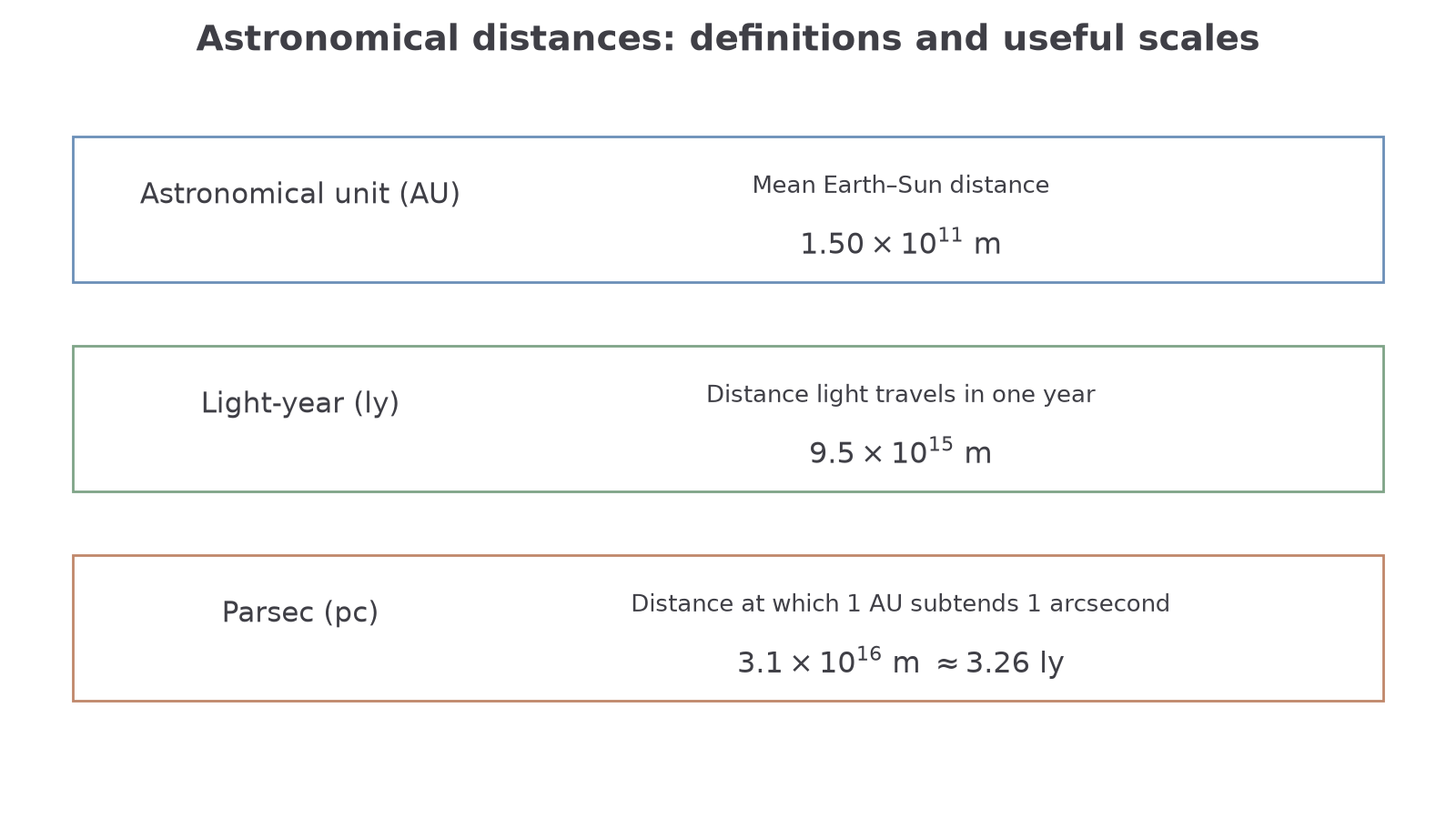
One astronomical unit, , is the mean distance between Earth and the Sun. It is about .
The astronomical unit is useful inside the Solar System. For example, saying that Earth is from the Sun and Jupiter is about from the Sun is much clearer than comparing long metre values.
Light-year
One light-year, , is the distance travelled by light in a vacuum in one year.
A light-year is a distance, not a time. Since light travels at and one year is about ,
This is the conversion supplied in the OCR data booklet.
Parsec
One parsec, , is the distance at which subtends an angle of one second of arc.
The parsec is built for parallax work. The OCR data booklet gives
and, to a useful comparison,
Worked example: converting light-years to metres
Proxima Centauri is about from the Solar System. Estimate this distance in metres.
Use the data-booklet conversion:
Then
The answer is enormous, which is the whole point of using astronomical units in the first place.
[DIAGRAM: asset_slug: 5_05_3a_astronomical_distances_and_parallax__diagram_01; description: Definitions and conversions for astronomical units, light-years and parsecs; the cards do not imply a graphical length scale.; caption: Definitions and conversions compare the astronomical unit, light-year and parsec.]
Stellar Parallax
Stellar parallax is a direct distance method for nearby stars. It uses the fact that Earth observes the same nearby star from different positions as Earth orbits the Sun.
Stellar parallax
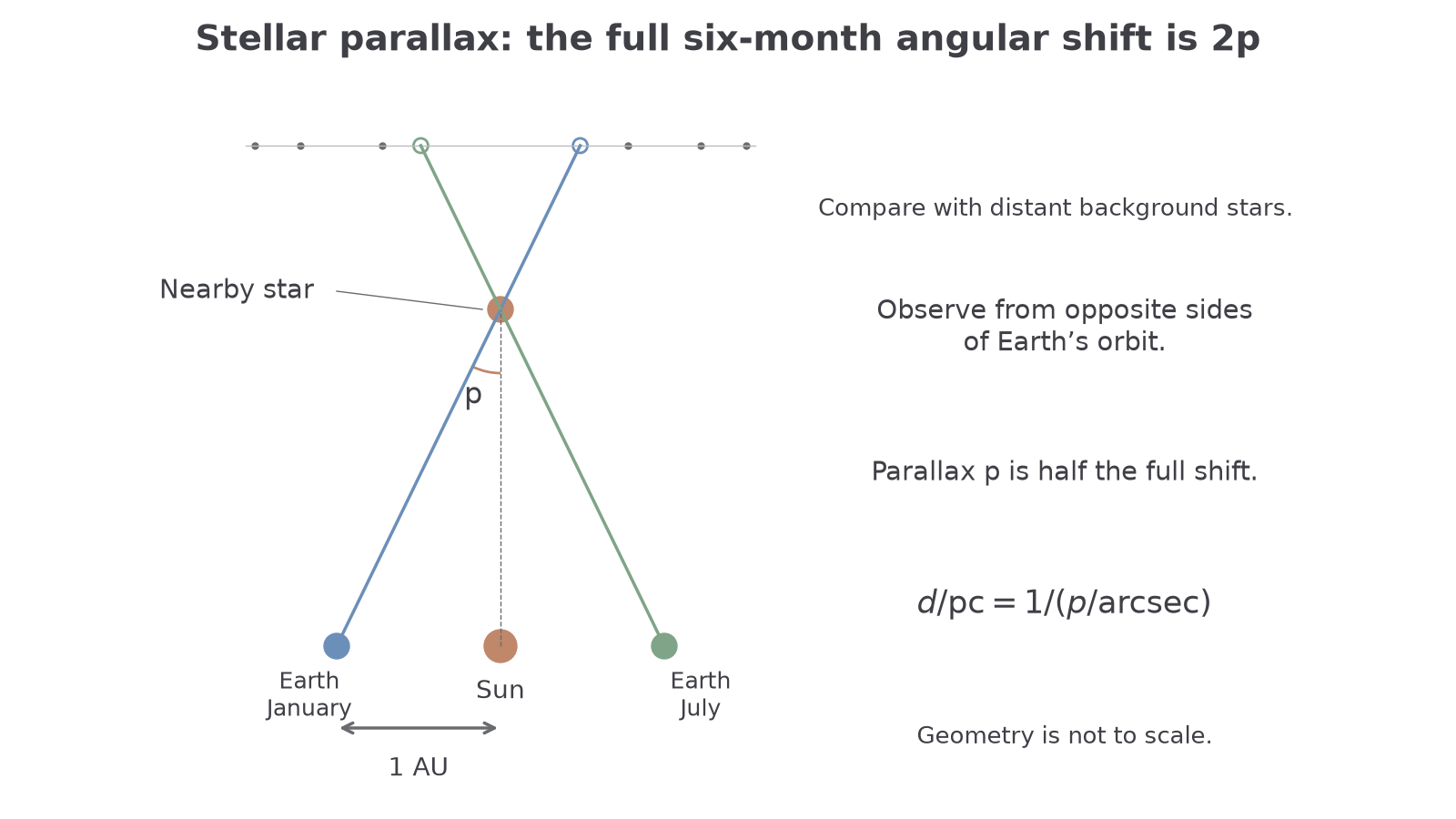
Stellar parallax is the apparent change in position of a nearby star relative to more distant background stars, caused by the motion of Earth around the Sun.
You can see the same idea with your thumb. Hold your thumb at arm's length, close one eye, then swap eyes. Your thumb seems to jump relative to the room behind it. Your thumb has not really moved; your observing position has changed.
For stars, the two observing positions are often taken about six months apart, on opposite sides of Earth's orbit. A nearby star appears to shift against much more distant stars. The closer the nearby star is, the larger the angular shift.
The parallax angle used in OCR is not the full apparent shift from one side of Earth's orbit to the other. It is half that full annual shift. Equivalently, it is the angle subtended by , the radius of Earth's orbit, at the star.
A common OCR mark-scheme shape is:
- apparent displacement of the nearby star relative to more distant stars;
- caused by Earth's orbit around the Sun;
- a parallax of one second of arc corresponds to a distance of one parsec.
The word "relative" matters. Parallax is measured against a background that is so distant that its own shift is much smaller for this purpose.
[DIAGRAM: asset_slug: 5_05_3a_astronomical_distances_and_parallax__diagram_02; description: The parallax angle is half the full six-month angular shift relative to distant background stars.; caption: The parallax angle is half the full six-month angular shift relative to distant background stars.]
Using The Parallax Equation
The parsec is defined so that the parallax equation is especially simple when the correct units are used.
Stellar parallax
: parallax angle in seconds of arc (arcseconds); : distance to the star in parsec (pc). Valid only with this unit pairing.
The equation is listed in the OCR data booklet, but the unit pairing is essential. If is not in arcseconds, or is not in parsec, the simple reciprocal form does not apply.
Continue this lesson.
You’re previewing NovaLearn without an account. Create a free account to read the rest.
Create free account