4.1.2 - Mean drift velocity and number density
A current in a wire looks continuous from the outside, but at microscopic level it is made from many charge carriers moving through a cross-section each second. In this lesson you will connect that microscopic picture to the OCR relationship . You will also use number density to distinguish conductors, semiconductors and insulators.
Mean Drift Velocity
In a metal wire, the mobile charge carriers are electrons. Even when no current flows, electrons move rapidly and randomly in many directions. That random motion does not produce a current because there is no overall flow of charge in one direction.
When a potential difference is applied, an electric field is set up in the wire. The electrons still move randomly, but their motion now has a small average movement along the wire. That small net average is the drift velocity.
Mean drift velocity
Mean drift velocity is the average velocity of the charge carriers along a conductor due to an applied electric field or potential difference.
For electrons in a metal, the drift velocity is opposite to the direction of conventional current because electrons have negative charge. In the equation , the symbol is normally used as the magnitude of the mean drift velocity, so it is entered as a positive speed in .
A crucial scale point is that drift speed is usually very small. Individual electrons have rapid random thermal motion, but the net progress along a wire can be fractions of a millimetre per second. The circuit can still respond quickly because the electric field is established through the circuit, not because one electron races all the way round at high speed.
Do not confuse three different ideas:
- current : charge passing a point per second
- drift velocity : mean net velocity of the charge carriers
- signal or energy-transfer speed: how quickly the circuit responds when the field is established
Deriving I = Anev
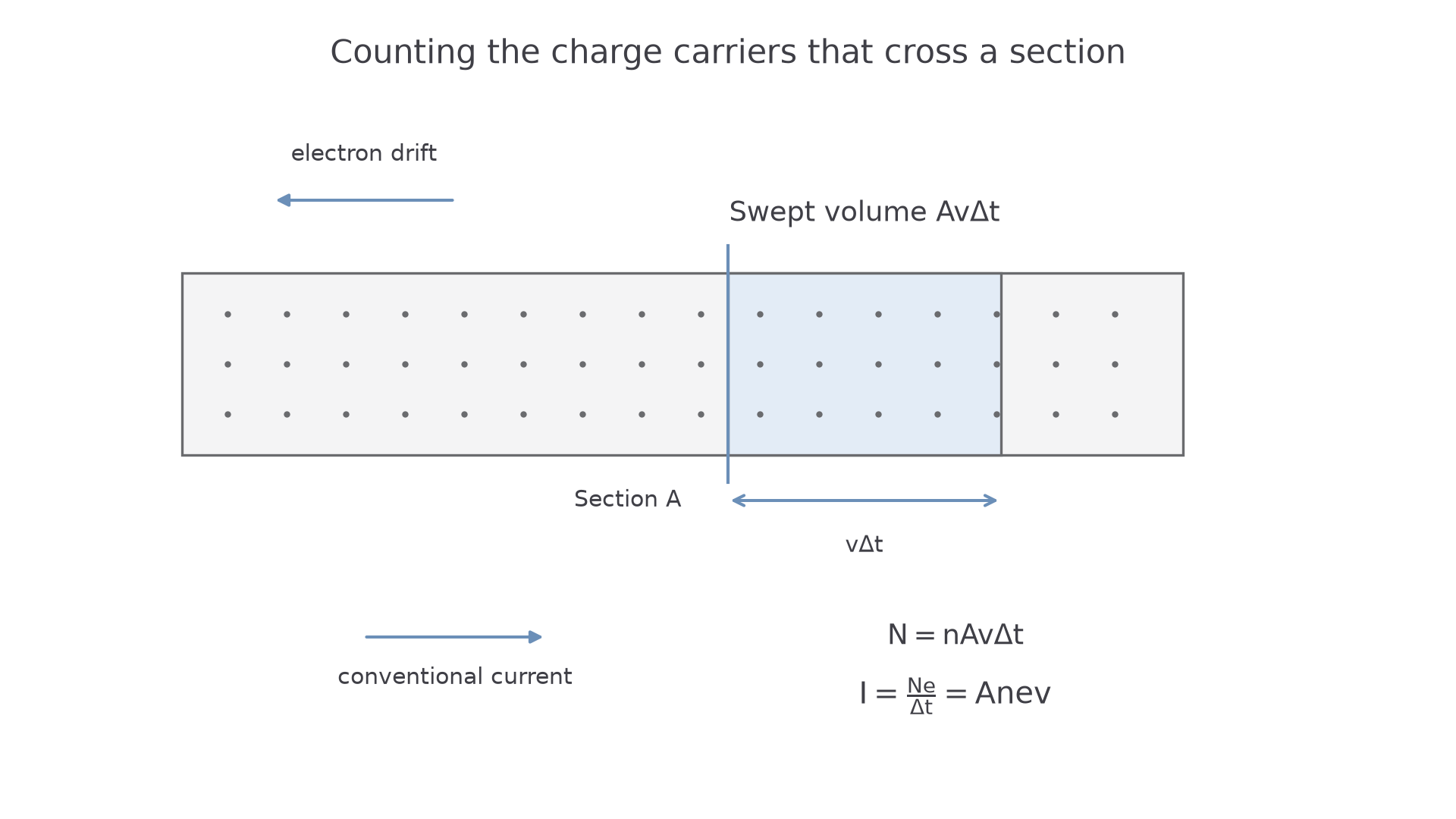
The drift-velocity equation comes from counting how much charge crosses a cross-section of a conductor in a given time.
Suppose a uniform wire has cross-sectional area . In a time interval , charge carriers with mean drift speed move a mean distance:
The volume of wire whose carriers cross the chosen cross-section in that time is:
If is the number density of mobile charge carriers, then means "number of mobile carriers per cubic metre". The number of mobile charge carriers in that swept volume is:
Each carrier contributes a charge magnitude , so the charge crossing the section is:
Current is charge flow per unit time:
Therefore:
Mean drift velocity equation
Here is current in amperes, is cross-sectional area in , is number density in , , and is mean drift speed in .
The unit check is a good guard against mistakes:
The equation is often easier if you read it in words: current is bigger if the wire has a bigger area, more mobile carriers per cubic metre, more charge per carrier, or a larger mean drift speed.
[DIAGRAM: asset_slug: 4_01_2_mean_drift_velocity_and_conductivity__diagram_01; description: The carriers in the swept volume cross a section during the time interval, giving I = Anev.; caption: Counting carriers in a swept volume explains the current.]
Using the Equation
A drift-speed calculation connects the measured current to the wire geometry and carrier density. The area must be in square metres and the radius must be used in , not the diameter.
Worked example: a metal wire carries a current of . The wire has diameter , and its mobile electron number density is . Calculate the mean drift speed of the electrons.
Convert the diameter to metres and halve it:
Calculate the cross-sectional area:
Rearrange :
Substitute:
That is only about . This small answer is reasonable for electron drift in a metal.
The same equation can be rearranged for any one of the four quantities:
Worked example: a sample has current , area , and mean drift speed . Estimate the number density of mobile charge carriers.
The unit is important. is not the total number of charge carriers in the object; it is the number per cubic metre.
If two wires are made from the same material, they have the same . For the same current, a wire with a larger cross-sectional area needs a smaller drift speed because more carriers can pass through the cross-section side by side.
Continue this lesson.
You’re previewing NovaLearn without an account. Create a free account to read the rest.
Create free account