5.2.2 - Centripetal acceleration and force
Circular motion looks familiar, but it is easy to misread the forces. In this lesson you will learn why an object moving at constant speed in a circle is still accelerating, how to calculate the inward acceleration and resultant force, and how the whirling-bung experiment tests the same relationships in the laboratory.
Why a circle needs an inward resultant
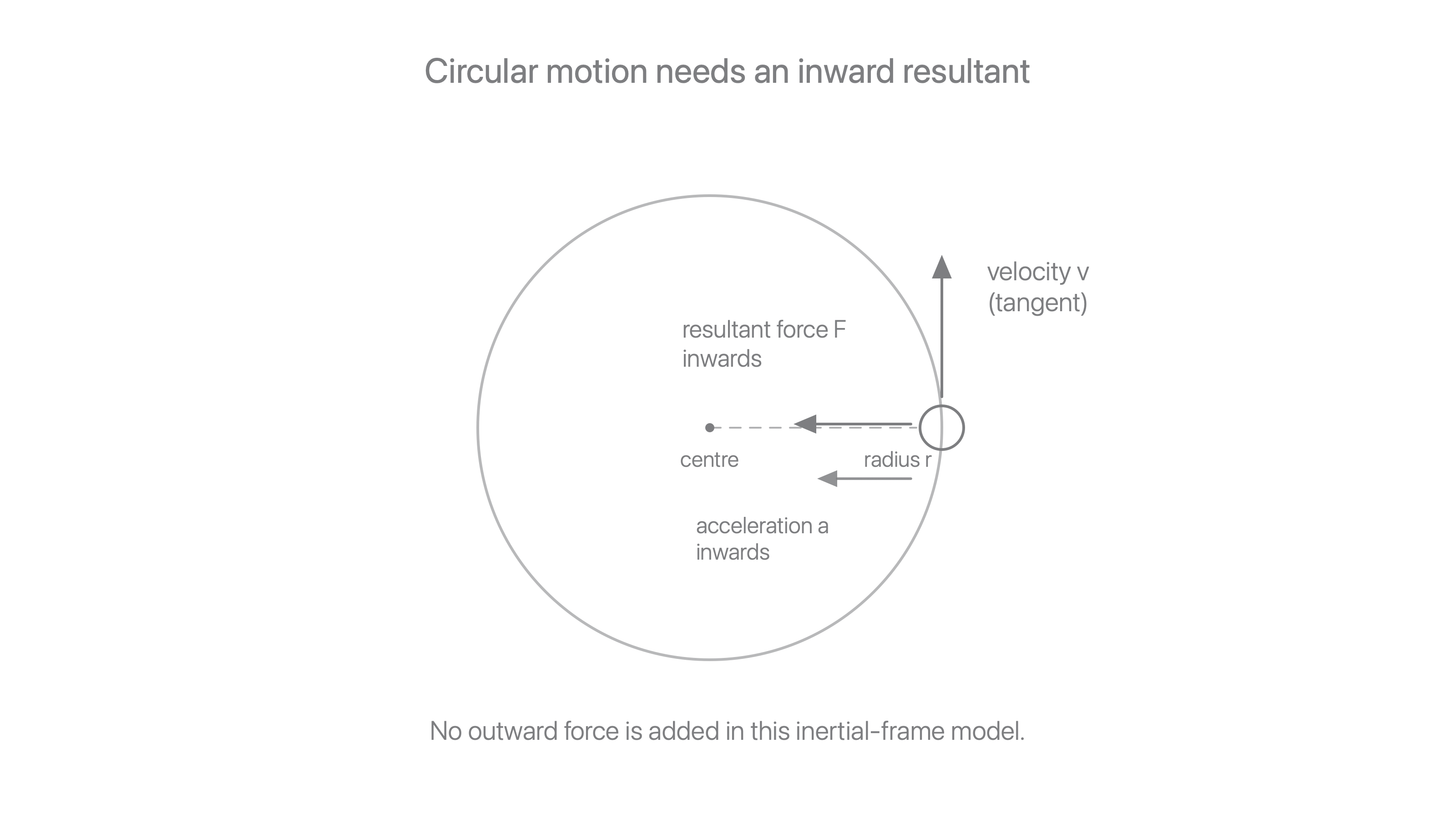
An object can move round a circle at a constant speed, but its velocity is not constant. Velocity is a vector, so changing direction means changing velocity. That means there must be an acceleration.
For uniform circular motion, the acceleration is directed towards the centre of the circle. The resultant force has the same direction as the acceleration because Newton's second law says that the resultant force determines the acceleration.
Centripetal
Centripetal means directed towards the centre of a circular path.
In the OCR statement, a constant net force perpendicular to the velocity means a constant-magnitude resultant that is always at right angles to the instantaneous velocity. Its direction keeps turning so that it continues to point towards the centre.
The velocity at any instant is tangential to the circle. The inward resultant force is perpendicular to that velocity, so it changes the direction of motion without doing work along the direction of motion at that instant. This is why the speed can stay constant while the velocity keeps changing.
The phrase centripetal force does not mean that a new kind of force has appeared. It names the inward resultant force needed for circular motion. In real situations this resultant may be supplied by tension, friction, weight, a normal contact force, or a combination of real forces.
For circular motion, look for a resultant force towards the centre, not a mysterious extra force.
[DIAGRAM: asset_slug: 5_02_2_centripetal_acceleration_and_force__diagram_01; description: Tangential velocity and inward acceleration and resultant force in uniform circular motion.; caption: Tangential velocity and inward acceleration and resultant force in uniform circular motion.]
Centripetal acceleration
The magnitude of the inward acceleration depends on the speed of the object and the radius of the circle.
Centripetal acceleration
Here is the centripetal acceleration in , is the linear speed in , is the radius in , and is the angular velocity in . OCR's data booklet gives these circular-motion relationships, but you still need to choose and rearrange them correctly.
The previous circular-kinematics relationship links the two acceleration forms:
Linear speed in a circle
Substitute into :
That derivation is useful because it tells you when each form is convenient. Use when you know linear speed. Use when you know angular velocity.
Worked example: acceleration from angular velocity
A toy car moves in a circular track of radius with angular velocity . Calculate its centripetal acceleration.
Use:
Substitute:
The acceleration is , directed towards the centre of the track.
Notice the square: doubling or makes the centripetal acceleration four times larger if the radius is unchanged. A small increase in speed can therefore require a much larger inward acceleration.
Centripetal force as the resultant
Newton's second law links the inward acceleration to an inward resultant force:
Using the centripetal acceleration formulae gives the centripetal-force formulae.
Centripetal force
Here is the inward resultant force in newtons, is the mass of the object in kilograms, is the linear speed, is the radius, and is the angular velocity.
The important modelling step is not simply writing . It is deciding which real force, or which component of real forces, supplies the inward resultant.
For example:
- a bung on a string: tension in the string is mainly the inward force
- a car turning on a level road: friction provides the sideways inward force
- clothes in a washing-machine drum: weight and normal contact force may combine differently at different positions
- a charged particle in a magnetic field: the magnetic force can provide the inward force
These examples share the same structure: choose the centre of the circle, resolve real forces towards that centre, then set the inward resultant equal to or .
Worked example: tension providing the inward resultant
A rubber bung of mass moves in a horizontal circle of radius at speed . Estimate the tension in the string if the tension supplies the centripetal force.
Use:
Substitute:
So the string tension is about , provided the string force is the only significant inward force on the bung.
Misconception to kill cleanly: the bung does not have "tension plus centripetal force" acting on it. The tension is the real force that provides the required inward resultant.
Continue this lesson.
You’re previewing NovaLearn without an account. Create a free account to read the rest.
Create free account