5.4.3 - Planetary motion and geostationary orbits
Planets and satellites are not held up by an outward force. They are continually accelerating towards the body they orbit, with gravity providing the centripetal force. In this lesson you will connect Kepler's laws to Newton's law of gravitation, derive the orbital-period equation that OCR expects, and use the same model to understand why a geostationary satellite has one special orbit.
Kepler's Laws
Kepler's laws are a compact description of orbital motion. They were originally written for planets orbiting the Sun, but the same ideas can describe moons orbiting a planet or spacecraft orbiting a planet when one central mass dominates the gravitational field.
Kepler's First Law
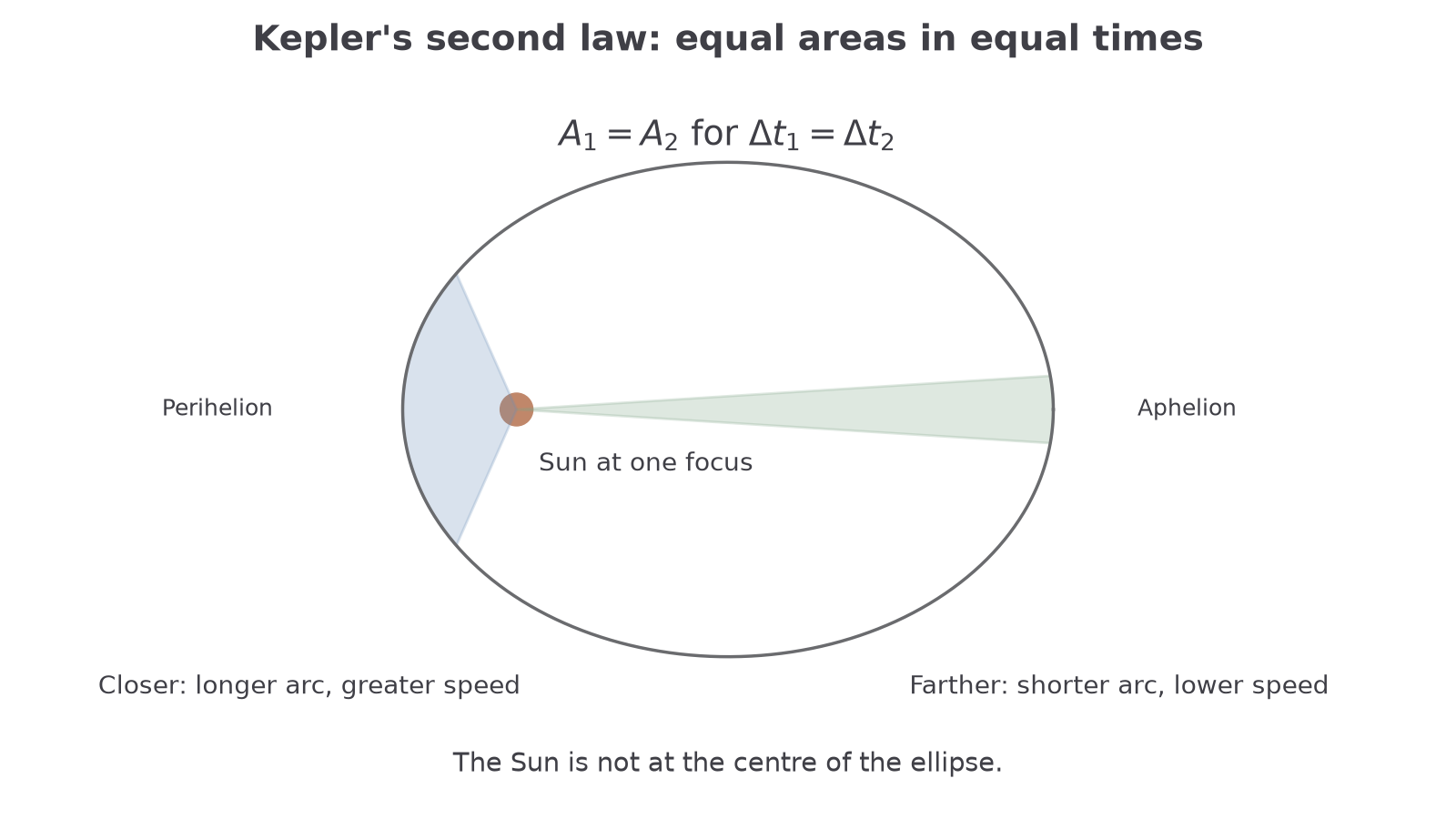
The orbit of a planet is an ellipse, with the Sun at one focus of the ellipse.
An ellipse has two foci. The Sun is not at the centre of the ellipse unless the orbit is a perfect circle, which is a special case. For a satellite around Mars, Earth, or another planet, replace "Sun" with the central body being orbited.
Kepler's Second Law
A line joining a planet to the Sun sweeps out equal areas in equal time intervals.
This law is about changing speed. A planet moves faster when it is closer to the central body and slower when it is farther away. It does not sweep out equal distances in equal times.
Kepler's Third Law
For objects orbiting the same central mass, the square of the orbital period is proportional to the cube of the orbital radius or semi-major axis.
In symbols,
where is the orbital period and is the orbital radius for a circular orbit. For an ellipse, the corresponding distance is the semi-major axis. OCR questions often provide an average distance from the centre of the body being orbited.
A useful misconception contrast is this: Kepler's laws describe the observed geometry and timing of orbits, while Newton's law of gravitation explains why those patterns occur. OCR can ask for either.
[DIAGRAM: asset_slug: 5_04_3_planetary_motion_and_geostationary_orbits__diagram_01; description: The Sun is at one focus of an ellipse; computed equal-area sectors correspond to equal time intervals.; caption: A planet follows an ellipse with the Sun at one focus and sweeps out equal areas in equal times.]
Gravity As Centripetal Force
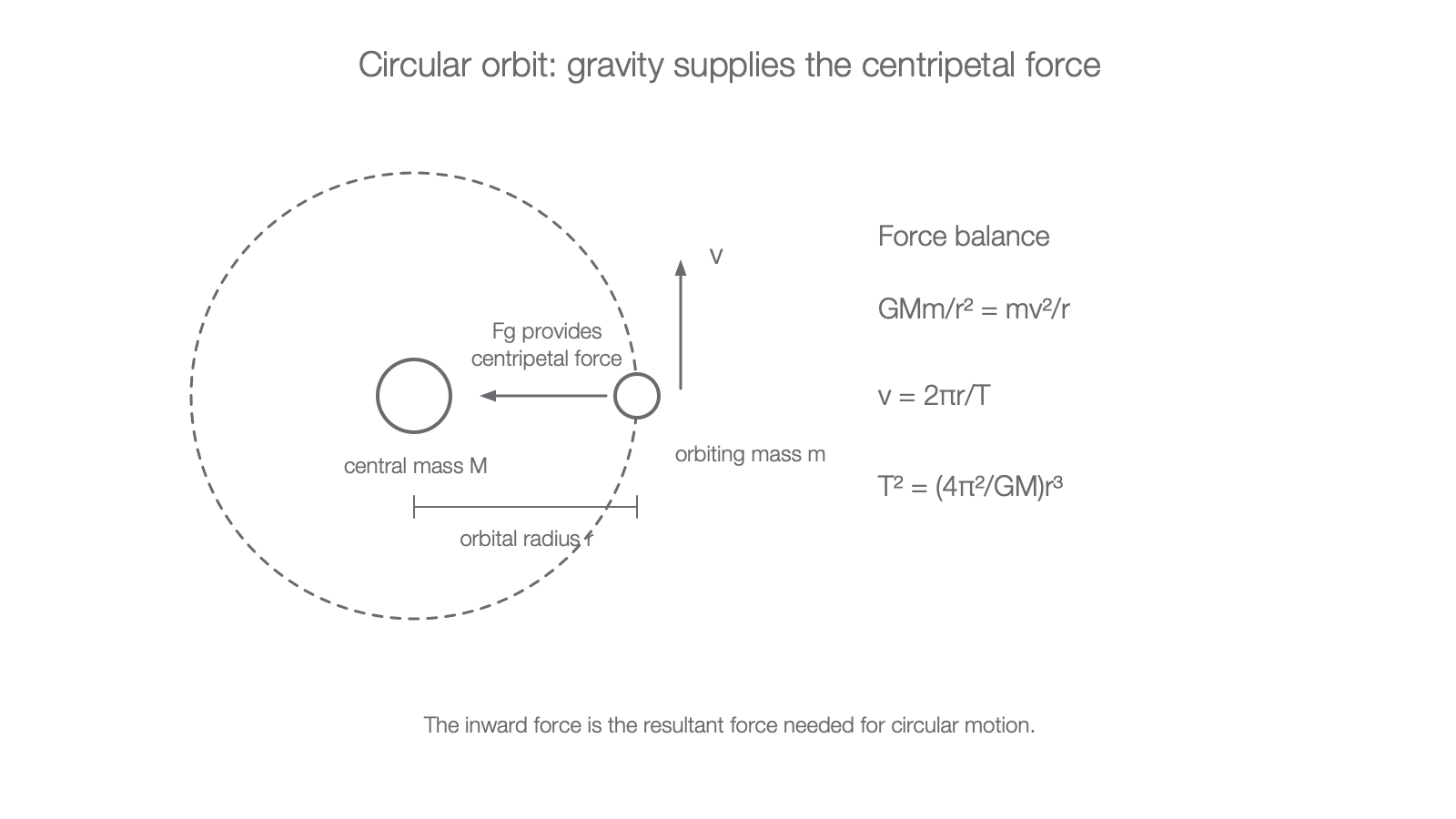
An object in circular orbit is accelerating because its velocity direction is continually changing. The acceleration is towards the centre of the orbit, so the resultant force must also be towards the centre.
For a planet of mass orbiting the Sun of mass , the gravitational force acts along the line joining their centres. In the circular-orbit model, that same inward gravitational force is the centripetal force.
Newtonian Force Balance For A Circular Orbit
Here is the gravitational constant, is the central mass, is the orbiting mass, is the distance between their centres, and is the orbital speed. The left-hand side is Newton's gravitational force; the right-hand side is the centripetal force required for circular motion.
The orbiting object is not pulled outwards by a "centrifugal force" in this A-level model. If gravity disappeared, the object would travel off along the tangent. Gravity continuously changes its direction so that it follows a curved path.
For a circular orbit, the speed is linked to the period:
because the object travels one circumference, , in one period, .
[DIAGRAM: asset_slug: 5_04_3_planetary_motion_and_geostationary_orbits__diagram_02; description: Gravity supplies the inward resultant force required for a circular orbit.; caption: Gravity supplies the inward resultant force required for a circular orbit.]
Deriving The Period Equation
OCR includes the orbital-period equation in the data booklet, but the specification says you must also be able to derive it from first principles. "First principles" here means starting from gravitational force and centripetal force, then using the circular-motion expression for speed.
Start with the force balance:
The mass of the orbiting planet or satellite appears on both sides, so it cancels:
For a circular orbit,
so
Substitute this into the force-balance equation:
Now rearrange:
Period Of A Circular Orbit
This equation says that, for a fixed central mass , a larger orbital radius gives a much longer period. It also explains why the mass of the orbiting satellite does not affect the period in this ideal model: cancelled during the derivation.
Worked Example: Finding A Central Mass
A small moon moves in a near-circular orbit of radius around a planet. Its orbital period is . Estimate the mass of the planet.
Continue this lesson.
You’re previewing NovaLearn without an account. Create a free account to read the rest.
Create free account