6.3.2 - Charged particles in magnetic fields
A current-carrying wire is many moving charges at once; this lesson zooms in on one charged particle. You will calculate the magnetic force on a moving charge, explain why a uniform magnetic field can make a particle move in a circular path, and use crossed electric and magnetic fields as a velocity selector.
Force on a moving charge
A charged particle experiences a magnetic force when it moves through a magnetic field. Here the particle is travelling at right angles to a uniform magnetic field, so the required relationship is:
Magnetic force on a moving charge
Here is the magnetic force in newtons (N), is magnetic flux density in tesla (T), is the charge of the particle in coulombs (C), and is the particle's speed in .
The equation is a magnitude equation for the perpendicular case. Use the size of the charge for the calculation, then state the direction separately. A proton and an electron with the same speed in the same field have magnetic forces of the same magnitude, but opposite directions, because their charges have opposite signs.
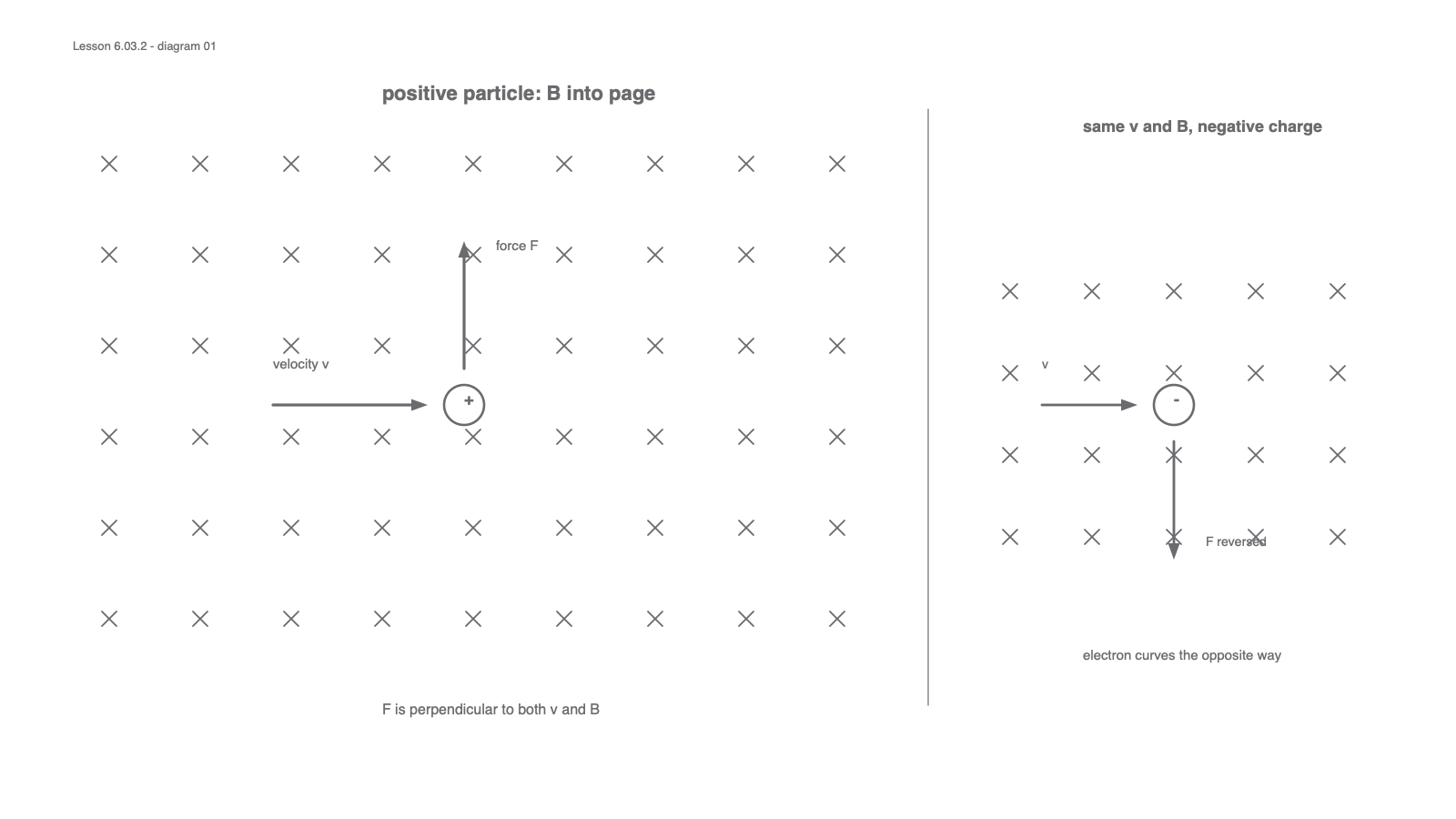
The force direction is perpendicular to both the velocity and the magnetic field. For a positive particle, you can adapt Fleming's left-hand rule by taking the second finger as the direction of motion of positive charge. For an electron, reverse the force direction because electron charge is negative. For motion exactly parallel to the magnetic field, the magnetic force is zero because there is no perpendicular motion to deflect.
[DIAGRAM: asset_name: 6.3.2 - Charged particles in magnetic fields - diagram 1; asset_slug: 6_03_2_motion_of_charged_particles_in_magnetic_fields__diagram_01; recommended_method: drawn_physics; caption: Positive and negative particles moving right experience opposite forces in an into-page magnetic field.; description: Clean 16:9 drawn physics diagram on a pure white background showing a positive particle moving to the right through a uniform magnetic field into the page, represented by evenly spaced crosses. Show velocity v to the right, magnetic force F upward, and a small vector key labelled B into page, v, F. Include a second small inset showing an electron under the same v and B with force downward. Use only #6A6B6E, true arrowheads, anti-aliased sans-serif labels, and small gaps before particle targets.]
Worked example: force on an electron near the Earth
At the Earth's equator, the magnetic flux density is about . An electron moves at perpendicular to the magnetic field. Calculate the magnitude of the magnetic force.
Convert first:
Use :
That force is tiny, but for a particle with a tiny mass it can still produce a large acceleration.
Circular paths in a uniform field
If a charged particle enters a uniform magnetic field at right angles to the field, the magnetic force is perpendicular to the velocity. At every instant the velocity is tangential to the path, while the magnetic force points sideways.
That sideways force changes the direction of the velocity. It does not change the speed, because there is no component of force along the direction of motion. Equivalently, the magnetic force does no work on the particle in this ideal model.
The result is uniform circular motion. The magnetic force acts as the centripetal force.
Centripetal force in a magnetic field
For a charged particle moving in a circular path in a uniform magnetic field, the magnetic force is the inward resultant force directed towards the centre of the circle.
[DIAGRAM: asset_name: 6.3.2 - Charged particles in magnetic fields - diagram 2; asset_slug: 6_03_2_motion_of_charged_particles_in_magnetic_fields__diagram_02; recommended_method: drawn_physics; caption: Magnetic force points towards the centre of a circular path while velocity remains tangent.; description: Clean 16:9 drawn physics diagram showing a circular path of a positive charged particle in a uniform magnetic field into the page. At three points on the circle, draw tangent velocity arrows and inward magnetic-force arrows toward the centre, each with true arrowheads and small gaps before the particle. Label radius r, centre, v tangent, inward, and 'speed constant; direction changes'. Use only #6A6B6E on white.]
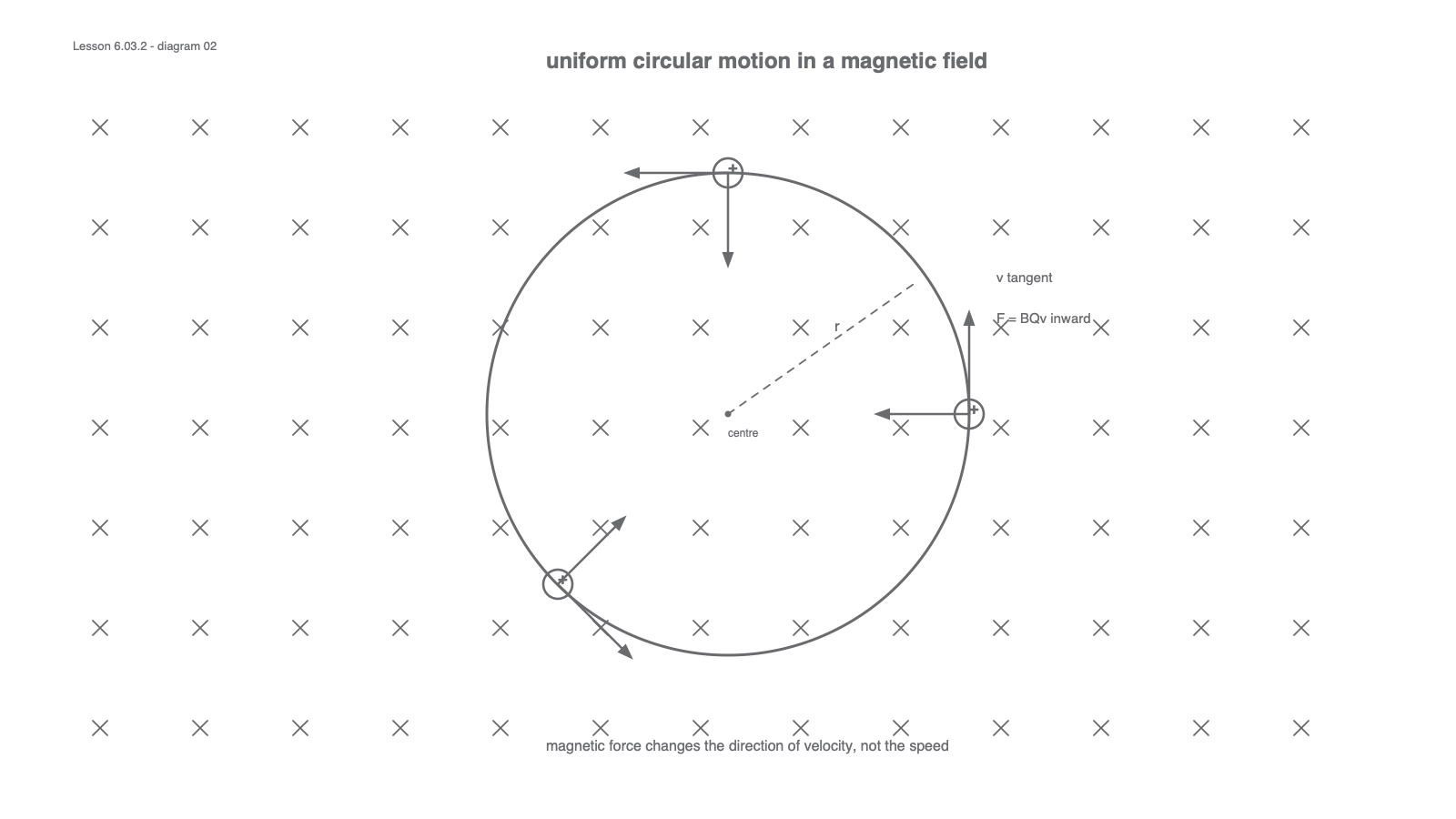
The sign of the charge decides which way the path bends. If a positive particle curves clockwise for a particular velocity and field direction, a negative particle with the same speed curves anticlockwise. The radius may still be the same if the masses and charge magnitudes are the same, but the direction of curvature reverses.
This model assumes the magnetic field is uniform, the particle enters perpendicular to the field, and other forces such as weight and drag are negligible. In many OCR charged-particle questions, the path is in an evacuated chamber, which supports those assumptions.
The circular model requires a uniform field, a velocity perpendicular to it, and negligible other forces. A magnetic field does no work because its force is perpendicular to the instantaneous velocity. If the field weakens, the local curvature decreases at unchanged speed. If drag slows the particle, its local magnetic radius decreases; drag supplies a tangential force, so the whole path is no longer one circle. A velocity component parallel to a uniform field is unchanged; together with the perpendicular circular motion it produces a helix.
Continue this lesson.
You’re previewing NovaLearn without an account. Create a free account to read the rest.
Create free account